BIO105 First Class Meeting , May 20th, Introductory Biology, David Champlin, USM
 Watch on YouTube →
Overview
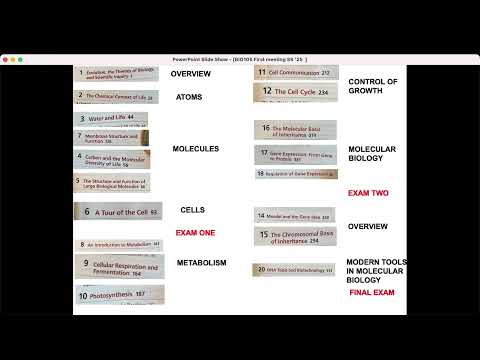
David Champlin introduces USM’s compressed BIO105 summer course: four in-person meetings, three 80-question multiple-choice exams, and a rapid sequence through chapters 1–20, skipping chapter 19. He explains how recorded mini-lectures, textbook reading, emailed notes and practice quizzes support learning, then previews the molecular biology foundation of the course—from atoms and chemical interactions to water, phospholipids, proteins, cells, and gene regulation.
Key takeaways
- BIO105 compresses chapters 1–20, skipping chapter 19, into a summer course with four in-person meetings and three exams of 80 multiple-choice questions each.
- The first exam covers chapters 1–7, and take-home practice quizzes are designed to resemble exam questions and provide feedback on both content and question format.
- Champlin recommends watching each mini-lecture before reading its chapter, then making handwritten or otherwise active-recall notes that can double as a personalized study guide.
- All cells use DNA and regulate which genes they express; specialized cells can carry genes such as insulin and hemoglobin genes even when those genes are not active.
- Cell membranes form because phospholipids have water-attracting heads and water-repelling tails, while membrane proteins provide selective channels for water movement.
- Covalent bonds share electrons, whereas ionic interactions arise from attraction between oppositely charged ions; water can dissolve ionic partners such as sodium and chloride.
Chapters
0:00
BIO105 Format: Four Meetings and Three Multiple-Choice Exams
- David Champlin says BIO105 has just four scheduled class meetings, with the first exam about two weeks after the May 20 kickoff.
- The course has three exams, each containing 80 multiple-choice questions; take-home practice quizzes use similar questions.
- The first in-person exam meeting includes about 45 minutes for review before students take the exam.
2:30
How BIO105 Fits into the Two-Semester Biology Sequence
- The first introductory biology semester emphasizes suborganismal topics, including molecules, cells, and processes inside organisms.
- The second semester typically covers ecology, systematics, evolution, populations, and organism–environment relationships.
- Genetics and metabolism introduced in BIO105 later help explain population change and food chains.
5:30
Chapters 1–20 Build from Atoms Toward Cells
- Champlin plans to cover textbook chapters 1–20, skipping chapter 19, at a fast summer-course pace.
- The sequence begins with atoms and chemical bonds, then develops molecules and cell structures; chapter 7’s phospholipids are brought forward to introduce membranes.
- Champlin describes molecular biology as a bottom-up, physical approach, comparing its cause-and-effect reasoning to diagnosing a car that will not start.
10:30
Metabolism, Cell Growth, and Molecular Genetics in the Course Sequence
- After building stable molecules, students study metabolism, including cellular respiration that consumes oxygen and releases carbon dioxide.
- A scab illustrates cell-growth regulation: platelets release platelet-derived growth factor (PDGF), which stimulates skin-cell division during healing.
- Champlin connects abnormal PDGF production to a rare skin cancer, then uses the example to motivate DNA, gene expression, and genetics.
15:00
Seven Shared Features of Life on Earth
- The course emphasizes universal properties: life consists of cells, and cells arise from pre-existing cells—the core claims of cell theory.
- Cells share water-based environments, membrane structures, and fundamental chemistry, including the need to synthesize proteins.
- DNA is the primary heritable molecule; cells carry many genes they are not currently using and regulate which genes are active.
22:00
Membrane Water Channels Explain Tears, Sweat, and Urine
- Champlin uses a membrane protein shaped like a donut with a water-sized channel to make protein structure memorable.
- Salt movement in tear-gland cells draws water through channels, helping produce tears; related water movement also contributes to sweat and urine production.
- A single channel can pass billions of water molecules per second, illustrating the speed and scale of cellular processes.
26:00
Weekly Work, Brightspace, and the Four-Week Course Flow
- Weekly chapter assignments, mini-lecture links, quizzes, and handouts are distributed through Brightspace announcements.
- Students email most assignments to Champlin because the class meets in person only four times; BIO106 lab students can also hand work in during lab.
- The first week includes chapters 1–4, with the first exam covering the first seven chapters.
31:00
Mini-Lectures Come Before Textbook Reading
- Champlin recommends watching each recorded mini-lecture before reading its corresponding textbook chapter.
- Students must take notes on every mini-lecture; recordings can be paused, replayed, or adjusted in speed on YouTube.
- The lectures were recorded for flexible summer study, and occasional references to past in-class activities can be disregarded.
35:00
Soft Tuesday Deadlines and Assignment Submission Options
- Champlin aims for each week’s work to be completed by the following Tuesday, while calling that target a soft due date.
- He posts the next week’s materials around Thursday or Friday so students with full-time jobs can plan weekend study.
- Students can submit photographed or scanned notes and quizzes by email, or hand in work during BIO106 lab; quiz answers may also be typed into an email.
41:00
Use Diagrams, Flashcards, and Active Recall to Study Biology
- Champlin recommends drawing and writing material from memory, rather than merely copying text, to strengthen recall for STEM courses.
- Large diagrams, spatially arranged notes, and flashcards can help distinguish related steps and prepare for multiple-choice exams.
- Students should label email attachments clearly—for example, by identifying mini-lecture notes, chapter notes, or quiz numbers—so Champlin can track and grade submissions.
49:00
David Champlin’s Background in Molecular Biology and Insect Research
- Champlin says he has taught at USM for nearly 25 years and remains available by email for course, career, and advising questions.
- His research examines hormonal regulation of insect metamorphosis, including how a caterpillar activates genes needed to develop into a reproductive moth.
- He contrasts his original interest in animal behavior and nature with his later enthusiasm for molecular biology’s mechanistic, “nuts and bolts” approach.
58:00
Campus Research Work and Tailoring Notes to Exam Questions
- Students may gain research experience through volunteer work, independent study, or campus work-study jobs; some positions can lead to publication credit.
- Champlin advises treating notes as both a learning tool and a personalized study guide geared toward likely multiple-choice questions.
- A practical recall exercise is to read a page or watch five minutes of a lecture, then close the source and write down what can be remembered.
1:05:00
Learning Support and Electronic Textbook Reserves
- The USM Learning Commons offers tutoring and study-skills support, with a physical location on the second floor of the library and online resources.
- Champlin says he will check that the electronic reserves contain the first five textbook chapters for students awaiting a book.
- Students are encouraged to report missing materials or course-specific technical problems so Champlin can correct issues affecting the class.
1:09:00
Atoms: Protons, Neutrons, and Electrons
- An element’s atomic number identifies its number of protons: for example, carbon has six protons.
- Neutrons add mass without charge; carbon-12 has six protons and six neutrons, while carbon-14 is a radioactive isotope.
- Electrons matter especially in biology because atoms share or transfer them to form chemical bonds and molecules.
1:15:00
From Water Molecules to Phospholipid Cell Membranes
- Water, H₂O, contains two hydrogen atoms and one oxygen atom joined through shared electrons.
- A membrane phospholipid contains roughly 200 atoms, with a water-attracting end and water-repelling tails that assemble into a bilayer.
- Champlin contrasts these with larger proteins such as insulin, which he estimates contain roughly 10,000 atoms.
1:19:00
Chemical Bonding Rules Shape Large Biological Molecules
- Atoms form characteristic numbers of covalent bonds: in water, oxygen forms two bonds and each hydrogen forms one.
- Covalent bonds do not stretch or bend in Champlin’s introductory model, but atoms can rotate around bonds, allowing large molecules to change shape.
- Molecular behavior depends on polarity: polar regions interact favorably with water, while nonpolar regions tend to avoid it.
1:25:00
Protein Channels Stabilize a Precise Water-Passing Opening
- Champlin compares a water channel’s opening to a basketball hoop if a water molecule were basketball-sized; the whole protein would scale up to roughly a large truck.
- Proteins are large partly because their many atoms are constantly moving with heat, while the functional channel must maintain a stable size and chemistry.
- The channel’s molecular structure selectively lets water pass while the surrounding protein supports and stabilizes the opening.
1:29:15
Ionic Interactions, Lab Catch-Up, and Tutoring Questions
- Champlin distinguishes ionic interactions from covalent bonds: sodium and chlorine carry opposite charges and attract without sharing electrons.
- Salt crystals hold together through these attractions, but water can dissolve the ions and disrupt their interactions.
- After class, Champlin tells a student who missed BIO106 lab that there is no separate lab makeup, but posted homework and the next class can help them catch up.
Summary, takeaways, and chapters were generated by AI from the video's transcript and may contain errors. The video belongs to its creator, The New Evolution for Everyone.