Bernoulli Equations Made Easy (Differential Equations 24.5)
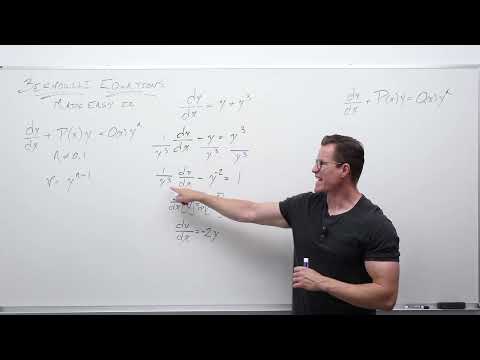 Watch on YouTube →
Overview
Professor Leonard presents a streamlined method for solving Bernoulli differential equations by treating them as a special case of embedded derivatives, simplifying the substitution process. This approach transforms the Bernoulli equation into a linear first-order differential equation earlier, reducing algebraic complexity compared to traditional textbook methods. The technique is demonstrated through multiple examples, including a proof that it works universally for Bernoulli equations.
Key takeaways
- Bernoulli differential equations can be solved more easily by treating them as a specific type of embedded derivative problem.
- Professor Leonard's method involves dividing by y^n first, then substituting V = y^(1-n), which simplifies the transformation to a linear differential equation.
- The core of the simplified method relies on the relationship: y^-n dy/dx = 1/(1-n) dV/dx when V = y^(1-n).
- This approach bypasses the more cumbersome algebraic manipulations often required by traditional textbook methods for Bernoulli equations.
- The technique is proven to be universally applicable to Bernoulli equations, regardless of whether the exponent 'n' is positive, negative, or fractional (as long as n is not 0 or 1).
Chapters
0:00
Introduction to an Easier Bernoulli Equation Method
- Professor Leonard introduces a new, simpler method for solving Bernoulli differential equations.
- The traditional method involves complex substitutions and algebraic manipulation.
- This new approach aims to reduce the difficulty and potential for errors.
1:36
Defining the Bernoulli Differential Equation Form
- A Bernoulli equation is a first-order differential equation of the form dy/dx + P(x)y = Q(x)y^n.
- The power 'n' cannot be 0 or 1; if n=0, it's linear; if n=1, it's separable.
- The power 'n' can be negative or fractional.
4:05
Initial Example: Transforming to Bernoulli Form
- An example differential equation is presented: dy/dx - y = y^3.
- This equation is rearranged to match the standard Bernoulli form.
- The initial form is dy/dx - y = 1 * y^3, with P(x) = -1, Q(x) = 1, and n = 3.
6:56
Professor Leonard's Simplified Substitution Strategy
- Instead of the textbook substitution V = y^(1-n), Professor Leonard divides by y^n first.
- For dy/dx - y = y^3, dividing by y^3 yields y^-3 dy/dx - y^-2 = 1.
- The substitution is then made on the y^-2 term, letting V = y^-2.
10:12
Deriving the Embedded Derivative for Substitution
- Taking the derivative of V = y^-2 with respect to x using the chain rule gives dV/dx = -2y^-3 dy/dx.
- Rearranging, y^-3 dy/dx = -1/2 dV/dx.
- This relationship is crucial for substituting into the transformed differential equation.
17:21
Substituting into the Linearized Equation
- The transformed equation y^-3 dy/dx - y^-2 = 1 becomes -1/2 dV/dx - V = 1.
- Multiplying by -2 to isolate dV/dx yields dV/dx + 2V = -2.
- This is now a standard linear first-order differential equation in terms of V.
21:47
Solving the Linear Equation with an Integrating Factor
- The integrating factor is e^(integral of 2 dx) = e^(2x).
- Multiplying the equation by e^(2x) gives e^(2x) dV/dx + 2e^(2x)V = -2e^(2x).
- The left side is the derivative of (e^(2x)V).
25:51
Integrating and Back-Substituting
- Integrating both sides: e^(2x)V = integral of -2e^(2x) dx = -e^(2x) + C.
- Solving for V: V = -1 + Ce^(-2x).
- Substituting back V = y^-2: y^-2 = -1 + Ce^(-2x), leading to y^2 = 1 / (Ce^(-2x) - 1).
32:14
General Proof of the Embedded Derivative Technique
- A general Bernoulli equation is dy/dx + P(x)y = Q(x)y^n.
- Dividing by y^n gives y^-n dy/dx + P(x)y^(1-n) = Q(x).
- Letting V = y^(1-n), then dV/dx = (1-n)y^(-n) dy/dx, so y^-n dy/dx = 1/(1-n) dV/dx.
34:59
Applying the Technique to a New Example
- Example: dy/dx + 2/x * y = 5y^3.
- Here, P(x) = 2/x, Q(x) = 5, and n = 3.
- Divide by y^3: y^-3 dy/dx + 2/x * y^-2 = 5.
49:07
Solving the Second Example
- Let V = y^-2, so dV/dx = -2y^-3 dy/dx, which means y^-3 dy/dx = -1/2 dV/dx.
- Substitution yields -1/2 dV/dx + 2/x * V = 5.
- Linear form: dV/dx - 4/x * V = -10.
52:34
Integrating Factor and Solution for Second Example
- Integrating factor: e^(integral of -4/x dx) = e^(-4 ln|x|) = x^-4.
- Multiplying by x^-4: x^-4 dV/dx - 4x^-5 V = -10x^-4.
- Integrating: x^-4 V = integral of -10x^-4 dx = 2x^-3 + C.
- Substituting back V = y^-2: y^-2 = 2x + Cx^4.
1:00:02
Final Example with Fractional Exponent
- Example: x*y^2 dy/dx + y^3 = x / (1 + x^4).
- Rearrange to dy/dx + 1/x * y^3 = 1/(1 + x^4).
- This fits the Bernoulli form with n=3.
Summary, takeaways, and chapters were generated by AI from the video's transcript and may contain errors. The video belongs to its creator, Professor Leonard.