Average rate of change (Calc 1; Lecture 1-1; Fall 26)
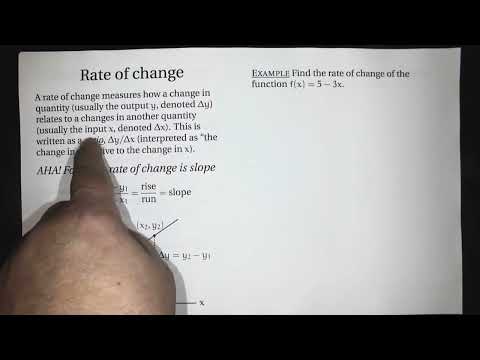 Watch on YouTube →
Overview
Beard Meets Calculus introduces average rate of change as the slope of a secant line, using the formula (f(b) − f(a))/(b − a) to measure how a function changes over an interval. The lecture places the concept in the broader goals of calculus—studying change and totals, eventually connected by Newton’s Fundamental Theorem of Calculus—and works through both a function example and a multi-interval problem.
Key takeaways
- Average rate of change over [a, b] is (f(b) − f(a))/(b − a), equivalently the slope of the secant line through (a, f(a)) and (b, f(b)).
- A linear function has a constant rate of change: for f(x) = 5 − 3x, the slope is −3 at every input.
- Adding a constant such as π³ to a function shifts its graph vertically but does not change its average rate of change, because the constant cancels in f(b) − f(a).
- To combine interval-rate information, first convert each average rate into an endpoint difference; compatible differences can then be added or subtracted so intermediate function values cancel.
- Limits, algebra and trigonometry, and geometry are foundational for calculus; practicing prerequisite algebra can prevent background skills from obstructing new concepts.
- Explaining a math solution aloud—to a study partner or even a rubber duck—can reveal errors that are difficult to notice while working silently.
Chapters
0:00
Algebra Refresher and Rubber Duck Debugging
- Evaluate 7 − 2 × 3 using order of operations: multiply first to get 1, not 15.
- Find the slope through (3, −1) and (−1, 5) as (5 − (−1))/(−1 − 3) = −3/2.
- Expand (x + h)² as x² + 2xh + h²; the so-called freshman’s dream incorrectly drops the cross term.
- Rubber duck debugging works by explaining a problem aloud, and Beard Meets Calculus recommends discussing math with others to expose mistakes.
4:30
Calculus Studies Change and Totals
- Calculus is framed around two broad questions: how a quantity changes and what its total is.
- Newton’s work connected these questions through the Fundamental Theorem of Calculus, which the course will develop by semester’s end.
- Calculus applies familiar flat shapes—lines and rectangles—to curved and irregular quantities.
- The course relies on limits, solid algebra and trigonometry, and geometry; weak background skills can be a bigger obstacle than new calculus topics.
11:19
Rate of Change as Rise over Run
- For dependent quantities y and x, rate of change is the ratio Δy/Δx.
- On a line, Δy/Δx is rise over run, which is the line’s slope.
- For f(x) = 5 − 3x, the rate of change is −3 because the coefficient attached to x gives the slope.
- A line has the same rate of change everywhere; a nonlinear function can change its rate from point to point.
15:30
Average Rate of Change and the Secant Line
- For a nonlinear function, average rate of change over [a, b] is (f(b) − f(a))/(b − a).
- Geometrically, the formula is the slope of the secant line joining (a, f(a)) and (b, f(b)).
- The average describes the net change from the interval’s starting input to its ending input, rather than the rate at one specific point.
17:47
Compute Average Change for 2ˣ − x² + π³
- For f(x) = 2ˣ − x² + π³ on [1, 3], substitute a = 1 and b = 3 into the average-rate formula.
- Evaluate f(3) − f(1): the constant π³ cancels, leaving (8 − 9) − (2 − 1) = −2.
- Divide by 3 − 1 = 2 to get an average rate of change of −1.
- A negative rate is valid and indicates that the function’s net change across the interval is downward.
24:07
Combine Interval Changes to Find the Rate from 3 to 15
- Given average rates 5 from 3 to 7, −3 from 5 to 7, and 7 from 5 to 15, convert each statement into endpoint differences.
- Multiplying by interval lengths gives f(7) − f(3) = 20, f(7) − f(5) = −6, and f(15) − f(5) = 70.
- Add the first and third differences and subtract the middle one; the f(7) and f(5) terms cancel, producing f(15) − f(3) = 20 − (−6) + 70 = 96.
- Since 15 − 3 = 12, the average rate of change from 3 to 15 is 96/12 = 8; the plus-minus-plus signs track the interval directions.
Summary, takeaways, and chapters were generated by AI from the video's transcript and may contain errors. The video belongs to its creator, Beard Meets Calculus.