AU26 CHEM 2310 - Lecture 12 - October 1 - Aromaticity (needs updated transcript)
 Watch on YouTube →
Overview
Jennifer Walters explains how aromatic stability governs electrophilic aromatic substitution (EAS): benzene requires strongly activated electrophiles, briefly loses aromaticity, then rapidly restores it by eliminating a proton. She compares nitration, sulfonation, halogenation, and Friedel–Crafts reactions, then develops substituent effects, directing rules, aromatic-ring reductions, functional-group conversions, and a retrosynthetic example.
Key takeaways
- EAS succeeds because benzene accepts a temporary loss of aromaticity only when the final deprotonation restores the ring; forming the nonaromatic carbocation intermediate is the rate-determining step.
- The five core EAS transformations use distinct electrophile-generation conditions: HNO₃/H₂SO₄ for nitration, SO₃/H₂SO₄ for sulfonation, X₂/Lewis acid for halogenation, and Lewis-acid-activated alkyl or acyl halides for Friedel–Crafts reactions.
- Friedel–Crafts alkylation risks carbocation rearrangement and repeated substitution, whereas acylation avoids rearrangement and gives a less nucleophilic ketone that can later be reduced to an alkyl group.
- Substituent electronics control both rate and position: EDGs activate and usually direct ortho/para, while most EWGs deactivate and direct meta; halogens deactivate but still direct ortho/para.
- When directing effects conflict, para substitution often reduces steric crowding, and stronger donating effects generally dominate weaker directing effects.
- Benzene resists ordinary hydrogenation and oxidation, but forcing reduction conditions, Birch reduction, benzylic reactions, and substituent interconversions expand the available synthesis routes.
Chapters
0:00
Pre-Lecture Conversation Before the Aromaticity Review
- The class begins with informal conversation about attendance, the pleasant weather, and a Browns–Steelers game.
- Jennifer Walters transitions to chemistry questions and resumes the aromaticity topic at about 9:54.
7:33
EAS Replaces a Benzene Hydrogen with an Electrophile
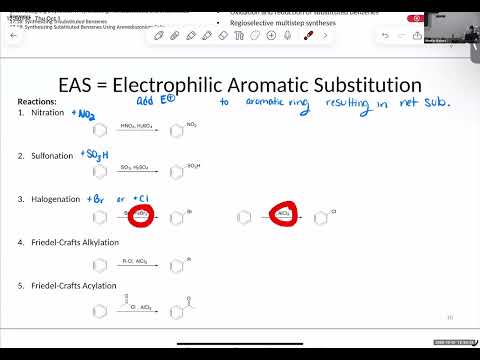
- Electrophilic aromatic substitution (EAS) adds an electrophile to an aromatic ring and ultimately replaces a hydrogen.
- The lecture surveys nitration, sulfonation, halogenation, Friedel–Crafts alkylation, and Friedel–Crafts acylation.
- Nitration uses nitric acid and sulfuric acid; sulfonation uses sulfur trioxide and sulfuric acid; halogenation uses Cl₂ or Br₂ with a Lewis acid.
13:13
Lewis Acids Activate Electrophiles for Benzene
- Benzene acts as a nucleophile, so EAS requires an electrophile reactive enough to overcome the ring’s stability.
- A Lewis acid such as AlCl₃ accepts a lone pair from chlorine in a halogen reagent, producing a highly electrophilic chlorine and an AlCl₄⁻ leaving group.
- The lecture distinguishes the overall substitution outcome from its acid–base, addition, and elimination steps.
18:02
The EAS Mechanism Breaks and Restores Aromaticity
- The shared mechanism activates the electrophile, adds it to a benzene π bond, and removes H⁺ to restore the aromatic ring.
- The addition intermediate is nonaromatic because the carbon bearing both the new electrophile and hydrogen is sp³-hybridized.
- The addition step is rate-determining: forming the unstable, nonaromatic carbocation intermediate has the highest activation barrier.
- A base removes the hydrogen, and the C–H bond electrons reform the π bond; this fast elimination restores aromaticity.
27:40
Nitration Uses the Nitronium Ion, NO₂⁺
- Nitric acid and sulfuric acid generate the activated electrophile NO₂⁺, called the nitronium ion.
- A benzene π bond attacks nitrogen; electrons shift onto oxygen to keep second-row nitrogen within its octet.
- The addition intermediate carries a positively charged nitrogen, negatively charged oxygen, and a positive charge on the ring.
- Deprotonation restores aromaticity and leaves a nitro group on benzene.
30:46
Sulfonation Adds an SO₃H Group to Benzene
- Sulfur trioxide and sulfuric acid generate the activated sulfur electrophile for sulfonation.
- The benzene ring attacks sulfur; unlike nitrogen, third-row sulfur can exceed an octet, so no additional bond-breaking arrow is needed in this step.
- A base removes the ring hydrogen to restore aromaticity and form the sulfonated product.
33:12
Cl₂ or Br₂ Requires a Lewis Acid for Halogenation
- Benzene halogenation uses Cl₂ or Br₂ together with a Lewis acid such as AlCl₃ or FeBr₃.
- Lewis-acid activation makes the terminal halogen electrophilic; the ring attacks it while the halogen–halogen bond breaks.
- A base removes the hydrogen from the addition intermediate, restoring aromaticity and producing chlorobenzene or bromobenzene.
36:13
Friedel–Crafts Alkylation Adds an Alkyl Group
- An alkyl halide and a Lewis acid such as AlCl₃ activate an alkyl electrophile for benzene attack.
- The benzene π bond forms a bond to the electrophilic carbon as the carbon–halogen bond breaks.
- Deprotonation restores aromaticity, leaving an alkyl substituent on the ring.
38:08
Friedel–Crafts Acylation Adds a Carbonyl-Containing Group
- Friedel–Crafts acylation uses an acyl halide and a Lewis acid to generate an acylium ion electrophile.
- The ring attacks the acyl carbon, not the positively charged oxygen; a resonance form places electron deficiency on carbon.
- Deprotonation restores aromaticity and produces an aryl ketone.
41:42
Why Friedel–Crafts Acylation Avoids Alkylation’s Side Reactions
- Friedel–Crafts alkylation can form carbocations that rearrange, creating multiple electrophiles and a mixture of products.
- Alkylated benzene is often more nucleophilic than benzene, so it may react again and produce polyalkylated products.
- Older workarounds included restricting substrates to groups unlikely to rearrange and using a large excess of benzene.
- Acylation avoids carbocation rearrangement, and its ketone product is less nucleophilic; zinc amalgam with HCl can then reduce the carbonyl to an alkyl group.
50:29
Electron-Donating and Electron-Withdrawing Groups Set Ring Reactivity
- Electron-donating groups (EDGs) make a benzene ring more nucleophilic and increase its EAS reaction rate; alkyl groups donate by induction.
- A lone pair directly attached to the ring can donate by resonance, placing electron density at ring positions.
- Electron-withdrawing groups (EWGs) reduce ring nucleophilicity and slow EAS; examples include CF₃, nitro, cyano, sulfonic acid, and carbonyl-containing groups.
- Halogens withdraw by induction, while resonance donation from their lone pairs explains their distinct directing behavior.
55:08
Resonance Explains Ortho/Para and Meta Direction
- To predict reaction speed, assess the starting ring’s electron density; to predict substitution position, compare the addition intermediates.
- EDGs generally direct new substituents to ortho and para positions because those intermediates gain extra stabilization.
- Most EWGs direct meta because ortho and para pathways place positive charges unfavorably close together.
- Halogens are the exception: they deactivate the ring by induction but direct ortho/para through resonance stabilization of those intermediates.
1:02:34
Sterics and Directing-Group Strength Resolve Regioselectivity
- When an existing group directs to both ortho and para positions, para is often favored because it is less sterically crowded.
- For trisubstituted products, avoid placing a new substituent between two existing groups when less crowded positions are available.
- When directing effects compete, Walters gives the priority order: resonance EDGs, inductive EDGs, inductive EWGs, then resonance EWGs.
- In a para-methylchlorobenzene example, the methyl group’s inductive donation outranks chlorine’s inductive withdrawal, so substitution is directed next to methyl.
1:07:33
An Ether Substituent Is an Ortho/Para-Directing Activator
- For an ether with oxygen directly attached to benzene, an oxygen lone pair donates by resonance into the ring.
- Resonance structures show increased ring electron density, making the ether an activating electron-donating group.
- The addition intermediate gains an extra resonance form involving oxygen, so the ether directs ortho/para.
1:11:53
Benzene Reduction Requires More Forcing Conditions
- Unlike ordinary alkene hydrogenation, H₂ with Pd/C does not normally reduce benzene because the aromatic ring is unusually stable.
- High pressure or a more reactive metal such as rhodium can drive hydrogenation toward cyclohexane.
- Sodium in liquid ammonia performs a partial Birch reduction, yielding an isolated cyclohexadiene rather than a conjugated diene.
- Walters cautions that heating hydrogen reactions presents an explosion hazard.
1:18:36
Transform Ring Substituents and Use Benzylic Reactivity
- Standard alkene oxidation conditions do not normally oxidize benzene itself, but functional groups attached to the ring can be oxidized or reduced.
- Reducing a nitro group to an amine switches a meta-directing EWG into an ortho/para-directing EDG; trifluoroperacetic acid can convert the amine back to a nitro group.
- Zinc amalgam with HCl reduces an aryl ketone carbonyl to a methylene, while strong oxidation can convert benzylic side chains to carboxylic acids.
- Light or heat can drive benzylic radical halogenation; an aniline can also be converted to an aryl diazonium salt, whose N₂ leaves as a gas when replaced.
1:22:54
Retrosynthesis Uses Directing Effects to Choose Reaction Order
- For bromobenzene from benzene, identify the missing Br and use Br₂ with FeBr₃ for electrophilic aromatic substitution.
- For a nitro group, use nitric acid and sulfuric acid to nitrate benzene.
- To obtain a meta relationship between Br and NO₂, nitrate first because NO₂ is meta-directing, then brominate.
- Check a proposed sequence by applying each substituent’s directing effect; Walters closes by reminding students to prepare for the next day’s recitation.
Summary, takeaways, and chapters were generated by AI from the video's transcript and may contain errors. The video belongs to its creator, Dr. Jennifer Walters.