AU26 CHEM 2310 - Lecture 11 - September 29 - Quiz 5 - Aromaticity and EAS
 Watch on YouTube →
Overview
Dr. Jennifer Walters reviews quiz logistics and naming mistakes, then develops a systematic test for aromaticity: a molecule must be cyclic, planar, fully conjugated, and have 4n + 2 π electrons. Examples include benzene, charged cyclopentadienyl rings, seven-membered rings, fused polycycles, and heterocycles; electrophilic aromatic substitution (EAS) and regioselectivity are previewed but not covered before the lecture ends.
Key takeaways
- Aromaticity requires a cyclic, planar, fully conjugated loop with 4n + 2 π electrons; benzene qualifies because its three double bonds contribute six π electrons.
- A single sp³ atom in a ring interrupts continuous conjugation, which is why neutral cyclopentadiene is non-aromatic despite having two double bonds.
- Lone-pair participation depends on orbital location and energetic benefit: the cyclopentadienyl anion gains aromaticity with six π electrons, while the seven-membered anion avoids an eight-electron anti-aromatic arrangement by keeping its lone pair out of the conjugated loop.
- For furan, pyrrole, and thiophene, one heteroatom lone pair occupies a p orbital and contributes two electrons to the aromatic six-electron system; a second lone pair does not count.
- Pyridine’s nitrogen lone pair occupies an sp² orbital and is excluded from the π count, leaving six electrons from its three π bonds.
- Fused systems such as naphthalene and anthracene are assessed around the continuous outer loop, yielding ten and fourteen π electrons, respectively.
Chapters
0:00
Course Announcements: Retakes, Feedback Survey, and Quiz 4
- The next retake period is October 23–25, when all three attempts for Quiz 3 will unlock.
- Students can review missed quiz questions using Respondus LockDown Browser.
- The university mid-semester feedback survey will arrive by email, and the class votes to keep Quiz 4 on its scheduled weekend.
8:00
Quiz 3 Results and Finding the Longest Carbon Backbone
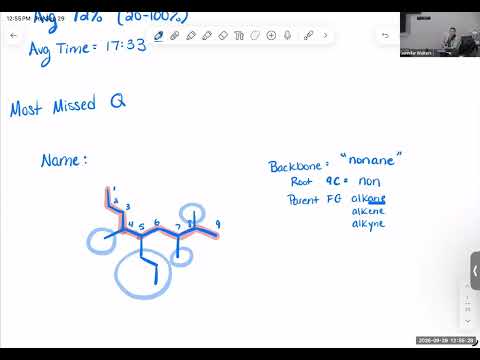
- Quiz 3 averaged 72% and took about 17 minutes, which Jennifer Walters describes as strong performance for the first reaction-focused quiz.
- For the naming question, identify the longest continuous carbon chain by checking alternate paths at each branch rather than automatically tracing left to right.
- The example backbone contains nine carbons, so its root is non-, and all-single-bond connectivity makes the parent nonane.
16:30
Naming Substituents, Numbering, and Common Alkyl Names
- Name branches as substituents: one carbon is methyl and three carbons is propyl; do not count a backbone carbon again as part of a branch.
- Choose the numbering direction with the lowest locant set: the example uses 2, 3, 5, and 6 rather than 4, 5, 7, and 8.
- Group identical substituents with prefixes such as tri-, alphabetize by the substituent root, and use hyphens between numbers and words.
- Common names such as isopropyl and tert-butyl describe connectivity; systematic alternatives include 1-methylethyl and 1,1-dimethylethyl.
22:00
Quiz 5 Scope and Benzene’s Delocalized Structure
- Quiz 5 covers aromatic compounds; homework is due the following Thursday, and the quiz is scheduled to open October 9–11.
- Benzene, C₆H₆, has one ring and three π bonds, with six equivalent carbons and six equivalent hydrogens.
- Benzene’s carbon–carbon bonds are equal in length and intermediate between ordinary single and double bonds because its π electrons are delocalized around the ring.
- A circle inside the benzene hexagon represents the resonance hybrid and its continuous conjugated loop.
27:00
Choosing Benzene or a Larger Ring as the Parent
- When benzene is the parent, use benzene as the name ending and name each group attached to the ring as a substituent.
- For a benzene ring bearing ethyl, chloro, and cyclohexyl groups, compare numbering directions and select the lower locant set.
- Benzene takes priority over a same-sized cyclohexane ring, but a larger cycloheptane ring becomes the parent and the attached benzene group is named phenyl.
32:00
Ortho, Meta, and Para Positions; Four Aromaticity Conditions
- For disubstituted benzene, ortho means 1,2; meta means 1,3; and para means 1,4, regardless of how the ring is drawn.
- Aromaticity requires a ring that is planar and fully conjugated, with a continuous loop of sp² or sp atoms.
- The fourth requirement is 4n + 2 π electrons, known as Hückel’s rule; aromatic compounds gain extra stability.
36:00
Hückel’s Rule and Benzene’s Extra Stability
- Hückel’s 4n + 2 formula gives allowed π-electron counts of 2, 6, 10, 14, and 18 when n is 0, 1, 2, 3, and 4.
- Count π electrons, not π bonds: benzene has three π bonds but six π electrons, satisfying Hückel’s rule.
- Conjugation lowers energy by spreading electron density across multiple atoms; benzene’s stabilization is much greater than simply adding the energies of three isolated double bonds.
41:00
Aromaticity Decision Flow: Ring, Hybridization, Electron Count
- First ask whether the structure is cyclic; an open-chain molecule is non-aromatic.
- For a ring, check whether every atom in the loop can be sp² or sp hybridized; an sp³ atom interrupts conjugation and makes the structure non-aromatic.
- If the ring is fully conjugated, count π electrons: 4n + 2 indicates aromaticity, while a fully conjugated planar ring with 4n electrons is anti-aromatic.
- Aromatic systems are lower in energy than ordinary non-aromatic molecules, while anti-aromatic systems are higher in energy.
44:00
Open-Chain and Cyclopentadiene Examples
- The open-chain five-carbon example is penta-1,3-diene and is non-aromatic because its ends do not form a ring.
- Cyclopentadiene has five ring carbons and two double bonds, but its CH₂ carbon has four single bonds and is sp³ hybridized.
- Because that sp³ carbon breaks the conjugated loop, cyclopentadiene is non-aromatic despite being cyclic.
49:00
Cyclopentadienyl Cation and Anion: Lone-Pair Participation
- The cyclopentadienyl cation is cyclic and fully conjugated because a carbocation is sp² hybridized; its two double bonds supply four π electrons, making it anti-aromatic.
- For a lone pair next to a π bond, compare the sp³, non-aromatic option with the sp², conjugated option rather than assuming resonance is always favorable.
- The cyclopentadienyl anion can place its lone pair in a p orbital, giving six π electrons and an aromatic, lower-energy system.
- Orbital counting helps: σ bonds use hybrid orbitals, π bonds use p orbitals, and a lone pair in a p orbital contributes two π electrons.
57:00
Seven-Membered Ring Anion: Avoiding Anti-Aromaticity
- The seven-membered ring anion has two double bonds plus a possible lone-pair contribution, which would total eight π electrons if fully conjugated.
- Eight π electrons do not fit 4n + 2, so the conjugated form would be anti-aromatic; the molecule instead favors an sp³ lone pair and a non-aromatic structure.
- When choosing between possible structures, use the lower-energy alternative: non-aromatic is preferred over anti-aromatic in this example.
1:03:00
Ring Size, Planarity, and Anti-Aromaticity Avoidance
- Eight- to eleven-membered rings commonly buckle out of plane instead of maintaining a flat, fully conjugated geometry.
- A nonplanar ring cannot sustain the continuous p-orbital overlap needed for anti-aromaticity, so buckling provides a way to avoid the high-energy state.
- Anti-aromatic molecules are uncommon because structures can often avoid the condition by breaking conjugation or planarity.
1:06:00
Fused Polycycles: Naphthalene and Anthracene
- For fused polycyclic systems, count π electrons around the largest continuous outer loop rather than separately counting each internal ring.
- Naphthalene has ten π electrons around its outer perimeter and is aromatic.
- Anthracene has fourteen π electrons around its outer perimeter and is also aromatic.
- Atoms inside the selected perimeter do not determine the outer loop’s aromaticity count.
1:10:00
Furan: Counting One Oxygen Lone Pair
- Furan is a five-membered heterocycle containing oxygen; its ring is cyclic, and oxygen’s hybridization must be assessed because it has lone pairs.
- If oxygen is sp² hybridized, one lone pair occupies a p orbital and joins the two double bonds, producing six π electrons.
- The other oxygen lone pair occupies an sp² orbital and is not included in the π-electron count; the six-electron system is aromatic.
1:13:00
Pyrrole and Thiophene: Heterocycle Lone-Pair Rules
- Pyrrole is aromatic when its nitrogen lone pair occupies a p orbital, contributing two electrons alongside the two double bonds for a total of six π electrons.
- Thiophene is aromatic by the same count: one sulfur lone pair contributes two π electrons, while the other is outside the π system.
- For furan, pyrrole, and thiophene, count only the lone pair that occupies a p orbital and participates in the conjugated ring.
1:16:00
Pyridine, Pyrimidine, and Nitrogen Lone Pairs
- In pyridine, the nitrogen is sp² hybridized because it is part of a double bond, and its lone pair occupies an sp² orbital rather than the π system.
- Pyridine’s three π bonds provide six π electrons; do not add the nitrogen lone pair to that count.
- A lone pair on a double-bonded nitrogen is not counted, while a lone pair adjacent to the π system may be counted if its participation produces a favorable aromatic configuration.
1:19:30
Purines, Pyrimidines, and the Lecture’s Aromaticity Review
- The nucleotide bases adenine and guanine are purines, while thymine and cytosine are pyrimidines; these terms identify ring structures.
- Walters recommends recognizing furan, pyrrole, thiophene, and pyridine for coursework and exams.
- The lecture concludes after aromaticity; EAS reactions, regioselectivity, and synthesis are identified as upcoming topics rather than covered material.
Summary, takeaways, and chapters were generated by AI from the video's transcript and may contain errors. The video belongs to its creator, Dr. Jennifer Walters.