Aquaporin Structure and Function, BIO105 Introductory Biology, David Champlin, USM
 Watch on YouTube →
Overview
David Champlin connects membrane osmosis to aquaporin, a channel protein whose folded amino-acid structure creates a selective, high-speed route for water across cell membranes. He explains how mutations can disrupt aquaporin function and cause conditions such as nephrogenic diabetes insipidus and cataracts, then links the family of human aquaporins to gene duplication and evolutionary specialization.
Key takeaways
- Aquaporin’s membrane-spanning pore has hydrophobic residues oriented toward the lipid bilayer and hydrophilic residues lining the channel, matching the protein’s structure to its location and function.
- Aquaporin selectivity depends on more than a small opening: pore geometry and specific hydrogen-bond interactions help favor water transport.
- A mutation can cause disease either by changing an amino acid that interacts with water, as in the AQP2 example, or by destabilizing the channel structure, as in the aquaporin 0 cataract example.
- Gene duplication creates opportunities for aquaporin paralogs to diverge, allowing related proteins to acquire specialized roles in different tissues or transport additional small molecules.
- Champlin gives an approximate transport rate of one billion water molecules per second through a single aquaporin channel.
Chapters
0:00
Membrane Osmosis and Why Cells Need Aquaporins
- Cell membranes combine phospholipids with proteins that regulate what enters and leaves the cell.
- During osmosis, water moves in both directions across a semipermeable membrane, with net movement toward the side with higher solute concentration.
- Aquaporins accelerate water transport beyond what passage through the phospholipid bilayer alone can support; examples include water handling in the kidneys and tear production.
- Champlin relates concentration differences to potential energy and reviews isotonic, hypertonic, and hypotonic solutions.
5:25
Aquaporin’s Folded Amino-Acid Chain Forms a Water-Selective Pore
- Aquaporin is a several-hundred-amino-acid protein that folds into a barrel-like channel spanning the membrane.
- Hydrophobic amino acids face the membrane’s lipid interior, while hydrophilic regions face the watery surroundings and line the pore.
- Specific amino acids in the channel form hydrogen-bond interactions with water; pore size, shape, and chemistry help make transport selective.
- Four aquaporin channels can associate in one membrane complex, while each channel provides its own route for water.
12:40
Aquaporin Mutations Disrupt Channel Function and Cause Disease
- DNA encodes the amino-acid sequence; mutations can alter a channel’s water-interacting residues or disrupt the protein’s folded structure.
- A mutation in the AQP2 gene that substitutes cysteine for arginine is presented as a cause of nephrogenic diabetes insipidus.
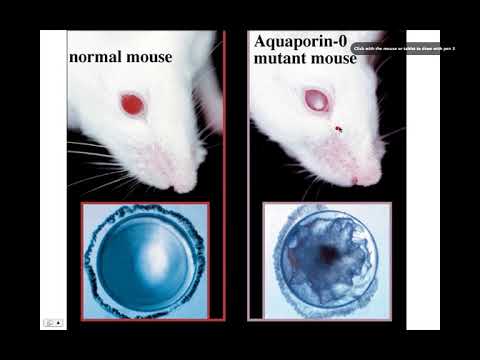
- A change from glutamate to glycine in aquaporin 0 can cause cataracts by destabilizing the channel, even though the altered residue does not directly contact water.
- Champlin also describes inherited aquaporin mutations in mice associated with dry eyes and early lens degeneration.
17:56
Aquaporin Gene Duplication, Specialization, and Transport Speed
- Champlin describes humans as having 10 aquaporin genes, with different forms expressed in different locations and some transporting additional small molecules.
- Gene duplication can leave one copy performing an ancestral role while another accumulates changes that support a new function; related copies within a species are paralogs.
- Comparisons among aquaporin sequences can reveal shared ancestry and patterns of gene duplication followed by divergence.
- A single aquaporin channel can pass approximately one billion water molecules per second.
Summary, takeaways, and chapters were generated by AI from the video's transcript and may contain errors. The video belongs to its creator, The New Evolution for Everyone.