Applied Probability - F26 - Lecture 3
 Watch on YouTube →
Overview
Arash Amini develops the pi-lambda theorem as a practical uniqueness tool: two probability measures that agree on a generating pi-system agree on its generated sigma-algebra. He then explains measure construction through algebras, premeasures, and the Carathéodory outer-measure method, before characterizing probability measures on R by right-continuous CDFs and introducing random variables as measurable maps.
Key takeaways
- If two probability measures agree on a pi-system that generates a sigma-algebra, the pi-lambda theorem guarantees that they agree on the entire sigma-algebra.
- A CDF F(x) = P((−∞, x]) uniquely determines a probability measure on R because the half-lines form a generating pi-system.
- Measure construction begins with a premeasure on an algebra; countable additivity is required for disjoint unions only when their union remains in that algebra.
- Carathéodory’s method builds an outer measure from infimum-cost covers, then identifies measurable sets by the additive splitting condition.
- A probability distribution function must be nondecreasing, right-continuous, and approach 0 and 1 at the two ends of the real line.
- Random-variable events are preimages: measurability ensures that {X ∈ B} is an event in the source sigma-algebra and can therefore be assigned a probability.
Chapters
0:00
Why Agreement on a Generating Collection Is Not Enough
- Two measures can agree on a collection that generates a sigma-algebra yet differ on other sets in that sigma-algebra.
- The sets where two measures agree form a lambda-system: it contains the whole space, is closed under complements, and is closed under countable disjoint unions.
- Lambda-systems have weaker closure requirements than sigma-algebras, so an additional condition is needed to prove uniqueness.
3:00
Pi-Systems and the Pi-Lambda Theorem
- A pi-system is closed under pairwise intersections, and hence under finite intersections.
- Half-lines and suitable collections of half-open intervals are examples used to generate the Borel sigma-algebra on R.
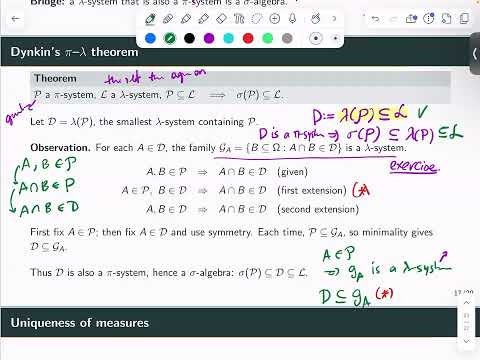
- The pi-lambda theorem states that if a pi-system P is contained in a lambda-system L, then the sigma-algebra generated by P is also contained in L.
10:00
The Core Idea Behind the Pi-Lambda Proof
- Consider the smallest lambda-system containing P; the proof shows that this smallest system is also closed under intersections.
- The intersection argument extends the known closure for sets in P to pairs of sets in the generated lambda-system.
- A collection that is both a lambda-system and a pi-system is a sigma-algebra, which yields the theorem.
14:00
Proving Uniqueness of Probability Measures
- For probability measures P and Q, the sets A satisfying P(A) = Q(A) form a lambda-system.
- Agreement on complements follows from P(Aᶜ) = 1 − P(A) and Q(Aᶜ) = 1 − Q(A); countable disjoint additivity supplies the other key closure property.
- If P and Q agree on a generating pi-system, the pi-lambda theorem gives agreement throughout its generated sigma-algebra.
21:00
CDFs Determine Probability Measures on the Real Line
- The half-lines (−∞, x] form a pi-system that generates the Borel sigma-algebra on R.
- A probability measure is therefore determined by its distribution function F(x) = P((−∞, x]).
- F is a real-valued function that encodes a set function on the much larger collection of Borel subsets of R.
25:00
Lebesgue Measure Uniqueness and the Need for Existence
- Agreement on intervals can determine a measure when the intervals form an appropriate generating pi-system.
- Lebesgue measure on R is characterized by assigning length b − a to intervals with endpoints a and b, alongside the required finite-measure or sigma-finite conditions.
- Uniqueness does not establish that a measure with prescribed interval values exists; additivity and continuity can impose consistency constraints.
32:00
Algebras as Simpler Domains for Defining Measures
- An algebra of sets contains the whole space and is closed under complements and finite unions; a sigma-algebra additionally requires countable-union closure.
- The interval algebra on R consists of finite unions of intervals and is simpler to describe than the Borel sigma-algebra it generates.
- Specifying values on an algebra provides a manageable starting point for constructing a measure on the generated sigma-algebra.
36:00
Premeasures and Countable Additivity on an Algebra
- A premeasure μ₀ assigns zero to the empty set and is countably additive for disjoint sequences whose union remains in the algebra.
- The definition does not require every countable union to belong to the algebra; it requires additivity whenever that union does belong.
- For interval lengths, countable decompositions must give values consistent with the length of the original interval.
46:00
Extending a Premeasure with Outer Measure
- A premeasure on an algebra extends to a measure on the sigma-algebra generated by that algebra, under the extension theorem discussed in class.
- For a general set, define an outer measure by covering it with algebra sets and taking the infimum of the sums of their premeasure values.
- Carathéodory measurability requires every set S to split additively across E: μ*(S) = μ*(S ∩ E) + μ*(S \ E).
53:00
Carathéodory-Measurable Sets and Lebesgue Measure
- The sets satisfying the Carathéodory splitting condition form a sigma-algebra, and restricting the outer measure to them gives a measure.
- For Lebesgue measure, start with interval length on an interval algebra; verifying the premeasure property allows extension to the Borel sigma-algebra.
- The resulting Lebesgue-measurable sets include Borel sets and additional subsets of null sets, extending beyond the Borel domain.
59:00
Necessary Properties of a Probability Distribution Function
- If F(x) = μ((−∞, x]) for a probability measure on R, then F is nondecreasing and right-continuous.
- The probability limits are F(x) → 0 as x → −∞ and F(x) → 1 as x → +∞.
- Interval probabilities follow from F: μ((a, b]) = F(b) − F(a), and the mass at x is F(x) − F(x−).
1:03:00
Constructing Measures from Right-Continuous CDFs
- A nondecreasing, right-continuous function with limits 0 and 1 defines a probability measure on the Borel sets of R.
- One construction assigns F(b) − F(a) to intervals (a, b] and extends the resulting premeasure from the interval algebra.
- Right continuity is essential to verifying the premeasure property; an alternative construction can start from Lebesgue measure.
1:05:00
A Mixed Distribution: an Atom and a Uniform Component
- The example combines one-half of a point mass δ₀ with one-half of Lebesgue measure restricted to the interval from 1 to 2.
- Its CDF jumps by one-half at zero, stays flat between zero and one, rises linearly from one to two, and then remains at one.
- The distribution has an atom and a continuous component, so it is neither purely discrete nor described by a density alone.
1:10:12
Random Variables as Measurable Maps
- A random variable is a measurable function from a probability space (Ω, F) to a target measurable space; a real-valued variable uses the Borel sigma-algebra on R.
- For the six-face die, the indicator of an odd outcome maps outcomes 1 through 6 to values 1 or 0.
- An event such as {X ∈ B} is the preimage X⁻¹(B); measurability requires this preimage to belong to F for every measurable target set B.
Summary, takeaways, and chapters were generated by AI from the video's transcript and may contain errors. The video belongs to its creator, ARASH AMINI.