Applied Probability - F26 - Lecture 2
 Watch on YouTube →
Overview
ARASH AMINI develops the measure-theoretic foundations of probability by reviewing sigma-algebras, generated sigma-algebras, Borel sets, measures, probability measures, finite and sigma-finite measures, and Lebesgue measure. The lecture then derives consequences of countable additivity and introduces point masses, mixtures, pi-systems, lambda-systems, and the π-λ theorem as the mechanism for proving that two measures agreeing on a suitable generating class also agree on the full sigma-algebra.
Key takeaways
- Countable additivity is the defining property that distinguishes measures from merely finitely additive set functions and enables continuity results for increasing and decreasing sequences of events.
- Lebesgue measure on R is sigma-finite rather than probabilistic: R is covered by (-n,n), each having finite measure 2n, but λ(R)=∞.
- A generating family alone does not guarantee uniqueness of a measure; the family must have additional structure such as being a pi-system.
- The sets on which two probability measures agree form a lambda-system, so the π-λ theorem converts agreement on a generating pi-system into agreement on the full generated sigma-algebra.
- Finite sigma-algebra measures are determined by their values on atoms, whereas on Borel subsets of R, assigning zero to every singleton does not determine the distribution.
- Probability measures on R can be constructed from right-continuous, nondecreasing CDFs through μ((a,b])=F(b)−F(a), covering continuous, discrete, and mixed distributions.
Chapters
0:00
Probability Spaces Begin with Sample Spaces and Sigma-Algebras
- A probability model starts with a sample space Ω, a collection of observable events, and a rule assigning probabilities to those events.
- A sigma-algebra F contains Ω, is closed under complements, and is closed under countable unions.
- Countable closure ensures that limits and compound events built from a sequence of events remain measurable.
4:00
Finite Sigma-Algebras, Partitions, and Correcting the Intersection Example
- For a finite sample space such as die outcomes {1,2,3,4,5,6}, sigma-algebras correspond to partitions whose blocks act as atoms.
- The intersection of two sigma-algebras is always a sigma-algebra; in the discussed die example, the intersection can reduce to {∅, Ω}.
- The union of two sigma-algebras is generally not a sigma-algebra and must be completed by taking the sigma-algebra it generates.
8:00
Generated Sigma-Algebras and Combining Information
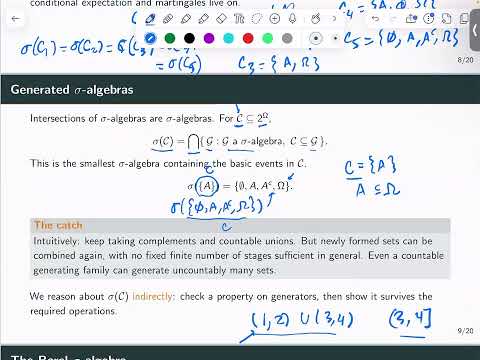
- For a collection C, σ(C) is the smallest sigma-algebra containing C, equivalently the intersection of all sigma-algebras that contain C.
- Combining sigma-algebras generated by parity and another die classification adds intersections and complements, potentially producing all subsets 2^Ω.
- The intersections of sets from two generating families can create singleton atoms; once every singleton is available on a finite Ω, the generated sigma-algebra is the full power set.
12:00
Borel Sigma-Algebra on R and Countable Interval Generators
- The Borel sigma-algebra on R is generated by open sets but is much smaller than the full power set 2^R.
- Half-open intervals such as (a,b] and half-lines with rational endpoints generate the same Borel sigma-algebra.
- Singletons belong to the Borel sigma-algebra because they can be represented as countable intersections of suitable half-open intervals, unlike the finite case this does not imply σ-algebra = 2^R.
16:00
Measures as Countably Additive Set Functions
- A measure μ maps sets in a sigma-algebra F to values in [0,∞], assigns μ(∅)=0, and is countably additive over pairwise disjoint measurable sets.
- For disjoint events A1,A2,..., μ(⋃n An)=Σn μ(An); disjointness prevents overlapping mass from being counted twice.
- On a six-outcome die space, μ(A)=|A|/6 is a probability measure because it gives Ω measure 6/6=1.
20:00
Probability Measures, Finite Measures, and Sigma-Finiteness
- A probability measure is a normalized measure satisfying μ(Ω)=1, while a finite measure only requires μ(Ω)<∞.
- A measure is sigma-finite if Ω can be covered by countably many measurable sets of finite measure.
- Lebesgue measure λ on R is not a probability measure because λ(R)=∞, but it is sigma-finite since R=⋃n(-n,n), with λ((-n,n))=2n.
24:00
Lebesgue Measure, CDFs, and Probability Laws on R
- Lebesgue measure assigns interval length, for example λ((a,b])=b−a, and provides the standard continuous notion of size on R.
- A probability measure on R can be constructed from a nondecreasing, right-continuous cumulative distribution function F with limits 0 at −∞ and 1 at +∞.
- For intervals, the associated measure satisfies μ((a,b])=F(b)−F(a); Gaussian, uniform, and discrete distributions fit this framework.
28:00
Why Countable Additivity Is Stronger Than Finite Additivity
- Finite additivity alone cannot establish probabilities for countably infinite unions such as the rational numbers in an interval.
- For the uniform distribution on [0,1], every singleton has probability 0, while countable additivity correctly implies that the rationals in [0,1] also have probability 0.
- Uncountable additivity is not required and would create contradictions: [0,1] is an uncountable disjoint union of zero-probability singletons but has total probability 1.
33:00
Point Masses and Mixtures of Measures
- The point mass δx assigns δx(A)=1 when x∈A and 0 otherwise; δ3 is a probability measure concentrated entirely at die outcome 3.
- Weighted combinations such as μ=αμ1+(1−α)μ2 define new probability measures when 0≤α≤1.
- More generally, Σi αiμi is a probability measure when αi≥0 and Σiαi=1, while dropping normalization yields a general measure.
38:00
Discrete Measures and Atomic Representations
- On a discrete space, assigning masses pi to points determines every set through μ(A)=Σx_i∈A pi.
- On a finite sigma-algebra, every measurable set is a disjoint union of its atoms, so μ(A) is the sum of the measures of the atoms contained in A.
- A measure on a finite sigma-algebra can therefore be represented by a vector of values, one for each atom; probabilities additionally require those values to sum to 1.
44:00
Monotonicity and Countable Subadditivity
- Countable additivity implies monotonicity: if A⊆B, then μ(A)≤μ(B).
- For arbitrary, possibly overlapping sets, μ(⋃n An)≤Σn μ(An), which is countable subadditivity.
- The proof uses disjointification: replace A2 by A2\A1, A3 by A3\(A1∪A2), and continue to obtain disjoint pieces.
50:00
Continuity of Measures for Increasing and Decreasing Events
- If A1⊆A2⊆⋯ and A=⋃n An, then μ(An) increases to μ(A), known as continuity from below.
- If A1⊇A2⊇⋯ and A=⋂n An, then μ(An) decreases to μ(A) provided μ(A1)<∞.
- The finite-measure condition is automatic for probability measures but matters for sigma-finite measures such as Lebesgue measure on R.
56:00
Why Agreement on a Generating Family May Fail
- Two measures can agree on a collection C that generates F without agreeing on every set in F.
- On Ω={1,2,3,4}, the uniform measure and the measure assigning mass 1/2 to 1 and 4 can agree on sets such as {1,2} and {1,3} while disagreeing on {2,3}.
- The family of sets on which two probability measures agree is closed under complements and countable disjoint unions, but need not be closed under intersections.
1:02:00
Pi-Systems, Lambda-Systems, and Their Closure Properties
- A lambda-system contains Ω, is closed under complements, and is closed under countable pairwise-disjoint unions.
- A pi-system is a collection closed under finite intersections; half-lines such as (−∞,a] form a standard pi-system on R.
- A sigma-algebra is both an algebra and a lambda-system, while a lambda-system that is also a pi-system becomes a sigma-algebra.
1:08:00
The π-λ Theorem and Uniqueness of Measures
- The π-λ theorem states that if P is a pi-system contained in a lambda-system L, then σ(P)⊆L.
- For two probability measures, the sets on which they agree form a lambda-system; agreement on a generating pi-system therefore extends to the entire generated sigma-algebra.
- For Borel probability measures on R, agreement on a suitable pi-system of half-lines or intervals is enough to prove equality on all Borel sets.
Summary, takeaways, and chapters were generated by AI from the video's transcript and may contain errors. The video belongs to its creator, ARASH AMINI.