Applied Probability - F26 - Lecture 1
 Watch on YouTube →
Overview
ARASH AMINI builds the measure-theoretic foundations of probability by showing how experiments become sample spaces, meaningful questions become events, and countable set operations motivate sigma algebras. He connects finite sigma algebras to partitions and information, then defines generated sigma algebras and the Borel sigma algebra on ℝ, closing with a preview of measures as countably additive set functions.
Key takeaways
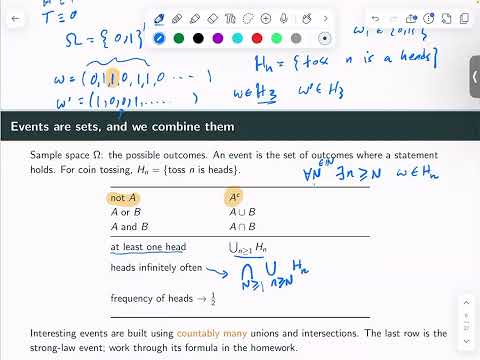
- An event is a subset of a sample space: for infinite coin tosses, “heads infinitely often” is the countable set expression ⋂ₙ ⋃ₖ≥ₙ Hₖ.
- A sigma algebra contains Ω and is closed under complements and countable unions; these rules also guarantee closure under countable intersections.
- Finite sigma algebras correspond to partitions: their atoms are disjoint blocks, and every measurable event is a union of those blocks.
- Treating a sigma algebra as information clarifies why an F-measurable function must be constant on each atom: it cannot distinguish outcomes F does not distinguish.
- The Borel sigma algebra on ℝ is generated by open sets, and even intervals with rational endpoints suffice to generate it.
- A measure is a countably additive set function defined on a sigma algebra, not necessarily on every subset of the sample space.
Chapters
0:00
Infinite Coin Tosses as a Sample Space
- Represent an outcome of infinitely many coin tosses as a sequence in {0,1}^ℕ, with 1 for heads and 0 for tails.
- The sample space Ω contains all possible infinite sequences, while an individual sequence is one outcome.
- Statistical models, random variables, conditioning, dependence, and limits can all be framed as operations on measures.
5:00
Coin-Toss Events as Sets and Logical Statements
- Define Hₙ as the event that toss n is heads; membership depends on the nth coordinate, not the rest of the sequence.
- Use complements for “not Hₙ,” unions for “A or B,” and intersections for simultaneous events such as H₃ ∩ H₅.
- The event that at least one head occurs is ⋃ₙ Hₙ.
11:00
Writing “Heads Infinitely Often” as an Event
- Heads occur infinitely often exactly when, for every cutoff N, some later toss n ≥ N is heads.
- Translate that quantifier structure into ⋂ₙ ⋃ₖ≥ₙ Hₖ: universal quantifiers correspond to intersections and existential quantifiers to unions.
- Once a probability measure is defined, assigning a probability to this logical statement means assigning a number to its corresponding set.
17:00
Countable Set Operations Capture Limit Events
- The event that the frequency of heads converges to 1/2 can be written using unions and intersections that encode the ε–N definition of convergence.
- The strong law of large numbers concerns whether the fraction of heads among the first n tosses converges to 1/2.
- Countable operations are essential for expressing events about infinite sequences and limits; finite unions alone cannot capture them.
22:00
The Three Defining Rules of a Sigma Algebra
- A sigma algebra F is a collection of subsets of Ω, written F ⊆ 2^Ω, whose members are the measurable events.
- It contains Ω, is closed under complements, and is closed under countable unions.
- Countable intersections follow from those rules by De Morgan’s laws; finite unions and intersections follow as well.
- The pair (Ω, F) is called a measurable space.
27:00
Why Measurability Does Not Require Every Subset
- A sigma algebra need not be closed under uncountable unions; its axioms require only countable unions.
- For finite Ω, the power set 2^Ω is a possible sigma algebra, but on an uncountable space it may be impossible to define a countably additive, translation-invariant measure on every subset.
- The Vitali-set example illustrates the technical reason to restrict measurable sets; sigma algebras can also represent limited information.
32:00
Die-Roll Sigma Algebras and Their Information
- For a die with Ω = {1,2,3,4,5,6}, the trivial sigma algebra {∅, Ω} represents knowing only that some outcome occurred.
- The parity sigma algebra {∅, Ω, evens, odds} records whether the result is even or odd without revealing the exact roll.
- A partition into more blocks generates a more detailed sigma algebra; the full power set contains all 2⁶ = 64 subsets.
37:00
Atoms Link Finite Sigma Algebras to Partitions
- An atom is the smallest measurable set containing a given outcome; for the parity sigma algebra, each atom is either the even outcomes or the odd outcomes.
- The atoms of a finite sigma algebra are disjoint and cover Ω, so they form a partition of the sample space.
- Every event in that sigma algebra is a union of atoms, giving a one-to-one correspondence between finite partitions and finite sigma algebras.
42:00
Sigma Algebras as Information and Resolution
- A larger sigma algebra represents finer information: the full power set reveals the exact die result, while the parity sigma algebra reveals only even versus odd.
- Two sigma algebras can encode incomparable information; knowing a different partition need not determine parity.
- In a finite space, an F-measurable function is constant on each atom, so its values cannot reveal distinctions that F does not contain.
- Increasing information over time can be represented by nested sigma algebras, a structure used in conditional expectation and martingales.
47:00
Constructing the Sigma Algebra Generated by Events
- For a collection C of subsets of Ω, define σ(C) as the intersection of all sigma algebras that contain C.
- Intersections of sigma algebras are again sigma algebras, so this construction gives the unique smallest sigma algebra containing C.
- If C consists of one event A, closure adds Aᶜ, Ω, and ∅; “generated by” means the resulting closure, not that C already contains every resulting set.
52:00
Different Generators Can Produce the Same Sigma Algebra
- A sigma algebra can have multiple generating collections: for example, {A}, {Aᶜ}, and {A, Aᶜ, ∅, Ω} all generate the same four-set sigma algebra.
- On ℝ, the Borel sigma algebra is defined as the sigma algebra generated by all open sets.
- Although the collection of open sets is uncountable, a generating collection itself does not need to be countable.
57:00
Borel Sets on ℝ and the Definition of a Measure
- Open intervals generate the Borel sigma algebra on ℝ; intervals with rational endpoints are sufficient as a smaller generator.
- Borel sets include closed sets, half-open intervals, and singletons, since complements and countable intersections preserve membership.
- The Borel sigma algebra is large but is not the power set of ℝ; countable closure does not permit arbitrary uncountable unions.
- A measure assigns numbers to sets in a sigma algebra, gives ∅ measure zero, and is countably additive; probability measures are the normalized case.
Summary, takeaways, and chapters were generated by AI from the video's transcript and may contain errors. The video belongs to its creator, ARASH AMINI.