Anthropic's Boris Cherny: Why Coding Is Solved, and What Comes Next
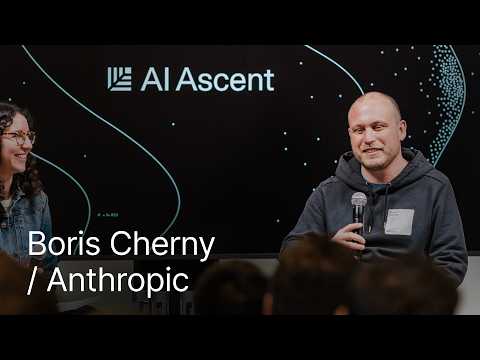 Watch on YouTube →
Overview
Boris Cherny, creator of Claude Code at Anthropic, recounts how the tool emerged from Anthropic Labs in late 2024 as a deliberate bet on a 'product overhang' — building 6 months ahead of model capability — before exploding with Opus 4 in May. He details his current workflow of running hundreds of agents across loops and routines (hitting 150 PRs in a day), argues coding is effectively solved for on-distribution stacks like TypeScript/React, and predicts software development will democratize like literacy after the printing press.
Key takeaways
- Claude Code's exponential growth didn't begin at launch — it inflected with Opus 4 in May 2025, validating Cherny's bet to build 6 months pre-PMF for a model that didn't yet exist.
- Cherny ran 150 PRs in a single day using parallel agents and /loop, suggesting that scheduled, persistent agent loops (not single chat sessions) are the emerging primitive for AI-assisted engineering.
- Claude Code was deliberately written in TypeScript and React specifically because those were on-distribution for the model at the time — language choice was a model-performance decision, not a preference.
- Under Helmer's 7 Powers framework, AI erodes switching costs and process power (Claude 4.7 can hill-climb any defined target) but leaves network effects, scale economies, and cornered resources intact as defensible moats.
- Anthropic has eliminated manually written code internally — even SQL is model-generated — and agents communicate across employees' Slack to resolve unknowns autonomously.
- Cherny argues the model-vs-harness ratio was 50/50 a year ago but the harness (prompt injection guards, permission modes, human-in-the-loop) will matter less as alignment improves and models naturally decide when to spawn sub-agents or loops.
Chapters
0:00
Origin of Claude Code Inside Anthropic Labs
- Started late 2024 in a small incubator team alongside MCP and the desktop app, now restarted under Mike Krieger
- Built deliberately for a 'product overhang' — betting the next model would make agentic coding viable beyond Sonnet 3.5's tab-complete
- Barely usable for first 6 months; Cherny used it for only ~10% of his code until Opus 4 in May triggered exponential growth across 4.5, 4.6, and 4.7
5:00
Why Coding Is Solved and Cherny's Loop-Based Workflow
- Claude Code's codebase is plain TypeScript + React chosen for being on-distribution; models wrote 100% of it by October/November 2024
- Cherny now codes primarily from his phone, running 5–10 sessions with a few hundred agents concurrently (thousands overnight)
- Heavy reliance on /loop — cron-scheduled repeating agents that babysit PRs, fix flaky CI, and cluster Twitter feedback every 30 minutes
- New 'routines' feature moves loops server-side so they persist when the laptop closes
9:00
Cross-Disciplinary Generalists and the SaaS Apocalypse Question
- Predicts a surge of cross-disciplinary generalists — every Claude Code team member codes, including the PM, designer, data scientist, finance lead, and user researcher
- Applies Hamilton Helmer's 7 Powers: switching costs and process power erode under AI, while network effects, scale economies, and cornered resources remain durable moats
- Expects ~10x more disruptive startups in the next decade because incumbents face internal resistance to AI-native rebuilds
15:00
Democratization of Software, MCP, and the Anthropic Internal Stack
- Compares the moment to the 1400s printing press: post-Gutenberg, more was published in 50 years than the prior 1,000; literacy eventually reached ~70%
- Argues the best accounting software will be built by accountants, not engineers, because domain knowledge is the hard part
- Internally Anthropic uses the same models as customers (mostly Opus 4.7); Claudes coordinate over Slack between team members' loops, and all SQL is model-written
- MCP is the universal connector for knowledge work (Salesforce, Google Docs); computer use via Co-work handles software lacking MCP integration
Summary, takeaways, and chapters were generated by AI from the video's transcript and may contain errors. The video belongs to its creator, Sequoia Capital.