Ancient Athens: The Rise Of The Most Influential Society In History | Metropolis
 Watch on YouTube →
Overview
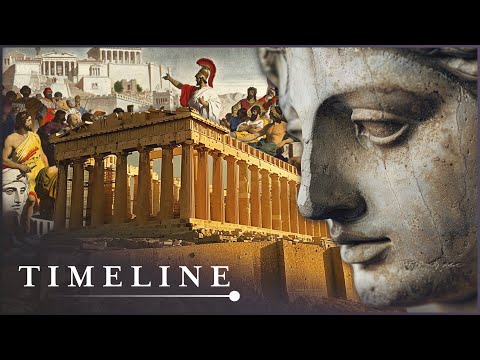
Timeline's documentary explores 5th-century BC Athens at its peak of 300,000 inhabitants, weaving together the trial of the courtesan Phryne (accused of blasphemy for modeling Praxiteles' Aphrodite statue) with the architecture of the Parthenon and Propylaea, the workings of the Agora and democracy, and daily life including slavery, trade, and the navy of triremes. Architect Nikos Toganidis and Professor John Camp guide viewers through ongoing restoration and excavation work that reveals how Athenian citizens built the first society where monumental architecture served the people rather than gods or kings.
Key takeaways
- The Parthenon's columns are not vertical: each tapers so precisely that extending the sides would converge kilometers in the sky, achieved using only compass, ruler and plumb line.
- Athenian democracy paid citizens to vote and serve, ensuring even potters and oarsmen could afford political participation — but it rested on a slave population roughly three times the free citizenry.
- The Propylaea was revolutionary as the first major Greek building constructed for secular public enjoyment rather than for gods or rulers, complete with benches for citizens to relax.
- Praxiteles' statue of Aphrodite, modeled on Phryne, is considered the first significant female nude in sculpture — and was nearly destroyed by a blasphemy trial that her courtroom disrobing reversed.
- Athens' trading reach extended from Ukrainian grain fields to Afghanistan (where Athenian coins have been found), with Themistocles' 200-trireme fleet requiring 40,000 oarsmen to fully mobilize.
- Annual rotation of nearly all government officials forced Athens to invent rigorous public record-keeping — thousands of stone inscriptions excavated at the Agora document grain accounts, laws and citizen names.
Chapters
- 5th-century BC Athens housed 300,000 people — a size not matched again until the 20th century
- Phryne was a celebrated hetaira whose beauty attracted scholars, artists and politicians
- Her pride would lead to a capital charge of blasphemy, framing the documentary's narrative
- One-ton marble blocks are hoisted 150 meters up the Acropolis to correct 19th-century restoration errors
- The temple, built 447 BC over 15 years, honored Athene and once housed a 12-meter gold-and-ivory statue
- Columns are subtly tapered so their extended sides would meet kilometers above — executed to the millimeter using only compass, ruler and plumb line
- Professor John Camp of the American School of Classical Studies has led 70 years of excavation
- The square hosted markets, elections, athletic contests, military drills and festivals on rotating days
- Surrounding buildings housed the Senate (boule of 500), magistrates, law courts, the Mint and water commissioners
- Praxiteles was commissioned to sculpt Aphrodite using Phryne as the model
- Nude depictions were acceptable, but a mortal posing as a goddess constituted blasphemy
- The restored two-story Stoa of Attalos now houses the Institute archiving Agora finds
- Most homes had clay floors, central courtyards, few windows and minimal furnishings — driving Athenians into public life
- Small sacrificial bowls found near hearths reveal household religious rituals for health and prosperity
- A deep well dug during Parthenon construction has yielded three years of stratified finds
- The Parthenon frieze depicts the annual procession to honor Athene with chariots, elders and amphora bearers
- Democratic Athens had no priests; citizens engaged the gods directly and confidently
- Gods were believed to descend from Olympus in human form — making Phryne's reversal especially transgressive
- A modern Athenian workshop preserves 4,000-year-old casting techniques using secret clay recipes passed father to son
- Tripodons — three-legged bowls — were awarded to patrons of successful plays and displayed along Tripodon Street
- Most ancient bronzes were melted down and marble statues burned for lime, erasing the era's colorful material culture
- Grain came from the Ukrainian Black Sea coast, wine from Asia Minor and Rhodes; Athenian coins reached Egypt and Afghanistan
- Athenians ate fish, bread, lentils, figs, olives — and grasshoppers and cicadas praised by Aristotle as delicacies
- Roughly three slaves existed per free citizen; some worked silver mines while others ran major Athenian banks
- Vase painter Dimitris Stathopoulos recreates the technique of painting with liquid clay that develops color only after kiln firing
- Despite democracy, aristocratic patrons funded art depicting feasts, hunting and partying
- Phryne's symposia for philosophers and politicians are interrupted when Praxiteles' studio is broken into and her secret exposed
- Themistocles convinced Athens to invest heavily in the fleet, creating 200 triremes manned by 170 oarsmen each
- Full mobilization required 40,000 rowers; all male citizens aged 18 to 59 were eligible for military service
- Sea power made Athens dominant in the Eastern Mediterranean for several decades in the 5th century BC
- The theater of Dionysus seated 17,000 and openly mocked politicians sitting in honor seats
- The Pnyx hosted the first parliament in history with voting by show of hands
- Annual rotation of officials demanded meticulous written records — every citizen had to read and write
- Lawyer Hypereides did not dispute the charge; instead Phryne revealed her body, and the jury deemed her worthy of Aphrodite
- Architect Tassos Tanoulas's Propylaea restoration highlights it as a secular building with benches for citizens
- For the first time in history, monumental architecture was built by citizens for citizens — not for gods or kings
Summary, takeaways, and chapters were generated by AI from the video's transcript and may contain errors. The video belongs to its creator, Timeline - World History Documentaries.