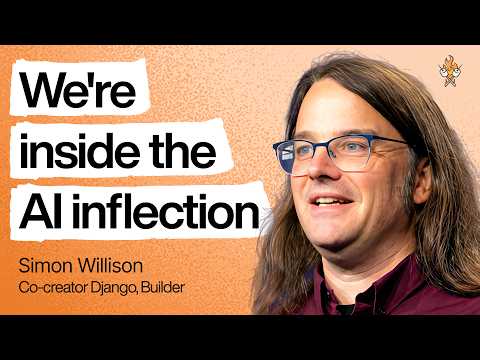
An AI state of the union: We’ve passed the inflection point & dark factories are coming
 Watch on YouTube →
Overview
Simon Willis explains how the November 2024 inflection point—when GPT‑5.1 and Claude Opus 4.5 became reliably productive coding agents—has triggered a shift from manual coding to AI‑driven "vibe coding" and "agentic engineering." He details emerging practices like dark‑factory software production, AI‑only QA swarms, and the economic impact on engineers at different seniority levels, while warning of burnout and the need for responsible use.
Key takeaways
- The November 2024 release of GPT‑5.1 and Claude Opus 4.5 marked the first point where coding agents reliably produce functional software without constant human correction.
- StrongDM’s “dark factory” prototype demonstrates that AI‑only QA swarms can test access‑management software 24/7 at a cost of roughly $10 k per day in token usage.
- Mid‑career engineers risk becoming the weakest link in AI adoption unless they develop deep prompt‑engineering skills, while interns benefit most from rapid AI‑driven onboarding.
- Despite AI generating up to 95% of code, human burnout is rising because managing multiple parallel agents demands intense cognitive supervision.
- Data‑labeling companies are paying premiums for pre‑2022 open‑source code, treating it as “artisan” training data free of AI‑induced bias.
Chapters
0:00
Opening: AI‑augmented coding productivity surge
- Developers report generating up to 10,000 lines of code per day with agents
- 95% of Lenny's own code now typed on a phone via AI assistance
- Early 2024 hype vs. actual workflow changes
2:00
The Challenger Disaster analogy for AI safety
- Simon compares repeated O‑ring failures to over‑reliance on unsafe AI systems
- Predicts a systemic AI failure unless safety practices improve
4:00
Background on the November 2024 inflection point
- Anthropic released Claude Code (Feb 2025) and OpenAI focused on code‑centric training
- Reasoning models (e.g., GPT‑4’s “thinking” mode) proved crucial for bug‑finding
- GPT‑5.1 and Claude Opus 4.5 crossed the reliability threshold
6:00
From buggy outputs to reliable code generation
- Agents now produce functional Mac apps with minimal back‑and‑forth
- Software engineers can spin up four parallel agents and exhaust themselves by 11 am
8:00
Vibe coding vs. agentic engineering terminology
- Vibe coding: non‑programmers describe functionality and receive a working prototype
- Agentic engineering: professional use of agents for full development lifecycle (write, test, debug)
- Simon prefers “agentic engineering” to avoid devaluing prototype work
10:00
Dark‑factory software production concept
- Analogy to fully automated factories that run “in the dark” without human oversight
- StrongDM’s experiment: AI agents write code, simulate Slack/Jira APIs, and run a 24/7 QA swarm
- Cost of simulation: ~$10,000 per day in token usage
12:00
AI‑only QA and security testing pipelines
- Swarm of simulated employees generates endless access‑request scenarios
- Anthropic and OpenAI maintain invite‑only security models that discover real vulnerabilities (e.g., 100+ bugs in Firefox)
- Distinguishing high‑quality AI‑generated vulnerability reports from noise
14:00
Bottlenecks shift from coding to ideation and validation
- Prototyping three UI concepts now takes minutes with Claude or GPT‑4
- Human effort moves to evaluating, user testing, and strategic decisions
- Traditional usability testing still beats AI‑simulated clicks
16:00
Impact on seniority: who benefits most?
- Experienced engineers amplify skills; interns accelerate onboarding (e.g., Cloudflare, Shopify hiring 1,000 interns in 2025)
- Mid‑career engineers risk being “middle‑level” bottleneck without strong AI fluency
- ThoughtWorks identified this group as most vulnerable
18:00
Managing burnout and the paradox of hyper‑productivity
- Simon admits mental exhaustion after running multiple agents in parallel
- Companies must guard against expectations of 5× output to avoid attrition
- Novelty effect may wear off, but current workload spikes are real
20:00
Side‑project explosion and the “backlog vacuum”
- AI enables finishing long‑standing personal projects in evenings
- Leads to a sense of loss when the backlog disappears and new ideas are needed
22:00
Handcrafted vs. AI‑generated code quality signals
- Rapidly built libraries lack the “alpha‑tested” credibility of traditional releases
- Proposal for a “proof of usage” metric to replace test‑coverage as quality indicator
24:00
Economic incentives for human‑written code
- Data‑labeling firms paying premiums for pre‑2022 open‑source repos as “artisan” code
- Analogy to pre‑nuclear metal: clean, untainted training data
26:00
Forecast: AI writing the majority of code
- Simon predicts 95% of an engineer’s code could be AI‑generated by year‑end 2024
- Cultural variance: European engineers more skeptical than U.S. peers
- Misconception that AI tools are “just chatbots” hindering adoption
28:00
Job market paradox: high demand despite automation
- Tech hiring remains strong; record number of open engineering and PM roles in 2024‑25
- Layoffs (e.g., Block’s 4,000 cuts) coexist with AI‑driven productivity gains
30:00
Strategic advice for mid‑career engineers
- Lean into AI to expand personal agency, not to replace it
- Use AI to learn new domains (e.g., AppleScript, cooking recipes) by lowering learning curves
- Maintain ambition while guarding against over‑extension
32:00
Human agency vs. AI agency debate
- Simon argues AI lacks intrinsic motivation; humans must retain decision‑making authority
- Invest in personal agency to direct AI tools toward meaningful outcomes
34:00
Future of software craftsmanship
- Artisan‑style, manually reviewed code may become a premium niche
- Potential emergence of “proof of usage” certifications for AI‑generated libraries
36:00
Closing reflections on ambition and AI
- Lenny’s New Year resolution: take on more, not fewer, projects using AI
- Both hosts find the current AI boom exhilarating yet uncertain
Summary, takeaways, and chapters were generated by AI from the video's transcript and may contain errors. The video belongs to its creator, Lenny's Podcast.