Almost No One Realizes This About AI Data Centers
 Watch on YouTube →
Overview
Economics Explained argues that while Ohio is attracting significant AI data center investment, this boom may not translate to widespread prosperity due to low job creation and substantial tax breaks. The state's historical industrial decline has made it attractive for data centers needing power, location, and land, but the economic benefits are disproportionately skewed towards tech companies, leaving local communities and electricity consumers to bear increased costs for grid upgrades and energy generation.
Key takeaways
- Ohio's appeal for data centers stems from its PJM grid access, central US location for low latency, and abundant cheap land, not its historical industrial base.
- A single hyperscale data center can consume as much electricity as 80,000 homes, necessitating significant grid infrastructure investment.
- The tax revenue generated by data centers is vastly outweighed by the tax breaks and incentives provided, estimated at $195,000 per job created.
- Data centers contribute to increased electricity costs for all consumers in the region due to capacity auction mechanisms and the need for grid upgrades.
- Ohio's reliance on fossil fuels, including subsidies for money-losing coal plants, is exacerbated by the energy demands of data centers.
- Local communities in Ohio are pushing back against data center development through moratoriums, questioning the trade-off between investment and prosperity.
Chapters
0:00
Ohio's Industrial Past and AI Present
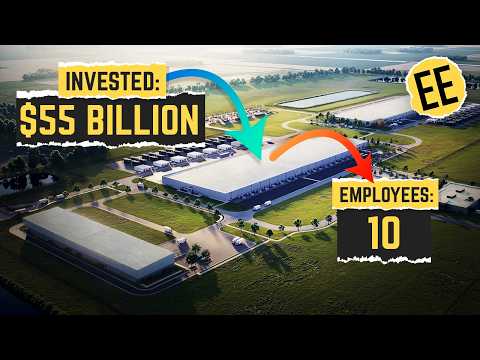
- Ohio, once an industrial powerhouse, is now a hub for AI data centers with over $55 billion invested by companies like Amazon, Google, and Meta.
- This shift has led to a 53% increase in average electricity bills since 2021 and a fraction of the jobs compared to former manufacturing roles.
- Billions in tax breaks were granted to attract these facilities, impacting funding for schools and local services.
5:19
The Criteria for Data Center Location
- Data centers require massive, continuous power (100 MW+), making locations within large grids like PJM and with cheaper industrial electricity attractive.
- Proximity to major population centers (47% of US within 10 hours of Columbus) minimizes latency, crucial for digital services.
- Abundant cheap land and existing fiber optic infrastructure, often remnants of deindustrialization, are key factors.
11:46
Economic Disparities: Manufacturing vs. Data Centers
- Manufacturing created thousands of direct and indirect jobs, fostering a broad tax base through worker income and corporate taxes.
- Data centers, by contrast, employ a minimal number of people (e.g., 10 jobs for a $136 million facility) and generate significantly less income tax revenue.
- While construction jobs are temporary, the long-term economic contribution of data centers is dwarfed by that of traditional factories.
16:51
Hidden Costs and Tax Giveaways
- Data centers drive up electricity costs for all consumers by requiring grid upgrades and new generation capacity, with PJM capacity auction prices spiking significantly.
- Ohio granted billions in tax exemptions, including a 5.75% sales tax waiver and 15-year property tax abatements, costing $2.3 billion over 40 years.
- Local communities are increasingly imposing moratoriums on new data center construction due to the disproportionate costs and minimal local benefits.
Summary, takeaways, and chapters were generated by AI from the video's transcript and may contain errors. The video belongs to its creator, Economics Explained.