Allele Terms, BIO105 Introductory Biology, David Champlin, USM
 Watch on YouTube →
Overview
David Champlin defines alleles as versions of a gene and explains how DNA mutations can change gene activity, from reduced function to a null allele with zero activity or a gain of function above the wild-type level. He connects genetic variation to evolution as changing allele frequencies in populations, then compares homozygous and heterozygous genotypes and explains dominant–recessive, incomplete-dominance, and codominance patterns.
Key takeaways
- An allele is a version of a gene, and differences between inherited alleles can alter a protein’s sequence, structure, or function.
- Wild-type activity is used as a typical 100% reference; a null allele causes complete loss of function at 0%.
- Mutations can affect coding regions, changing a protein, or promoters, changing when, where, and how much of a gene is made.
- Evolution is a change in allele frequencies in a population over time, and advantageous alleles may increase in frequency.
- A heterozygous genotype can produce complete dominance, an intermediate phenotype through incomplete dominance, or simultaneous expression through codominance.
- ABO blood types are a standard example of codominant alleles, while red and white flowers producing pink offspring illustrate incomplete dominance.
Chapters
0:00
Mutations Create Alleles with Different Levels of Gene Function
- People inherit two copies of a gene, one from each parent; their LDL receptor alleles may differ in nucleotide sequence.
- A DNA sequence change within a gene is a mutation that can produce a new allele and affect phenotype.
- Wild type represents typical activity, described as 100%; a loss-of-function allele reduces activity, while a null allele reduces it to zero.
- Mutations can affect protein-coding regions or promoters, which influence when, where, and how much of a gene is expressed.
6:00
Homozygous and Heterozygous Genotypes Shape Phenotypes
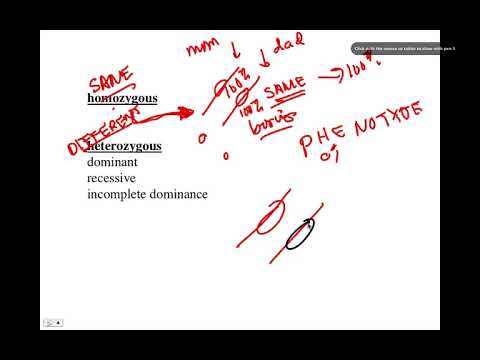
- Homozygous means the two alleles for a gene are effectively the same; heterozygous means they differ.
- Champlin illustrates gene activity with a 50%-activity allele and a 100%-activity allele, yielding a 75% average in a heterozygote.
- The phenotype of a heterozygote cannot always be predicted from activity averages alone; the relationship between alleles must be determined.
8:00
Three Heterozygous Expression Patterns: Dominance, Blending, and Codominance
- In complete dominance, one allele’s phenotype masks the other; the expressed allele is dominant and the masked one recessive.
- Incomplete dominance produces an intermediate phenotype, illustrated by red and white flowers producing pink offspring.
- Codominance expresses both alleles distinctly, illustrated with red-and-white polka-dot flowers and human ABO blood types.
- Champlin links evolutionary change to shifts in allele frequencies over time; either gain-of-function or loss-of-function alleles can sometimes provide an advantage.
Summary, takeaways, and chapters were generated by AI from the video's transcript and may contain errors. The video belongs to its creator, The New Evolution for Everyone.