AI is solving science's biggest problems — but has no idea why it's right | with Claire Malone
 Watch on YouTube →
Overview
Claire Malone explores how AI, particularly generative AI, is transforming scientific research by accelerating data analysis and simulation, exemplified by AlphaFold's protein structure prediction and CERN's faster detector simulations. However, she cautions that AI's pattern recognition, while powerful, lacks human understanding of causality and scientific judgment, raising questions about trust and the definition of scientific discovery itself. The future may involve AI as a collaborator, but human oversight remains crucial for true understanding and fundamental breakthroughs.
Key takeaways
- Claire Malone highlights that AI, exemplified by AlphaFold and CERN's simulations, significantly accelerates scientific discovery by processing vast datasets and generating realistic models faster than humans.
- Generative AI models like transformers, using mechanisms like self-attention, predict the next element (word, pixel, particle shower) based on statistical patterns, not causal understanding.
- While AI can automate scientific tasks and even guide experiments (e.g., Argonne's AI adviser for materials discovery), it currently lacks the scientific judgment, intuition, and causal reasoning for fundamental, 'from scratch' discoveries.
- The Nobel Turing Challenge envisions an AI scientist capable of Nobel-worthy discoveries by 2050, but current systems face a 'creativity gap' and operate on correlation rather than causation.
- The core tension is whether science is about finding patterns that work (AI's strength) or understanding why they work (human scientists' domain).
- AI should be treated as a powerful tool to augment human scientific inquiry, not an oracle that bypasses the need for understanding, skepticism, and validation.
Chapters
0:00
Introduction: AI's Role in Science and Defining Science
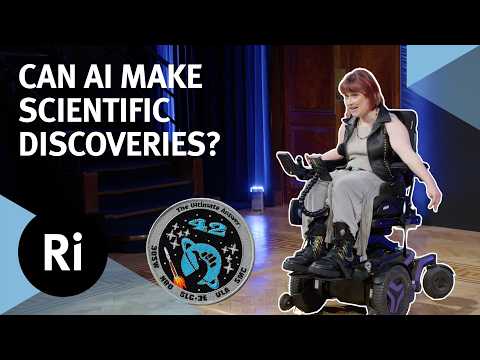
- Introduced the concept of AI solving problems without understanding 'why' through 'The Hitchhiker's Guide to the Galaxy' analogy (Deep Thought and the answer 42).
- Claire Malone's background in particle physics and witnessing AI's impact at CERN.
- Defined science as a process of agreement on principles, evidence, and convergence on conclusions, referencing logical positivism (Vienna Circle) and falsification (Karl Popper).
8:00
Defining Artificial Intelligence and Machine Learning
- AI performs tasks requiring human cognitive abilities: pattern recognition, problem-solving, decision-making, learning.
- Machine learning allows systems to learn from data without explicit programming, identifying patterns and improving performance.
- Distinguished between supervised learning (data with correct answers) and unsupervised learning (data without answers, for pattern discovery).
13:26
Deep Learning and Generative AI Explained
- Deep learning uses artificial neural networks inspired by the brain, processing data through layers to create abstract representations.
- Generative AI models learn the underlying structure of data to create new, similar examples (e.g., writing stories, generating images).
- The core idea is prediction, but used creatively, like predicting the next pixel or word.
26:44
The Transformer Architecture and Attention Mechanism
- Claude Shannon's early work on predicting the next word in language models.
- The 2017 'Attention Is All You Need' paper introduced the transformer architecture, overcoming sequential processing limitations.
- Self-attention allows models to weigh the relevance of all words in a sentence simultaneously, capturing long-range dependencies.
30:45
How Transformer Models Generate Text
- Transformer models have an encoder (understanding input meaning and context) and a decoder (generating new text).
- The encoder uses attention to grasp word relationships across long distances.
- The decoder predicts words sequentially based on the encoder's understanding and previously generated words.
33:45
AI Prediction vs. Human Understanding in Science
- Language models predict the next word/pixel/frame based on statistical probabilities, not semantic understanding.
- AI operates by predicting patterns at scale and speed, without human-like intention or questioning.
- This raises questions about whether AI accelerates existing methods or redefines scientific understanding.
40:03
AI's Impact on Scientific Data Analysis: AlphaFold and CERN
- Physics and AI are interconnected; AI excels at finding patterns in vast, unstructured data sets.
- AlphaFold (2021) demonstrated AI's power by accurately predicting protein 3D structures, solving a long-standing biological challenge.
- At CERN, AI acts as a filter for rare particle signals and is used to simulate detector responses (e.g., ColoClouds 2 using diffusion models) for faster analysis.
Summary, takeaways, and chapters were generated by AI from the video's transcript and may contain errors. The video belongs to its creator, The Royal Institution.