ACCT 417 (Fall 2026) - Chapter 18 Lecture
 Watch on YouTube →
Overview
Michael Barnes explains the PCAOB standard unqualified audit report and how auditors modify it for other opinions, emphasizing the report’s eight elements, critical audit matters (CAMs), and precise wording changes. He also covers materiality and pervasiveness, comparative statements, other information in annual reports, and special-purpose reporting, highlighting report-error analysis as a major Exam 2 focus.
Key takeaways
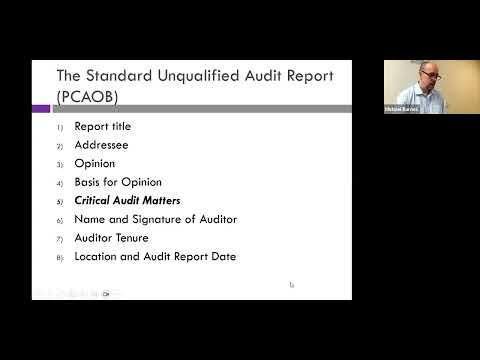
- The PCAOB standard unqualified report has eight elements: title, addressee, opinion, basis for opinion, CAMs, auditor name and signature, tenure, and location and date.
- A critical audit matter must satisfy three criteria: it arises from the audit and is communicated or required to be communicated to the audit committee, relates to a material financial-statement item, and involves complex or subjective auditor judgment.
- Qualified opinions use “except for” and require an explanatory paragraph; a scope-limitation qualification also requires “except as discussed above” in the scope paragraph.
- Adverse opinions say the financial statements do not present fairly; disclaimers say the auditor was engaged but could not audit, remove the scope paragraph, and omit CAMs.
- Pervasiveness depends on whether a misstatement extends beyond specific elements, affects a substantial portion of the statements, or is fundamental to users’ understanding; inventory errors can be pervasive for a retailer such as EarthWear Clothes.
- Auditors must read other information in documents such as annual reports and assess consistency with audited statements, even though they do not audit every item in those documents.
Chapters
0:00
Course Schedule, Exam 2 Preparation, and Assignment Deadlines
- There is no class Friday or Monday; Chapter 21 is scheduled for Wednesday, followed by homework the next Friday.
- Exam 2 is about two weeks away, and Barnes urges students to review the study guide and complete the practice exam early.
- The Excel assignment is due November 6 and requires steady work over several weeks; professional interactions are due the following week.
- Semester groups should coordinate presentation topics and choose between the final Wednesday and Friday, with two groups presenting each day.
4:33
The Eight Elements of a PCAOB Unqualified Audit Report
- The eight elements are the report title, addressee, opinion, basis for opinion, CAM section, auditor name and signature, auditor tenure, and report location and date.
- PCAOB reports use “unqualified”; the AICPA equivalent term is “unmodified,” which Barnes says is not the report type covered in this lecture.
- The basis-for-opinion section includes management responsibility, auditor responsibility, and a scope paragraph describing the audit work.
- Barnes says the Exam 2 report-error question will test students’ knowledge of the standard format and its details.
9:30
Reading the EarthWear Clothes Report and Comparative Statements
- The EarthWear Clothes example places the opinion near the beginning and says whether the statements present fairly in all material respects in conformity with GAAP.
- Comparative public-company statements commonly show two years of balance-sheet information and three years of income-statement and cash-flow information.
- The sample includes an explanatory paragraph about internal control over financial reporting (ICFR), generally included in public-company PCAOB reports.
- The report identifies the auditor’s tenure as serving EarthWear since 1975 and gives Boise, Idaho, and February 15, 2026, as the location and report date.
13:54
The Three Criteria for Critical Audit Matters
- A CAM must arise from the audit and be communicated, or required to be communicated, to the audit committee.
- It must relate to an item material to the financial statements and involve complex or subjective auditor judgment.
- Barnes stresses that these are three separate criteria, not two; CAM disclosures explain significant audit issues and the auditor’s response.
15:38
Explanatory Language: Other Auditors, Going Concern, and Comparability
- Modified wording is used when the primary auditor’s opinion is based partly on another auditor’s work and the primary auditor does not assume responsibility for that work.
- That treatment changes the opinion and basis-for-opinion wording and adds a PCAOB explanatory paragraph; if the primary auditor accepts responsibility, no such modification is needed.
- Explanatory paragraphs can address an integrated ICFR audit, substantial doubt about going concern, or lack of consistency, including changes in accounting principle, reporting entity, or corrections of prior-period misstatements.
- A change in estimate is prospective but may warrant an explanatory paragraph if it meaningfully affects comparability; substantial related-party transactions may also receive added emphasis.
24:18
Qualified Opinions for GAAP Departures and Scope Limitations
- A qualified opinion for a material GAAP departure uses the phrase “except for” and explains the departure in a paragraph immediately after the opinion.
- A qualified opinion caused by a scope limitation also uses “except for,” but describes the audit evidence the auditor could not obtain.
- For a scope limitation, the scope paragraph must acknowledge the limitation with the wording “except as discussed above.”
- The opinion and explanatory paragraph are the principal changes in both qualified-report examples; most other report elements remain unchanged.
29:41
Adverse and Disclaimer Opinions: What Changes in the Report
- An adverse opinion states that the financial statements do not present fairly in conformity with GAAP, and an explanatory paragraph follows the opinion to describe the problem.
- Both adverse and disclaimer reports omit the CAM section, because the fundamental reporting issue takes precedence over separate CAM disclosures.
- A disclaimer means the auditor cannot express an opinion; the report changes “we have audited” to “we were engaged to audit” and labels the section “Basis for Disclaimer of Opinion.”
- A disclaimer also removes the statement that the auditor’s responsibility is to express an opinion and eliminates the scope paragraph because the auditor could not complete the audit.
35:39
Pervasiveness, Comparative Opinions, and Other Annual-Report Information
- Materiality affects the choice of opinion; pervasiveness means misstatements are not confined to particular elements, affect a substantial portion of the statements, or are fundamental to users’ understanding.
- For EarthWear Clothes, an inventory misstatement could be pervasive because inventory is central to the retail business, even if the error is confined to one account.
- Comparative reports must disclose different opinions for different periods and use explanatory language when prior-period reports change, such as after a restatement.
- A successor auditor needs predecessor-auditor cooperation, including access to statements and a representation letter; auditors must also read annual reports and check that other information is consistent with audited statements.
42:08
Special-Purpose Frameworks, Specific-Element Audits, and Assurance Levels
- Special-purpose frameworks include regulatory, tax, cash, modified-cash, and contractual bases of accounting rather than GAAP.
- Auditors may be engaged to audit only a balance sheet, individual accounts, or specified elements, or to perform agreed-upon procedures.
- Compliance engagements assess whether an entity follows contractual or regulatory requirements; Barnes defers a fuller explanation of agreed-upon procedures to Chapter 21.
- Reasonable assurance is positive assurance used for financial-statement audits, while limited or negative assurance conveys that the auditor did not find problems rather than affirming that everything is correct.
Summary, takeaways, and chapters were generated by AI from the video's transcript and may contain errors. The video belongs to its creator, Michael Barnes.