Acceleration and Velocity with Resistance (Differential Equations 39)
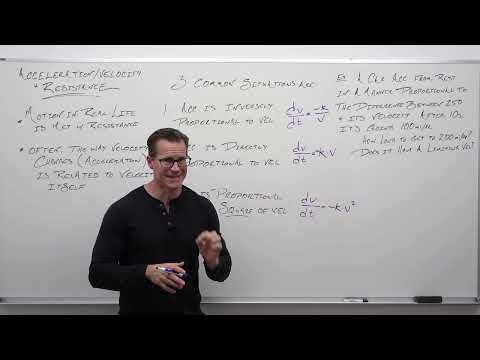 Watch on YouTube →
Overview
Professor Leonard explains how differential equations model motion with resistance, moving beyond basic calculus. He introduces three common resistance models: acceleration inversely proportional to velocity, directly proportional to velocity, and proportional to the square of velocity. Using a car acceleration example, he demonstrates solving the differential equation for acceleration proportional to the difference between a terminal velocity (250 mph) and current velocity, calculating time to reach 200 mph (31.5 seconds) and the limiting velocity (250 mph). He then contrasts the behavior of inverse and direct proportionality, showing that inverse proportionality leads to a definitive stop (velocity equals zero), while direct proportionality leads to an asymptotic approach to zero velocity and a limiting position.
Key takeaways
- Differential equations are essential for modeling real-world motion where resistance (e.g., wind, water) affects acceleration and velocity.
- Three common resistance models are: acceleration proportional to 1/V, V, or V^2, each leading to distinct motion behaviors.
- Inverse proportionality (dv/dt = K/V) results in the object definitively stopping (velocity = 0) at a specific time.
- Direct proportionality (dv/dt = KV) leads to velocity asymptotically approaching zero and position approaching a limiting value.
- Proportionality to V^2 (dv/dt = KV^2) results in position continuing to increase indefinitely, albeit slowly.
- In direct proportionality, a 'threshold velocity' is often used to define a practical stopping point when velocity asymptotically approaches zero.
Chapters
- Differential equations extend basic calculus models of motion by incorporating real-world variables like resistance.
- Resistance affects acceleration and velocity, unlike simpler models that ignore external forces.
- The complexity of the differential equation increases with more variables, but resistance is a manageable addition.
- Riding a bicycle faster increases wind resistance, making it harder to accelerate further.
- This resistance is a force that opposes motion and is often related to velocity.
- Professor Leonard will explore how this resistance impacts acceleration, velocity, and position.
- Acceleration can be inversely proportional to velocity (e.g., K/V).
- Acceleration can be directly proportional to velocity (e.g., KV).
- Acceleration can be proportional to the square of velocity (e.g., KV^2).
- Sets up the differential equation: dv/dt = -K/V.
- Explains inverse proportionality using the fraction K/V.
- Introduces the concept of a constant of variation, K.
- Sets up the differential equation: dv/dt = KV.
- Explains direct proportionality as a product KV.
- Notes that a negative K is often used to represent deceleration due to resistance.
- Sets up the differential equation: dv/dt = KV^2.
- Highlights that this model can lead to complex integrals, discussed in a future video.
- This model is common for higher velocities where resistance increases significantly.
- Scenario: A car accelerates from rest, with acceleration proportional to (250 - velocity).
- Initial conditions: v(0) = 0, v(10) = 100 mph.
- Goal: Find time to reach 200 mph and determine if there's a limiting velocity.
- The differential equation is dv/dt = -K(250 - V).
- Identifies 'acceleration' as dv/dt.
- Uses a negative constant K to represent resistance opposing acceleration.
- Separates variables: 1/(250 - V) dV = -K dt.
- Integrates both sides: ln|250 - V| = -Kt + C1.
- Exponentiates to solve for V, yielding 250 - V = C * e^(-Kt).
- Uses v(0) = 0 to find C = 250.
- Equation becomes 250 - V = 250 * e^(-Kt).
- Uses v(10) = 100 to solve for K, yielding K ≈ 0.0511.
- Final velocity function: 250 - V = 250 * e^(-0.0511t).
- Solves for time to reach 200 mph by plugging V=200 into the equation.
- Calculates time to reach 200 mph as approximately 31.5 seconds.
- Analyzes the velocity function as t approaches infinity.
- As t -> ∞, e^(-0.0511t) -> 0.
- The velocity approaches 250 mph, which is the limiting velocity.
- Sets up and solves dv/dt = K/V, leading to V^2/2 = Kt + C.
- Shows that V^2/2 = Kt + C implies the velocity will eventually reach zero.
- Concludes that inverse proportionality results in the object stopping (velocity = 0).
- Sets up and solves dv/dt = KV, leading to V = C * e^(Kt).
- Integrates velocity to find the position function: X(t) = (C/K) * e^(Kt) + C2.
- Shows that as t -> ∞, velocity approaches 0, and position approaches a constant (limiting position).
- Sets up and solves dv/dt = KV^2, leading to -1/V = Kt + C.
- Derives the velocity function V(t) = V0 / (1 + V0Kt).
- Integrates velocity to find the position function, showing position approaches infinity (does not stop).
- Scenario: Boat drifts with acceleration proportional to velocity (dv/dt = KV).
- Initial conditions: v(0) = 16 m/s, v(2) = 12 m/s.
- Calculates velocity function V(t) = 16 * e^(-0.1438t).
- Determines limiting position is ~111.26m; boat avoids 50m sandbar.
Summary, takeaways, and chapters were generated by AI from the video's transcript and may contain errors. The video belongs to its creator, Professor Leonard.