The Neuroscience of Addictive Storytelling (And How to Master It)
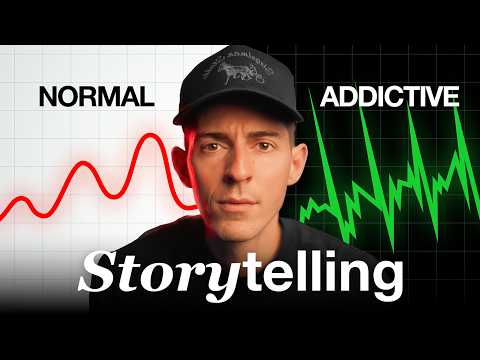 Watch on YouTube →
Overview
Kallaway argues that addictive storytelling is predictable because dopamine tracks prediction (anticipation/uncertainty) rather than “pleasure,” and that the same casino neuroscience can be applied to content. He provides a four-step addiction loop—stakes, big question, head fake (prediction error spike), and rehook (new unresolved question before the last ends)—and demonstrates the loop by retelling a simple prince-and-dragon plot with increasing engagement and then extracting tactical rules for writing hooks in YouTube videos, shorts, emails, tweets, and sales calls.
Key takeaways
- Dopamine functions primarily as a prediction/anticipation signal: it rises when the brain is trying to forecast what happens next, not when the reward is received.
- Story engagement can be engineered with uncertainty: slot-machine-style ambiguity drives continuous prediction updates, while vending-machine predictability yields little dopamine variation.
- The four-step loop that powers addictive storytelling is stakes (activate predictions) → big question (sustained dopamine drip) → head fake (prediction error dopamine spike) → rehook (new unresolved question without a gap).
- The dopamine “spike” of a head fake scales with how surprising the outcome is relative to the initial prediction; a random surprise that doesn’t connect to prior setup produces confusion instead of an “aha.”
- A practical rehook rule is timing-based: open the next loop the moment the head fake lands (when the viewer is still processing the result) to minimize attention drop-off.
- Effective stakes don’t require life-and-death danger; they require a relatable character, a defined consequence if things fail, and a measurable urgency window (e.g., “within 2 hours” or “by end of week”).
Chapters
0:00
Dopamine as Prediction: Casino Uncertainty vs Vending Certainty
- Kallaway reframes dopamine as a prediction/anticipation chemical: it fires when the brain tries to predict what happens next, not at reward moments.
- Casino example: after the dealer flips a visible card, blackjack tension comes from unresolved “hit vs stay” predictions—felt as anticipation.
- Uncertainty comparison: slot machines are more addictive than vending machines because reels create continuous prediction updates, while vending results repeat exactly.
4:00
The Four-Step Addiction Loop: Stakes → Big Question → Head Fake → Rehook
- Step 1 (stakes): real context that makes the prediction machine start running—no stakes implies no predictions/no dopamine/no addiction.
- Step 2 (big question): load a concrete problem the brain wants to resolve (e.g., dealer shows a card; player calculates outcomes). This produces a sustained low-grade dopamine “drip.”
- Step 3 (head fake): break the initial expectation via prediction error; the surprise magnitude scales the dopamine spike (drip vs burst).
- Step 4 (rehook): close one loop and open the next immediately so attention never fully disengages; casino-like “time per hand” reduces gaps between dopamine hits.
8:20
Retelling the Same Story Two Ways: Flat ‘Vending Machine’ vs Looped ‘Addictive’ Narrative
- Flat version compresses the prince/kingdom/dragon/flower plot into a quick summary with no stakes, no sustained big question, and no rehook—described as “autopilot.”
- Loop version adds: stakes (plague, ticking clock, family at risk), big question (how will the prince get past the dragon), and head fake (dragon is chained/“prisoner,” enabling rescue).
- Rehook example: when the prince reaches the tower and finds the king, a new question opens before the prior one closes, deepening investment.
- Kallaway generalizes beyond fairy tales to business/client stories (e.g., moving attention by keeping unresolved predictions active).
13:10
Tactical Playbook for Content: Stakes, Big Question, Head Fake, Rehook (Universal Formats)
- Stakes tactic: ensure viewer can root for a character (client or “you”), define something at risk (consequence), and add urgency (e.g., “within 48 hours” vs “eventually”). Also emphasize stakes need not be life/death—just personally relevant.
- Big question tactic: avoid vague teasers (“crazy happened” / “you won’t believe”); add enough specific context for the viewer to make a guess, so the later head fake has contrast.
- Head fake tactic: contrast what a normal viewer would predict with a reveal that makes logical sense immediately—contrast framework like a magician’s staged misdirection (“hat looks empty,” then rabbit appears).
- Rehook tactic: place a new question right when one loop resolves; use fast connective phrases (e.g., “which would have been amazing except…,” “that’s when I realized…”) to prevent dead air and maintain momentum across YouTube videos, shorts, emails, tweets, and sales calls.
Summary, takeaways, and chapters were generated by AI from the video's transcript and may contain errors. The video belongs to its creator, Kallaway.