8. The Sumerians - Fall of the First Cities
 Watch on YouTube →
Overview
Paul Cooper traces Sumerian civilization from early farming settlements in southern Mesopotamia to the rise and fall of Ur, showing how irrigation, cuneiform, mathematics, mass production, and long-distance trade enabled the first great cities. He argues that the final collapse of the Sumerian state around 2000 BC resulted from compounding pressures—including prolonged drought, salt-damaged farmland, political fragmentation, and invasions by the Martu and Elamites—while Sumerian language and ideas endured in later Mesopotamian cultures.
Key takeaways
- Sumerian cities depended on large-scale water management: canals and dams expanded farmland but required coordinated labor, engineering, and administration.
- Cuneiform began as clay-based accounting in Uruk and grew into a durable medium for recording laws, literature, trade, music, and historical memory.
- Sumerian agriculture faced cumulative environmental pressure: irrigation salt reduced wheat production, while the 4.2 kiloyear climate event brought prolonged drought.
- Political division and external attacks magnified environmental hardship: the Gutians helped destroy Akkad, and later Martu incursions and Elamite forces contributed to Ur’s fall.
- Sumerian political power and spoken language faded, but Sumerian writing, religious learning, and royal titles shaped Mesopotamian cultures for centuries.
Chapters
0:00
Pietro della Valle Finds the Ruins of Ur
- In 1625, Italian traveler Pietro della Valle sheltered with his wife and guides among monumental ruins in southern Iraq.
- He noticed stamped bricks joined with bitumen and copied recurring symbols, including a pyramid-like mark and an eight-pointed star.
- Della Valle carried clay tablets from Ur to Europe, among the first examples there of a language forgotten for thousands of years.
6:56
The Taurus Mountains, Tigris, Euphrates, and Fertile Silt
- Rain and snowmelt from the Taurus and Armenian highlands feed the Tigris and Euphrates, which flow across the plains of Iraq.
- The rivers carry quartz- and feldspar-rich silt from mountain rocks; this fine material helps soil retain water and supports crops.
- Southern Mesopotamia’s fertility depended on river-borne silt despite its hot, arid climate and scarce stone and metal.
12:12
Ubaid Farmers Move into Southern Iraq
- Early farmers settled in permanent villages, storing grain, shaping clay pots, and dividing agricultural work.
- From about 6500 BC, communities associated with the Ubaid Period gradually moved down the rivers from wetter foothills into southern Iraq.
- The Tigris and Euphrates brought unpredictable floods: drought years could be followed by destructive inundation.
16:28
Canals, Date Palms, and the Southern Marshes
- Ubaid farmers cultivated date palms and used their shade to protect more delicate crops from the Iraqi sun.
- Digging canals let farmers carry river water inland to fields of wheat, millet, sesame, fruit, and vegetables.
- At the rivers’ southern delta, reed marshes supplied building materials and supported wildlife; major Sumerian cities later grew in this region.
19:03
Sumerian Origins and the Flooded Persian Gulf
- Sumerian is a language isolate, unlike Akkadian, which belongs to the Semitic language family; its unfamiliarity prompted debate about Sumerian origins.
- One proposed theory connects Sumerian migration with the post-Ice Age flooding of a fertile river valley in the Persian Gulf.
- The flood traditions, the Oannes fish-man legend, and the identification of Dilmun with Bahrain are suggestive, but Cooper emphasizes that the migration theory remains speculation.
30:12
Sumerian Identity, Technology, and Base-60 Mathematics
- Sumerians called themselves ùĝ saĝ gíg ga, or “black-headed people”; Akkadians used a phrase with the same meaning.
- With little local stone or timber, Sumerians built with mudbrick and reeds and developed the pottery wheel, wagon wheel, plow, and sailboat.
- Their base-60 mathematics shaped the 60 minutes in an hour and 360 degrees in a circle; Sumerian texts also preserve calculations and multiplication tables.
37:45
Irrigation Builds Early States and the City of Eridu
- Canals, dams, reservoirs, and gates required engineering, labor coordination, food payments, and overseers—systems that helped create early bureaucracy.
- Historian Arnold Toynbee argued that southern Iraq’s difficult but manageable environment stimulated social organization and technical innovation.
- Eridu, founded around 5400 BC, may have been the region’s first city; early city-states were centered on temples and ruled by priest-kings called ensi.
42:21
Early City-States, Inanna’s Gifts, and Enslaved Labor
- Many early Sumerian cities had fewer than 10,000 residents, lacked defensive walls, and marked territories with canals and boundary stones.
- The myth “The Gifts of Inanna” lists crafts such as carpentry, metalworking, scribal work, and building, alongside warfare and plundering.
- Sumerian city growth included the capture and enslavement of people from hill communities, an early social cost of urban expansion.
45:07
Cuneiform Turns Clay Tablets into Written Records
- The earliest surviving cuneiform tablets come from Uruk and date to around the 32nd or 31st centuries BC.
- Scribes pressed cut reeds into clay to record goods and rations; early pictographs could show, for example, food bowls and counted grain sheaves.
- As record-keeping expanded, signs became more abstract and fewer in number, while sound-based signs helped create a specialized class of scribes.
50:15
Uruk’s Fast Wheel and the First Mass Production
- In the Uruk Period, the fast pottery wheel enabled workshops to produce far more vessels than the earlier slow wheel.
- Administrative records describe 15,000 women employed in Girsu’s textile industry and a flour factory producing about 1,100 tons annually.
- Workers were paid in goods rather than currency; an unskilled worker’s monthly ration included 20 liters of barley, with oil and wool allowances.
53:21
Uruk: The World’s Largest City and Everyday Life
- Around 3500 BC, Uruk had roughly 50,000 inhabitants and covered about 2.5 square kilometers, making it the largest city yet known.
- Its White Temple stood about 21 meters high, while houses, workshops, markets, and reed-shaded alleys filled the city around it.
- Residents brewed more than 30 varieties of beer; cuneiform proverbs preserve complaints about poverty, work, and social insults.
1:02:12
Ur’s Trade Networks and the Standard of Ur
- Ur’s position near the Euphrates and Persian Gulf made it a major port for fishing and trade in the region’s agricultural surplus.
- Sumerian trade brought copper from Iran and Cyprus, silver from the Taurus Mountains, cedar from Lebanon, and lapis lazuli from Indus-linked routes.
- The Standard of Ur, inlaid with shell, red limestone, and lapis lazuli, depicts both warfare and peaceful labor, including farmers, soldiers, and scribes.
1:07:27
Lagash and the Brutality of the Sumerian City Wars
- By about 2500 BC, Lagash and neighboring Umma fought over farmland along a river.
- The Stele of the Vultures depicts Lagash’s king Eannatum leading a phalanx; its inscription claims 3,600 Umma soldiers were killed.
- The monument’s images of vultures carrying severed heads capture the increasingly brutal character of inter-city warfare.
1:11:35
Lugalzagesi Topples Lagash and Expands Sumerian Rule
- After Lagash’s power weakened, Umma’s ruler Lugalzagesi rebelled, captured Ur and Uruk, and burned Lagash.
- Lugalzagesi claimed to rule lands between the Persian Gulf and the Mediterranean, though the inscription may exaggerate the reach of his campaigns.
- His empire, like Lagash’s, became overstretched and fractured amid civil wars and rebellion.
1:16:07
Sargon of Akkad Defeats Lugalzagesi
- Sargon, whose Akkadian name means “the one true king,” rose from a palace cupbearer at Kish to challenge Lugalzagesi’s empire.
- With a small force, he surprised Uruk, then defeated an army said to include as many as 50 subject kings.
- Sargon captured Lugalzagesi but spared him as a subordinate ruler, then established Akkad as his new imperial capital.
1:22:21
Sargon Centralizes the Akkadian Empire—and Fuels Resentment
- Sargon weakened conquered cities by demolishing their walls and strengthened central administration and the empire’s dating system.
- He promoted Akkadian in royal inscriptions, appointed Akkadians to key posts, and stationed Akkadian troops in Sumerian cities.
- These policies increased southern resentment; rebellions erupted late in Sargon’s 55-year reign and continued under his sons.
1:28:43
Naram-Sin, Language Shift, and the 4.2 Kiloyear Event
- Sargon’s grandson Naram-Sin restored imperial stability and adopted the broader title “King of Sumer and Akkad.”
- Akkadian gradually displaced Sumerian as the everyday language of trade and administration, partly because neighboring Semitic languages were more closely related to it.
- Around 2213 BC, the 4.2 kiloyear climate event brought prolonged aridity and reduced rainfall across the region, undermining agriculture.
1:37:25
Drought, Civil War, and the Gutian Invasion
- After Shar-Kali-Sharri died around 2193 BC, Akkad entered a period of civil war; the Sumerian King List says four rulers held power in three years.
- The Gutians, mountain raiders who had attacked the empire’s borders, invaded as drought, famine, and conflict weakened Akkadian defenses.
- The later literary work “The Curse of Akkad” portrays the Gutians as Enlil’s punishment, while also preserving memories of devastation.
1:40:10
Akkad Falls and Gutian Rule Fails to Maintain the Cities
- Gutian raids disrupted supply lines and intensified the crisis in a region where fields, orchards, and marsh fisheries were already failing.
- The Gutians destroyed the city of Akkad, whose exact location remains unknown, then struggled to administer the conquered territory.
- Neglect of agriculture, records, livestock management, roads, and canals deepened famine during more than 150 years of Gutian occupation.
1:45:38
Utu-Hengal’s Revolt Restores Sumerian Kingship
- When the Gutian king Tirigan had ruled for only about 40 days, Utu-Hengal of Uruk launched a prepared revolt.
- Utu-Hengal defeated Tirigan’s generals; Tirigan fled to Dabrum, where local residents helped Utu-Hengal’s envoy arrest him.
- The victory ended Gutian rule and began the Third Dynasty of Ur, also known as the Neo-Sumerian Empire or Sumerian Renaissance.
1:50:13
Ur-Nammu’s Law Code and the Ziggurat of Ur
- Ur-Nammu succeeded Utu-Hengal and standardized bronze weights and silver units, including the mina of 60 shekels.
- His surviving law code, about three centuries older than Hammurabi’s, specifies payments for injuries and for returning escaped slaves.
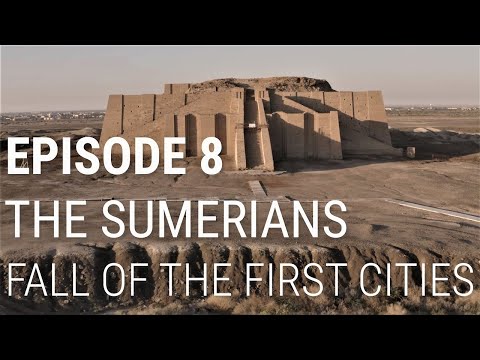
- Ur-Nammu rebuilt roads and irrigation works and raised Ur’s ziggurat, a baked-brick tower about 30 meters tall that required years of labor.
1:54:37
Irrigation Salinization Gradually Damages Sumerian Farmland
- In arid southern Iraq, irrigation water evaporated under the sun and left salts behind in the soil.
- Scribe records show wheat’s share of Girsu’s harvest fell from equal amounts with barley around 3550 BC to less than 2% by the 21st century BC.
- Sumerian farmers adapted by favoring salt-resistant barley and draining fields, but the cumulative damage reduced the land’s productivity.
2:00:44
Ur-Nammu Dies in the Mountains as Border Threats Grow
- Ur-Nammu died during a campaign against the Gutians, perhaps in an ambush; a poem mourned the king’s death far from Ur.
- Drought and declining harvests pushed nomadic groups, including the Martu from Syria and Lebanon, toward Sumerian farmland.
- King Shu-Sin ordered the Martu Wall, an earthwork defense stretching nearly 300 kilometers between the Tigris and Euphrates.
2:05:26
Ibbi-Sin Loses the Martu Wall and the Grain Supply
- Under the last Sumerian king, Ibbi-Sin, Eshnunna and Susa broke away, and the Martu breached the failing northern defenses.
- As grain prices rose to 60 times their usual level, Ibbi-Sin sent the general Ishbi-Erra to buy grain in Isin.
- Ishbi-Erra kept the grain, offered to defend Isin, and eventually declared himself king, further fragmenting the empire.
2:09:03
Elamite Forces Capture Ur and Ibbi-Sin
- After losing the surrounding cities, Ibbi-Sin attempted to recruit both the Martu and Ishbi-Erra to defend Ur, without success.
- Elamite forces breached Ur’s walls, looted its sacred precinct, burned the city, and captured Ibbi-Sin.
- The last Sumerian king was taken in chains to Elam; “The Lament for Ur” records the city’s devastation and the deaths of its people.
2:12:57
Sumerian Refugees and the End of Sumerian as a Spoken Language
- Drought, salt-damaged fields, and warfare drove large numbers of Sumerians north, where many adopted Akkadian and lost their connection to their homeland.
- Migrating Martu settled in conquered river-valley cities and mixed with Sumerian refugees and Akkadian populations.
- Sumerian ceased to be a spoken language but survived for at least 2,000 years in temple education and religious texts.
2:16:34
Ur’s Coastline Recedes and the City Is Abandoned
- Silt deposition and changing sea levels moved the Gulf coast about 150 kilometers south of Ur’s former shoreline.
- As the Euphrates changed course, Ur lost access to the river and sea that had sustained its trade and agriculture.
- Residents abandoned fields and canals; the ziggurat’s worship ended, and windblown sand gradually covered the city’s buildings.
2:19:03
Uruk’s Ruins and the Rediscovery of Sumerian Cities
- Uruk declined after Ur’s sack, later revived under the Assyrians, and was eventually abandoned as the Euphrates shifted away.
- Its ancient walls, associated with the Epic of Gilgamesh, still rise about 15 meters above the desert landscape.
- English archaeologist William Loftus described Uruk as exceptionally desolate; other ruined cities gradually became mounds of buried brick and sand.
2:25:01
Gilgamesh, Mortality, and the Written Legacy of Sumer
- Clay tablets preserved Sumerian records, recipes, music, prayers, and laments after knowledge of the language was lost.
- The Epic of Gilgamesh imagines kings and priests in a dark underworld where earthly crowns and power have disappeared.
- The closing appeal for books supports Book Aid’s effort to rebuild Mosul University’s library after ISIS burned more than one million books in 2015.
Summary, takeaways, and chapters were generated by AI from the video's transcript and may contain errors. The video belongs to its creator, Fall of Civilizations.