8:3 Conservation of Energy - Stream Functions, Flow Nets, Navier Stokes Equations
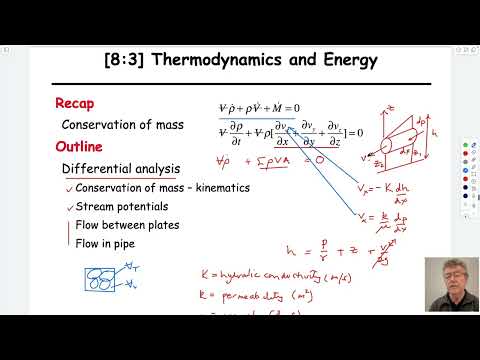 Watch on YouTube →
Overview
Derek Elsworth connects porous-media flow to external and internal fluid mechanics by tracing Darcy’s law back to conservation of mass, then showing how momentum conservation adds inertia and leads to the Navier–Stokes equations. He develops flow nets for estimating seepage through homogeneous media and relates standard parabolic velocity profiles in ducts and pipes to an idealized capillary-bundle permeability of k = φd²/32.
Key takeaways
- Darcy’s law combined with conservation of mass describes slow porous-media flow while implicitly neglecting inertia, making it appropriate for many groundwater problems.
- In steady, homogeneous, isotropic two-dimensional flow, hydraulic head satisfies Laplace’s equation, and its equipotentials intersect streamlines at right angles.
- A square-cell flow net estimates discharge using Q = (Ns/Nd)KΔH per unit thickness; the example with three stream tubes and eight head drops gives Q = 3KΔH/8.
- The Navier–Stokes equations add acceleration and viscous-stress effects to pressure and elevation forces; mass conservation completes the system for pressure and three velocity components.
- No-slip boundaries produce parabolic velocity profiles in both parallel-plate ducts and circular pipes, with maximum velocity at the center and zero velocity at the walls.
- An idealized capillary bundle yields k = φd²/32, connecting pore-scale tube flow to the permeability used in Darcy’s law.
Chapters
0:00
Course Context: Conservation of Energy and Fluid-Flow Applications
- Derek Elsworth places the lecture in a sequence covering conservation of mass, momentum, and energy.
- Applications include groundwater hydrology, reservoir engineering, geothermal fluids, and cleanup of contaminants from leaking underground storage tanks.
- The lecture moves from porous-media flow toward external flows such as air over a turbine blade or aircraft wing.
3:05
Darcy Flow Versus External Flow and Inertia
- Porous-media flow is modeled with Darcy’s law and conservation of mass, which implicitly omits inertia.
- Slow groundwater flow is suited to this approximation; high-velocity flows require momentum effects.
- External-flow examples include air moving over a wing and water moving over a hydroplane.
6:32
Darcy’s Law, Hydraulic Head, and Transient Flow
- Hydraulic head combines pressure head, P/γ, and elevation head, z; Darcy velocity is proportional to the negative head gradient.
- Hydraulic conductivity K and intrinsic permeability k are related through fluid viscosity, density, and gravitational acceleration.
- Substituting Darcy’s law into mass conservation produces pressure- or head-diffusion equations for transient flow.
13:00
Porosity, Storage, and the Role of Viscous Head Loss
- Porosity is void volume divided by total volume; Elsworth gives about 0.2 as a representative value for porous material.
- Specific storage describes how a change in hydraulic head releases or absorbs fluid from a unit volume of material.
- In extended Bernoulli accounting, frictional losses represent viscous resistance along the flow path.
17:37
Steady Isotropic Flow Reduces to Laplace’s Equation
- For steady two-dimensional flow with equal hydraulic conductivity in the x and y directions, head satisfies ∂²h/∂x² + ∂²h/∂y² = 0.
- Hydraulic head acts as the potential whose constant-value contours are equipotentials.
- The Laplace equation supports a graphical flow-net solution for suitable homogeneous flow regions.
19:00
Flow Nets: Orthogonal Streamlines and Equipotentials
- A flow net combines streamlines with constant-head equipotential lines.
- For the graphical method, intersections should be at right angles and the resulting cells should be approximately square.
- The same flow-net idea applies to flow through porous media and to idealized external-flow fields.
22:10
Sheet-Pile Seepage and the Flow-Net Discharge Formula
- A sheet-pile retaining wall provides an example of groundwater moving around an excavation boundary.
- For square flow-net cells, discharge per stream tube is proportional to hydraulic conductivity times the head drop across one interval.
- Total discharge is Q = (Ns/Nd)KΔH per unit thickness, where Ns is the number of stream tubes and Nd is the number of head drops.
- In Elsworth’s sketch, three stream tubes and eight head drops give Q = (3/8)KΔH per unit thickness.
35:30
Hydraulic Head as Pressure Plus Elevation
- Hydraulic head is the sum P/γw + z, so pressure increases with depth while elevation decreases.
- Along a hydrostatic vertical boundary, those changes offset one another, leaving total head constant.
- That constant-head boundary is an equipotential and helps explain why flow nets use head contours.
38:15
From Momentum Conservation to the Navier–Stokes Equations
- Momentum conservation balances mass-flow momentum with forces in a differential fluid element.
- The resulting equations account for acceleration, pressure, elevation, and viscous stresses; mass conservation supplies the additional equation needed to solve for pressure and three velocity components.
- Newton’s law of viscosity relates shear stress to velocity gradients, yielding the Navier–Stokes formulation for three-dimensional flow.
- Boundary conditions for a particular geometry can simplify the equations into standard solutions, including pipe flow.
48:46
Parallel-Plate and Circular-Pipe Velocity Profiles
- For flow between stationary parallel plates, no-slip sets velocity to zero at the walls and symmetry places the maximum velocity at the center.
- Integrating the parabolic plate-flow velocity profile across the gap gives volumetric discharge from the pressure gradient, viscosity, and duct dimensions.
- For a circular pipe, the axial velocity is also parabolic: it is greatest at the center and falls to zero at the wall.
- Hagen–Poiseuille pipe discharge scales with the fourth power of pipe diameter and inversely with viscosity.
53:24
Capillary-Bundle Permeability Links Pipe Flow to Darcy’s Law
- An idealized bundle of capillary tubes with diameter d gives permeability k = φd²/32, where φ is porosity.
- The derivation combines momentum-based flow in individual tubes with the aggregate behavior of many pores.
- This provides a conceptual bridge from pipe-flow mechanics to Darcy’s law for porous media and to numerical models that balance mass and momentum across many cells.
Summary, takeaways, and chapters were generated by AI from the video's transcript and may contain errors. The video belongs to its creator, Derek Elsworth.