2026 10 05 Math219 03
 Watch on YouTube →
Overview
Clark Bray Math develops flux, flow lines, divergence, and curl as interconnected tools for interpreting vector fields in fluid dynamics and physics. The lecture distinguishes volume flux from mass flux, derives particle motion as a vector differential equation, introduces divergence and curl as preliminary concepts for Chapters 6–7, and previews operator-composition patterns behind Green's theorem, Gauss's divergence theorem, and Stokes's curl theorem.
Key takeaways
- Flux uses the same mathematical expression for volume flow and mass flow, but mass flow requires a vector field equal to density times velocity rather than velocity alone.
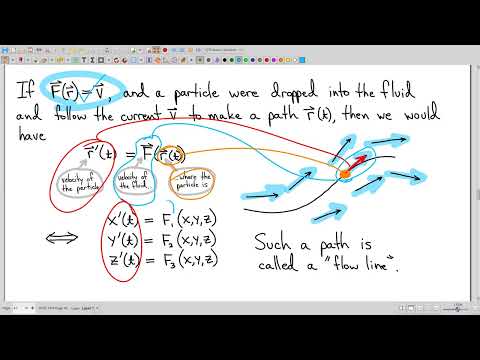
- A neutrally buoyant particle moving with a velocity field satisfies a vector differential equation, and its trajectory is called a flow line.
- Divergence measures net local outflow, so positive divergence can describe either dispersing material or a source that creates material such as photons from a light bulb.
- Curl describes the tendency of a small floating object to rotate, not merely whether the field's flow lines curve; its direction gives the rotation axis and its magnitude indicates rotational strength.
- Two-dimensional curl is a scalar because planar rotation has only clockwise or counterclockwise orientation, unlike three-dimensional rotation, which also requires an axis.
- The identities curl(gradient f) = 0 and divergence(curl F) = 0 exemplify a broader operator-composition pattern that connects Green's, Gauss's, and Stokes's theorems.
Chapters
0:00
Flux as Volume Flow and Mass Flow Rate
- Flux measures the amount of fluid crossing a surface per unit time when the vector field represents velocity.
- For mass flow, mass equals density times volume, so the vector field must represent density multiplied by velocity.
- The same flux formula applies to both volume flow and mass flow, but its physical interpretation depends on whether density is included in the vector field.
- Flux later becomes important in electricity and magnetism, especially in Physics 152 and vector calculus.
5:00
Photon Flow and the Limits of the Fluid Analogy
- Clark Bray Math notes that flux applies beyond water and air, including photon flow from light bulbs.
- Two light bulbs can produce photons moving in different directions, showing that a useful vector-field model does not require all particles to move together.
- The photon example is presented as optional enrichment for physics majors and as preparation for related ideas in Chapter 7.
7:00
Floating Particles Become Vector Differential Equations
- A perfectly buoyant, nearly massless particle such as a dried leaf is assumed to move instantly with the local fluid velocity.
- If the fluid velocity field is F, the particle position satisfies a vector differential equation whose velocity equals F evaluated at the particle's location.
- In three dimensions, the system contains three position coordinates and three velocity components.
- Solving this system determines the path followed by the particle through the fluid.
11:00
Flow Lines and the Stirred-Pot Example
- A curve traced by a particle moving with a vector field is called a flow line.
- For a two-dimensional stirred-pot field F(x, y) = (-y, x), a small piece of oregano is predicted to travel along a circle.
- The proposed circular motion can be verified by substituting the candidate coordinate functions into the associated two-equation differential system.
- Clark Bray Math emphasizes that solving such systems is difficult and is deferred to Math 353.
14:00
Use Both Fluid and Force Interpretations of Vector Fields
- Vector fields can model fluid velocities as well as gravitational, electric, and other force fields.
- Flux is often more intuitive when motivated through fluid flow, while later constructions in Chapter 6 require force-based intuition.
- Students are advised not to choose only one metaphor; both fluid and force interpretations are needed for multivariable and vector calculus.
16:00
The Del Operator and Divergence
- The del operator is written as ∇ = (∂/∂x, ∂/∂y, ∂/∂z) and is distinct from the gradient produced when ∇ is applied to a scalar function.
- Applying a dot-product-like operation, ∇ · F, defines the divergence of a vector field.
- For a fluid interpretation, divergence measures the net tendency of fluid to flow outward from a point.
- Clark Bray Math introduces divergence as a preview concept without fully deriving its meaning until vector calculus in Chapter 7.
23:00
Positive, Negative, and Zero Divergence
- For a field that points outward from the origin, the computed divergence is 3, matching the interpretation of positive net outflow.
- Positive divergence can represent material dispersing from a finite source or newly generated material, such as photons emitted by a light bulb.
- A field can have zero divergence even when some vectors point outward, because positive outward flow may cancel negative outward flow caused by inward-pointing vectors elsewhere.
- Divergence describes the net result across directions rather than requiring every local vector to point outward.
31:00
Three-Dimensional Curl Measures Local Rotation
- Curl is written as ∇ × F and can be computed using the determinant-style cross-product arrangement involving the del operator.
- The curl vector indicates the axis of local fluid rotation; a vertical curl corresponds to rotation around a vertical axis.
- The curl magnitude indicates the strength of rotation, with larger magnitudes representing more intense rotational behavior.
- The right-hand rule determines rotational direction: an upward curl vector corresponds to counterclockwise rotation when viewed from above.
37:00
Curl Is About Floating Objects, Not Curved Flow Lines
- A zero curl field can have straight flow lines and no tendency to rotate a small floating object.
- Curved flow lines alone do not define curl; curl concerns whether local forces from the fluid would make a small balloon or ball spin.
- A field with straight flow lines can still have nonzero curl when opposing pushes on opposite sides of an object produce rotation.
- Curl can be evaluated anywhere in the field, not only at the origin used in the illustrative examples.
42:00
Two-Dimensional Curl and the Lifetime-of-Two Pattern
- In two dimensions, curl is a scalar, commonly written ∂Q/∂x − ∂P/∂y or compactly as ∇ ∧ F, because planar rotation has no separate axis direction.
- Green's theorem, Gauss's divergence theorem, and Stokes's curl theorem are historically related results whose common structure became clearer in modern mathematics during the early 20th century.
- Operator composition reveals identities such as curl(gradient f) = 0 and divergence(curl F) = 0.
- Clark Bray Math describes these identities as a 'lifetime of two' pattern: applying the relevant operators twice produces zero, while a curl-free field can often be recognized as a gradient field.
Summary, takeaways, and chapters were generated by AI from the video's transcript and may contain errors. The video belongs to its creator, Clark Bray Math.