2026 10 02 Math219 02
 Watch on YouTube →
Overview
Clark Bray develops vector fields through concrete examples, then connects them to fluid flow, flux, flow lines, and divergence. Key results include the inverse-square field’s radial magnitude, the dot-product formula for flow through an oriented area, the differential equation governing a particle carried by a fluid, and the interpretation of divergence as local outward flow or fluid generation.
Key takeaways
- A vector field is a function that associates a vector with each domain point; for F(x,y)=(x,y), each vector points radially outward and has magnitude equal to the point’s distance from the origin.
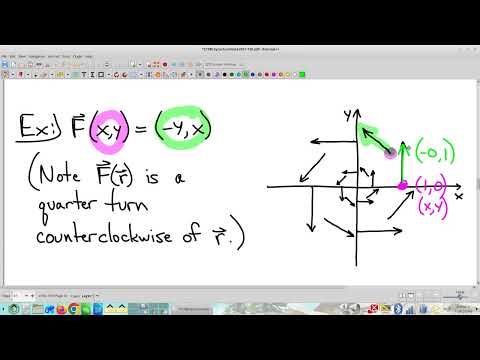
- The field F(x,y)=(-y,x) rotates position vectors 90° counterclockwise, creating circular flow; at (1,0), its value is (0,1).
- The inverse-square field is naturally understood as a radial unit vector scaled by 1/r², explaining its role in gravitational and electric-field models and its simpler form in spherical coordinates.
- Flux through an oriented area is a dot product of the field with the area vector: it vanishes when flow is parallel to the surface and is largest in magnitude when flow crosses normally.
- Mass flow is computed by using density times velocity as the vector field, while volume flow uses velocity alone.
- A particle carried by a fluid follows r′(t)=F(r(t)); for F=(-y,x), r(t)=(cos t,sin t) traces a circular flow line, while divergence measures local outward flow or generation depending on the physical model.
Chapters
0:00
Drawing Constant and Position Vector Fields
- A vector field assigns an output vector to every point in its domain, drawn with its tail at that point.
- The constant field F=(2,1) repeats the same vector everywhere; its illustration is a vector-field diagram, not a graph.
- For F(x,y)=(x,y), the field vector equals the position vector, pointing radially away from the origin with magnitude equal to distance from it.
3:48
Rotating Vectors to Build the Stirred-Pot Field
- The field F(x,y)=(-y,x) rotates each position vector 90° counterclockwise, producing circular flow around the origin.
- At (1,0), the field vector is (0,1), illustrating how to evaluate and draw the field at a particular point.
- The magnitude is √(x²+y²), so vectors are shorter near the origin; that behavior follows from this formula rather than from a general rule.
8:29
Inverse-Square Fields, Gravity, and Spherical Coordinates
- A radial inverse-square field can be written as a radially outward unit vector multiplied by 1/r²; the denominator’s cubic power in its coordinate formula includes the position vector’s length.
- Inverse-square fields model gravitational and electric fields and recur in physics and engineering.
- Rectangular components make the formula cumbersome, while spherical coordinates express the same field compactly using the radial unit vector and r².
12:23
Gradients as Fields and Potential-Function Sign Conventions
- A gradient can be viewed as a vector field: its formula assigns the direction of fastest increase at every point.
- Clark Bray suggests “anti-gradient” for the scalar function recovered by reversing a gradient operation, while noting that “potential function” is more common terminology.
- For gravitational force, the force points toward decreasing potential energy, so it is the negative gradient of gravitational potential energy; losing track of this minus sign can produce errors.
18:13
Fluid Flow as a Vector-Field Application
- A fluid-flow field commonly assigns the fluid’s velocity vector to each location; air moving through a room is one everyday example.
- Groups of animals, such as migrating zebras, can be approximated as a flowing continuum when estimating quantities crossing a boundary per unit time.
- Flow rate through an area measures volume per time, such as cubic meters per second, and is distinct from velocity, measured as distance per time.
21:24
Deriving Flux Through an Oriented Area
- The amount of fluid crossing a flat area depends on both the velocity field F and the area’s orientation, represented by its normal vector.
- The volume crossing in a time interval is found from the area times the displacement component in the normal direction; displacement equals velocity multiplied by elapsed time.
- Dividing by elapsed time gives flux, expressible as F·A for an oriented area vector A; the dot product gives zero for flow parallel to the surface and the largest magnitude for flow normal to it.
29:28
Using Density to Measure Mass Flux
- To measure mass per unit time instead of volume per unit time, multiply the volume flow by density.
- If the vector field is density times velocity, the same flux calculation gives mass flow through the area without repeating the geometric derivation.
- Flux applies to any vector field, but interpreting it as volume flow requires a velocity field, while mass-flow interpretation uses density times velocity.
34:15
Flow Lines and the Leaf-in-a-Stream Differential Equation
- A leaf carried by a stream moves with the local fluid velocity, so its path satisfies the differential equation r′(t)=F(r(t)).
- For the stirred-pot field F(x,y)=(-y,x), the unit-circle path r(t)=(cos t,sin t) is a flow line, verified by differentiating and substituting into the field.
- Solving systems of differential equations is deferred to Math 353; here the focus is recognizing and checking a proposed solution.
42:03
The Del Operator and the Definition of Divergence
- The del operator ∇ is a symbolic vector of partial-derivative operators with respect to rectangular coordinates, not an operator limited to computing gradients.
- Divergence is defined by ∇·F, applying each coordinate’s partial derivative to the corresponding component of the vector field.
- For F(x,y,z)=(x,y,z), divergence is 3, consistent with the field’s visually outward flow from the origin.
48:30
Interpreting Positive Divergence: Outflow or Generation
- Positive divergence indicates local outward flow, but its physical meaning depends on the kind of fluid being modeled.
- For a fixed supply of material flowing outward, density may decrease as material leaves the region.
- For light emitted by a bulb, photons are generated as they flow outward, so positive divergence can represent production rather than falling density.
- More precise explanations of divergence and how to distinguish these cases are postponed until Chapter 7.
Summary, takeaways, and chapters were generated by AI from the video's transcript and may contain errors. The video belongs to its creator, Clark Bray Math.