2026 09 30 Math219 03
 Watch on YouTube →
Overview
Clark Bray Math derives why the gradient of a function is perpendicular to its level sets and shows how rewriting equations as level sets yields normal vectors for tangent planes. The lecture then motivates the implicit function theorem: a nonzero partial derivative with respect to the variable to be solved for permits a local function, whose implicit partial derivatives follow from the level-set condition; the resulting formula includes an essential minus sign.
Key takeaways
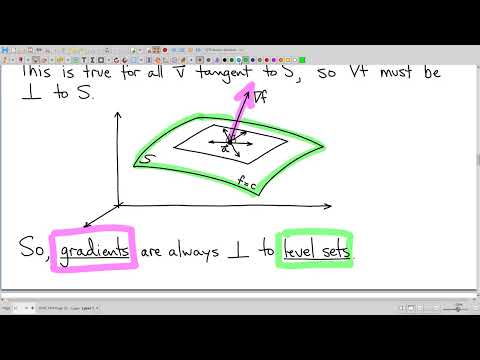
- For a differentiable function f, the gradient ∇f is perpendicular to each level set of f because the directional derivative along every tangent vector to that set is zero.
- To find a tangent-plane normal for a surface, rewrite its equation as a level set F=c and use ∇F at the point; the gradient must come from the function defining that level set.
- For F(x,y)=0, F_y ≠ 0 at a point guarantees that y can be viewed locally as a function of x; a vertical tangent with F_y=0 prevents that local representation.
- For a level set in several variables, test the partial derivative corresponding to the variable you want to solve for: F_z ≠ 0, for example, supports writing z locally as a function of the other variables.
- If F is constant and xᵢ is locally dependent on xⱼ, then ∂xᵢ/∂xⱼ = −F_xⱼ/F_xᵢ, with all other independent variables held fixed.
- The partial derivatives in the implicit-derivative ratio represent different dependency scenarios and cannot be canceled like ordinary fractions; the leading minus sign expresses cancellation of direct and indirect changes in F.
Chapters
0:00
Attendance Quiz Reminder and Directional Derivative Setup
- Clark Bray Math displays an attendance-quiz reminder and encourages students to set their own phone alarms or reminders.
- The lecture turns to directional derivatives as a way to understand properties of level sets.
0:43
Why a Level-Set Gradient Is Perpendicular to Its Surface
- A function f is constant along any curve contained in one of its level sets, so its directional derivative is zero along every tangent vector to that set.
- Because directional derivatives equal gradient dot products, ∇f has zero dot product with every tangent vector and is perpendicular to the level set.
- The perpendicularity applies to the gradient of the same function whose level set is being considered, not an unrelated function.
9:55
Use Level-Set Gradients as Tangent-Plane Normals
- A graph can be rewritten as a level set by moving all terms to one side and setting the resulting function equal to a constant.
- The gradient of that level-set function supplies a normal vector for finding the graph's tangent plane.
- An arbitrary surface equation can likewise be rearranged into level-set form, making its defining function's gradient a tangent-plane normal.
13:27
The Hidden Function Assumption in Implicit Differentiation
- The familiar chain-rule derivation of dy/dx from an equation such as a circle assumes y is a function of x.
- An implicit curve can fail the vertical line test, so y may not be a globally defined function of x even when the equation itself is valid.
- Since derivatives are defined for functions, implicit differentiation needs a justification that the dependent variable is actually a function, at least locally.
17:38
Local Functions, Vertical Tangents, and the Partial-Derivative Test
- Restricting attention to a neighborhood of a selected point can make a curve locally pass the vertical line test, even if distant parts of the curve do not.
- At a vertical tangent, no neighborhood makes y a function of x; dy/dx is not infinite but undefined as a derivative of y(x), because that local function does not exist.
- For a level set F(x,y)=0, F_y ≠ 0 is the local test for treating y as a function of x; a vertical tangent corresponds to F_y=0.
23:18
The Implicit Function Theorem for Curves and Surfaces
- For a surface level set, the same local test applies: to solve for z as a function of x and y, check that F_z is nonzero at the point.
- The variable being treated as dependent determines which partial derivative to test: use F_y for y, F_z for z, or the corresponding partial for another variable.
- Clark Bray Math states the implicit function theorem as a practical rule: a nonzero partial with respect to the desired dependent variable guarantees a local function.
30:09
Testing Whether x Is Locally a Function of y and z
- For the example surface, the equation is already expressed as a level set; any ordinary equation can be converted by moving terms to one side and setting them equal to zero.
- To decide whether x can locally depend on y and z, calculate the defining function's x-partial at the specified point.
- The example gives an x-partial of 4, which is nonzero, so x is locally a function of y and z without needing to visualize the complicated surface.
33:40
Deriving Implicit Partial Derivatives from a Constant Level Set
- Once the implicit function theorem establishes that xᵢ depends locally on the other variables, its partial derivative with respect to xⱼ is a valid quantity to compute.
- As xⱼ changes while the remaining independent variables are held fixed, F changes directly through xⱼ and indirectly through the induced change in xᵢ.
- Because F remains constant on its level set, the two contributions sum to zero, yielding ∂xᵢ/∂xⱼ = −F_xⱼ/F_xᵢ.
39:40
Why the Minus Sign Cannot Be Canceled Away
- The formula's minus sign is required because the direct and indirect changes in F must cancel while F stays constant.
- The two partial derivatives of F arise from different variable-holding assumptions, so treating them as ordinary fractions and canceling them is invalid.
- Omitting the minus sign signals a conceptual misunderstanding and can make partial credit difficult; Clark Bray Math recommends prominently circling it on an equation sheet.
46:56
Applying the Formula and Showing Both Steps on Exams
- For the earlier surface example, the requested derivative is ∂x/∂z; write the minus sign first, then place the appropriate partial derivatives in the formula and evaluate them at the point.
- The fraction-rearrangement idea can serve as a memory trick for locating partial derivatives, but Clark Bray Math distinguishes that shortcut from a valid derivation.
- Implicit-derivative questions often combine two tasks: first verify the relevant partial is nonzero to establish a local function, then compute its derivative; each step may account for about half the points.
Summary, takeaways, and chapters were generated by AI from the video's transcript and may contain errors. The video belongs to its creator, Clark Bray Math.