2026 09 30 Math219 02
 Watch on YouTube →
Overview
Clark Bray develops the implicit function theorem as a way to justify when a variable on a level set can be treated locally as a function, then derives the implicit differentiation formula and explains why its minus sign cannot be omitted. He moves into parametric curves and vector fields, connecting velocity and unit tangent vectors to arc length and previewing why vector fields are central to vector calculus.
Key takeaways
- For a level set f = c, if the partial derivative with respect to the variable being solved for is nonzero at a point, the implicit function theorem guarantees that variable is a local function of the others.
- A zero relevant partial derivative does not prove that a local function fails to exist; it only means the nonzero-partial test cannot decide the question.
- Implicit differentiation gives ∂xᵢ/∂xⱼ = −(∂f/∂xⱼ)/(∂f/∂xᵢ); the minus sign expresses the opposing changes required to keep f constant.
- When a problem gives only a surface equation, first establish that the requested variable is locally a function before computing its derivative; Clark Bray notes that existence and computation may each account for about half the credit.
- For a parameterized curve r(t), velocity r′ is tangent, the unit tangent is T = r′/|r′|, and dr = T ds with ds = |r′(t)|dt.
- The length of a parameterized curve from t = a to t = b is ∫ₐᵇ |r′(t)|dt; the resulting square-root integral may be intentionally left unevaluated.
Chapters
0:00
Why a Level-Set Curve May Not Be a Function
- Clark Bray revisits the common calculus assumption that an equation describing a curve lets you treat y as a function of x.
- The example curve fails the vertical line test globally, so differentiating it as a single function is not justified.
- A local function is defined only near a selected point, but even a small neighborhood can fail the vertical line test.
4:10
Vertical Tangents Motivate the Implicit Function Test
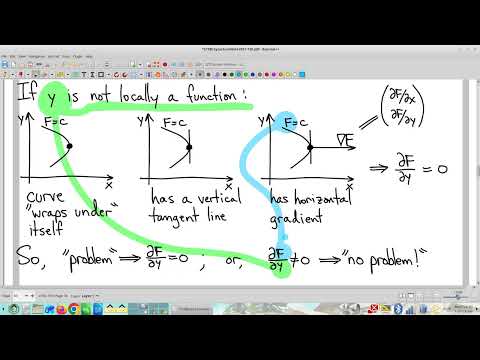
- A curve that wraps under itself cannot be made into a local function by shrinking the neighborhood around the problematic point.
- For a level set, a vertical tangent means the gradient is horizontal, so the partial derivative with respect to y is zero.
- The contrapositive gives a useful test: if the y-partial of the level-set function is nonzero, there is no vertical-tangent obstruction to viewing y locally as a function.
7:25
Generalizing the Local-Function Test to Surfaces
- For a three-variable level set, the surface may locally express z as a function of x and y except where it wraps under and has a vertical tangent plane.
- A vertical tangent plane makes the gradient horizontal, corresponding to a zero z-partial.
- The implicit function theorem generalizes the test: take the partial of the level-set function with respect to the variable you want to solve for, and a nonzero value guarantees a local function.
13:00
A Nonzero Partial Establishes a Local Function
- For a complicated cubic surface, geometric intuition may not reveal whether x is locally a function of y and z.
- Clark Bray evaluates the level-set function’s x-partial at the point of interest and obtains 4, which is nonzero.
- The theorem therefore guarantees that x can be treated locally as a function of y and z.
15:00
Why a Zero Partial Does Not Settle the Question
- The implicit function theorem’s nonzero-partial condition is sufficient, not necessary.
- A zero y-partial indicates a horizontal gradient and vertical tangent, but a vertical tangent may occur without the curve wrapping under itself.
- When the relevant partial is zero, the test gives no conclusion: the local function may exist or fail to exist.
20:00
The Minus Sign Is Essential, Not Fraction Cancellation
- The partial derivatives in the implicit formula describe different dependencies and cannot be canceled like ordinary fractions.
- The minus sign records that the direct and indirect changes in f must be negatives of each other for f to stay constant.
- Clark Bray recommends writing the minus sign first on exam work; omitting it can suggest a fundamental misunderstanding and make partial credit difficult to award.
26:30
Applying the Formula and Showing the Function Exists
- For the surface example, Clark Bray first establishes that x is locally a function of y and z, then uses the formula to compute a partial derivative such as ∂x/∂z.
- A memory aid can help place the numerator and denominator, but treating partial derivatives as cancelable fractions is not a valid derivation.
- On homework or exams, an equation alone does not establish that a variable is a function; proving local existence and computing the derivative are separate tasks, each potentially worth about half the points.
34:10
Parametric Curves: Velocity, Differentials, and Unit Tangents
- For a parameterized position vector r(t), the derivative r′(t) = dr/dt is the velocity vector and is tangent to the curve.
- The differential dr = r′(t) dt is a linear approximation to the curve’s position change over a small parameter interval.
- The unit tangent is T = r′/|r′|, and the differential can also be written dr = T ds, where ds = |dr|.
41:10
Computing Curve Length from Speed
- The length of a small curve segment is approximated by ds = |r′(t)| dt, or speed multiplied by a small time interval.
- Adding these segment lengths gives total arc length as the integral of speed over the parameter interval.
- In the worked example over t = 0 to t = 1, differentiating the parameterization and integrating the velocity magnitude produces a difficult square-root integrand; such problems may ask only to set up the integral.
46:10
Vector Fields as the Foundation of Vector Calculus
- A vector field on ℝⁿ is a function from ℝⁿ to ℝⁿ: each input point is a location, and its output is a vector drawn with its tail at that point.
- Vector fields can model fluid flow or force fields such as gravity and electromagnetism; electric and magnetic fields connect the topic to Maxwell’s equations.
- Vector-field diagrams are a distinct way to represent functions, so their calculus is not simply the slope-based calculus of graphs or level sets.
Summary, takeaways, and chapters were generated by AI from the video's transcript and may contain errors. The video belongs to its creator, Clark Bray Math.