2026 09 30 Math219 01
 Watch on YouTube →
Overview
Clark Bray Math connects the implicit function theorem to a practical test for whether a variable on a level set can be treated locally as a function, then derives the implicit differentiation formula and emphasizes why its minus sign matters. The lecture moves into parametric-curve calculus—velocity, differentials, unit tangent vectors, and arc length—before defining vector fields as functions from R^n to R^n and motivating them with fluid flow and force examples.
Key takeaways
- For a level set F = c, a nonzero partial derivative F_x at a point guarantees that x can be represented locally as a function of the other variables; a zero value makes the test inconclusive.
- After local dependence is established, implicit differentiation gives ∂x_i/∂x_j = −F_xj/F_xi, with the minus sign arising because the total change in F along its level set is zero.
- An implicitly requested derivative is not automatically valid: first rewrite the equation as a level set and verify the relevant partial is nonzero at the point.
- For a parametrized curve r(t), velocity is r′(t), the unit tangent is r′(t)/|r′(t)|, and total arc length is the integral of speed over the parameter interval.
- A vector field on R^n maps points in R^n to vectors in R^n and can model spatially varying quantities such as fluid velocity or force.
- Vector-field diagrams are geometrically distinct from graphs, level sets, and parametrized curves, so each representation requires its own interpretation of calculus.
Chapters
0:00
Why Local Function Tests Matter for Implicit Derivatives
- A curve that fails the vertical line test globally may still pass it in a small neighborhood, allowing a local function description.
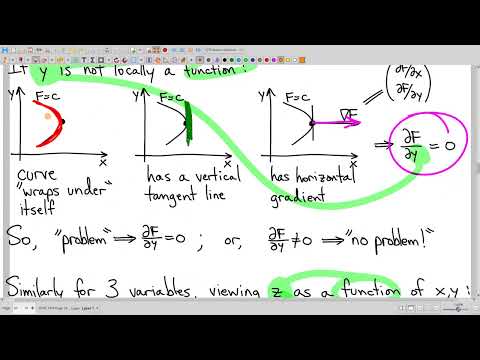
- If the curve continues to fail the vertical line test in every neighborhood, the dependent variable is not locally a function, so its derivative is undefined—not infinite.
- A curve that wraps under itself creates a vertical tangent; for a level set, the gradient-perpendicular-to-level-set relationship links this geometry to a zero partial derivative.
6:20
The Implicit Function Theorem’s Nonzero-Partial Test
- For a level set of F, test whether a variable can be viewed locally as a function by taking F’s partial derivative with respect to that variable.
- A nonzero partial at the point guarantees the local function description; write the equation as a level set before applying the test.
- A zero partial does not prove that no local function exists: a curve may have a vertical tangent momentarily and then turn back without wrapping under itself.
11:50
Checking a Cubic Surface Near a Given Point
- Clark Bray Math considers whether x can be written locally as a function of y and z near (1, 2, 3) on a cubic surface.
- Because the surface’s shape is not readily apparent, the geometric vertical-line-test intuition used for a circle is unavailable.
- The test is to evaluate the partial of the level-set function with respect to x at the specified point; a nonzero value permits the local function description.
19:00
Deriving the Implicit Partial-Derivative Formula
- Once the implicit function theorem establishes that x_i is locally a function of the other variables, its partial derivatives are meaningful.
- To find ∂x_i/∂x_j without solving explicitly for x_i, compute the total change in F with respect to x_j along the level set.
- Because F remains constant on the level set, its total derivative is zero; applying the chain rule and solving gives ∂x_i/∂x_j = −(∂F/∂x_j)/(∂F/∂x_i).
25:00
Why the Minus Sign Cannot Be Canceled Away
- The partial derivatives in the formula come from different chain-rule contributions, so they are not ordinary standalone fractions whose symbols can be canceled.
- The two contributions must sum to zero along the level set, which explains why their relationship includes a negative sign.
- Writing the formula without the minus sign is mathematically wrong and can signal a deeper misunderstanding; Bray recommends putting the sign down before filling in the partial derivatives.
30:20
Applying the Formula and Verifying the Derivative Is Valid
- For the earlier surface example, the class applies the formula to compute a partial of x with respect to another variable after establishing x is locally a function of y and z.
- A memory aid—after writing the minus sign, arrange numerator and denominator partials as if they canceled—is presented as a setup trick, not a valid algebraic justification.
- For a typical implicit-differentiation problem, first move all terms to one side to form a level set and check the relevant partial; Bray says this validity check may account for about half the question’s points.
32:10
Parametric-Curve Differentials as Linear Estimates
- For a parametrized curve r(t), the derivative r′(t) is the velocity vector v.
- The differential dr = r′(t) dt = v dt estimates the position change over a small time interval using the curve’s behavior at one point.
- The estimate is linear rather than the exact curved displacement; ds is the magnitude of dr and estimates the small arc length.
38:00
Unit Tangents and Arc Length as Integrated Speed
- The unit tangent vector T points in the direction of motion and is the normalized velocity, T = v/|v|.
- The differential displacement can be written dr = T ds, separating direction from the distance traveled.
- Adding small arc lengths gives total length: integrate speed with respect to time, L = ∫|r′(t)| dt; square roots in speed expressions often make these integrals challenging.
- Arc-length parametrization is introduced as a topic students can read independently rather than a focus of class time.
43:00
Vector Fields: Functions for Flow, Forces, and Vector Calculus
- A vector field on R^n is a function from R^n into R^n: its input is a point and its output is a vector in the same space.
- Drawing each output vector with its tail at the input point produces a field diagram that can represent fluid or airflow across space.
- The same representation can model position-dependent forces, such as the combined electric and gravitational force at different points.
- Bray frames vector calculus, especially the later course chapters on vector fields, as central to engineering and to understanding electric and magnetic fields.
47:00
Distinguishing Vector-Field Diagrams from Other Calculus Pictures
- A vector-field diagram is a distinct way of representing a function, not a graph, level set, or parametric curve.
- Calculus has different geometric interpretations for graphs, level sets, parametric curves, and vector fields; their pictures should not be conflated.
- The class ends as students begin interpreting vector-field diagrams as a new visual language for the upcoming vector-calculus material.
Summary, takeaways, and chapters were generated by AI from the video's transcript and may contain errors. The video belongs to its creator, Clark Bray Math.