2026 09 28 Math219 03
 Watch on YouTube →
Overview
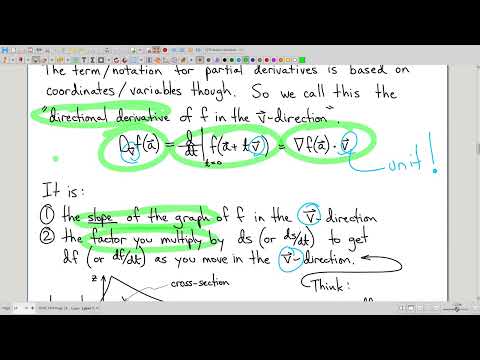
Clark Bray Math develops the directional derivative as the rate of change of a scalar function along a unit vector, showing that it can be computed as the gradient dotted with that vector. The lecture uses this formula to identify the gradient’s direction as the direction of fastest increase and its magnitude as the maximum rate of change, while distinguishing unit-vector and arbitrary-velocity conventions and clarifying how points on a graph relate to points in the domain.
Key takeaways
- For a unit direction v, the directional derivative is D_v F(A) = ∇F(A) · v; normalize a supplied direction vector before applying the Math 219 convention.
- The gradient at a point points in the direction of fastest increase, and the maximum directional derivative over unit vectors equals the gradient’s magnitude.
- DF/DS measures change per unit distance and describes the landscape’s steepness, whereas DF/DT also depends on how fast someone moves.
- Directional-derivative conventions differ: a unit-vector convention gives slope per unit distance, while an arbitrary-velocity convention incorporates the vector’s speed.
- For a function z = F(x, y), a domain point such as (1, 3) is distinct from its three-dimensional graph location (1, 3, F(1, 3)); the gradient is evaluated using the domain coordinates.
Chapters
0:00
Partial Derivatives as Motion Along Standard Basis Vectors
- A partial derivative measures how quickly a function changes while moving along a standard basis direction.
- The expression d/dt F(A + t e_i) describes motion from point A with velocity e_i; applying the chain rule recovers the corresponding partial derivative.
- The dot product of the gradient with e_i selects the partial derivative for that coordinate.
3:31
Changing Coordinates Extends Partial-Derivative Formulas to Unit Directions
- Coordinate axes are choices rather than fixed features of a landscape, so a unit vector can serve as a standard basis vector in a suitably chosen coordinate system.
- The slope, rate-of-change, chain-rule, and gradient-dot-product interpretations therefore extend to any unit vector.
- Clark Bray Math names this coordinate-independent rate of change the directional derivative, written D_v F, with v required to be a unit vector in Math 219.
11:18
DF/DS Measures Hill Steepness; DF/DT Also Depends on Speed
- DF/DS represents the change in F per unit distance traveled in a chosen direction.
- DF/DT depends on both the hill’s steepness and the hiker’s speed: moving faster produces a larger change per unit time.
- For temperature on a landscape, DF/DS describes how many degrees temperature changes per mile, while DF/DT describes the change over time.
15:30
Computing Directional Derivatives with a Normalized Gradient Dot Product
- For a requested slope at a point, compute the gradient there and dot it with the unit vector in the requested direction.
- A supplied vector such as v must be normalized to v/|v| before using the Math 219 directional-derivative formula.
- The same method applies to functions of three variables, even when their graphs cannot be visualized in ordinary three-dimensional space.
23:01
Two Directional-Derivative Conventions: Unit Direction or Any Velocity
- Some conventions require a unit vector; others allow any vector, treating it as the velocity along a path.
- With a non-unit vector, the result is a rate of change per unit time for that velocity, not a geometric slope or change per unit distance.
- Math 219 follows the textbook’s unit-vector convention, though Clark Bray Math notes that arbitrary-velocity usage is common elsewhere and recommends clarifying the convention.
29:04
The Gradient Gives the Direction and Value of Fastest Increase
- To maximize D_v F at a fixed point A, use D_v F = ∇F(A) · v with |v| = 1.
- The dot product equals |∇F(A)| cos θ, so it is largest when θ = 0 and v points along the gradient.
- Substituting that unit direction shows the maximum directional derivative is |∇F(A)|; the opposite direction gives the greatest decrease.
38:40
Reading the Gradient Geometrically on a Hill
- The gradient is more than algebraic shorthand: its direction indicates fastest increase, and its magnitude gives the maximum rate of change per unit distance.
- For the hill example at domain point (1, 3), the gradient is (-2, -2), pointing southwest when the positive y-axis represents north.
- The steepest uphill rate is |(-2, -2)| = 2√2, approximately 2.8; the downhill direction is the opposite vector.
41:00
A Zero Gradient and the Difference Between Domain and Graph Points
- At a locally level point such as the bottom of a smooth depression, the gradient can be zero, indicating no first-order uphill direction.
- For a function of x and y, the domain point (1, 3) has two coordinates, while its location on the graph z = F(x, y) has three.
- The gradient takes the two domain coordinates as input; informal phrases such as “at point (1, 3)” do not mean the physical location lies in a two-dimensional universe.
Summary, takeaways, and chapters were generated by AI from the video's transcript and may contain errors. The video belongs to its creator, Clark Bray Math.