2026 09 28 Math219 02
 Watch on YouTube →
Overview
Directional derivatives are computed as the gradient dotted with a unit direction vector, and the gradient’s direction and magnitude respectively identify the fastest increase and its rate. The lecture then derives that gradients are perpendicular to level sets, uses that fact to find surface normals, and motivates the implicit function theorem by showing why implicit differentiation requires a locally valid function relationship.
Key takeaways
- For a unit direction u, the directional derivative is ∇f(a) · u; if the given direction vector is not unit length, normalize it before using the Math 219 definition.
- At a fixed point, ∇f points in the direction of maximum increase, and |∇f| is the maximum directional derivative, or steepest rate of increase.
- For a level set F = C, every tangent vector t satisfies ∇F · t = 0, making ∇F a normal vector to the level set.
- To find a normal to the graph z = f(x, y), express it as the level set z − f(x, y) = 0 and use the gradient of z − f, not the gradient of f alone.
- Implicit differentiation is valid only when the curve can locally be represented as y = y(x) near the point; a local vertical-line-test failure means that assumption is not justified.
Chapters
0:00
Directional Derivatives: Slopes, Rates of Change, and Unit Vectors
- A directional derivative generalizes a partial derivative by measuring change along an arbitrary direction rather than a standard basis vector.
- The gradient dot product provides a direct computation: evaluate the gradient at the point, then dot it with the direction’s unit vector.
- For a supplied vector V, normalize it as V divided by its magnitude; the directional derivative requires a unit direction.
6:49
Two Conventions for the Term Directional Derivative
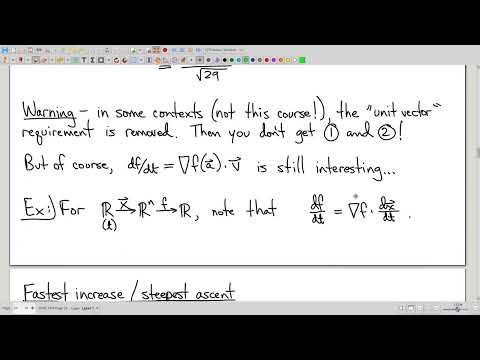
- In Math 219, the direction vector in the directional-derivative definition must have magnitude 1.
- Some mathematical contexts allow non-unit vectors, treating the input as velocity; the gradient dot product still applies, but the result scales with vector magnitude.
- Without a unit vector, the result no longer directly represents slope or rate of change per unit distance, so clarify which convention is intended.
13:05
Choosing a Direction to Increase Temperature or Engine Efficiency
- A direction of fastest increase answers practical questions such as where to move for warmer temperatures or how to adjust engine-design parameters to improve efficiency.
- At a fixed point, the gradient remains constant while candidate unit directions change.
- The goal is to maximize the directional derivative over all unit vectors.
18:00
Why the Gradient Gives the Fastest Increase and Its Rate
- Using the dot-product formula, the directional derivative is the gradient magnitude times the cosine of the angle between the gradient and the chosen unit direction.
- The maximum occurs when the angle is zero, so the direction of fastest increase is the gradient’s direction.
- The directional derivative in that optimal direction equals the gradient’s magnitude, which measures the maximum rate of increase.
24:29
Reading the Gradient at (1, 3) on a Height Graph
- For the hill example, evaluating the gradient at the domain point (1, 3) gives the vector (-2, -2).
- Taking positive y as north, (-2, -2) points southwest and gives the direction of fastest increase.
- The gradient magnitude is 2√2, approximately 2.8, so the maximum slope is about 2.8 units of height per unit of horizontal distance.
30:05
Distinguishing a Function’s Domain Point from Its Graph Point
- A height function takes longitude and latitude, or x and y, as its two-dimensional domain inputs; the corresponding graph point also includes altitude z.
- A domain point (1, 3) maps to a graph point (1, 3, f(1, 3)); these are not interchangeable.
- When a problem gives a three-coordinate point on a graph but asks for the gradient, use its x and y coordinates as the function’s inputs.
32:01
Why Gradients Are Perpendicular to Level Sets
- A level set of a function F in three variables consists of points where F equals a constant C; it is not the graph of a two-variable function.
- Moving along a curve contained in a level set leaves F unchanged, so the directional derivative along every tangent direction is zero.
- Since the directional derivative is ∇F dotted with the tangent vector, every tangent vector is orthogonal to ∇F; therefore the gradient is normal to the level set.
38:10
Finding a Graph’s Tangent Plane with a Level-Set Gradient
- A graph z = f(x, y) can be rewritten as the level set g(x, y, z) = z − f(x, y) = 0.
- Because ∇g is perpendicular to this level set, evaluating ∇g at the point of interest supplies a normal vector for the tangent plane.
- This recovers the tangent-plane formula through a level-set argument, provided the graph, function, and gradient are identified carefully.
41:24
Using an Implicit Surface Equation to Find a Normal
- The level-set method also applies to surfaces that are not being treated as graphs.
- Rewrite an implicit surface equation as F(x, y, z) = C; the gradient ∇F is normal to that surface at the point.
- The same-function condition matters: the gradient must belong to the function whose level set defines the surface.
43:06
Implicit Differentiation Requires a Local Function Relationship
- Implicit differentiation of a curve equation can produce a tangent slope, but differentiating y as a function of x assumes such a function relationship exists.
- A curve may fail the vertical-line test globally yet define y locally as a function of x near some points, allowing the chain rule there.
- At a point where every sufficiently small neighborhood still fails the vertical-line test, treating y as a function of x is invalid; the next lesson will introduce a test for avoiding this failure.
Summary, takeaways, and chapters were generated by AI from the video's transcript and may contain errors. The video belongs to its creator, Clark Bray Math.