2026 09 23 Math219 02
 Watch on YouTube →
Overview
Clark Bray Math develops the multivariable chain rule for second derivatives, showing how to track intermediate variables such as the partials of Z on a dependency diagram and avoid ambiguous notation. The lecture then uses coordinate choice to simplify the Laplacian for a point-charge potential, before deriving directional derivatives from partial derivatives and explaining why the gradient dot a unit direction measures change per unit distance.
Key takeaways
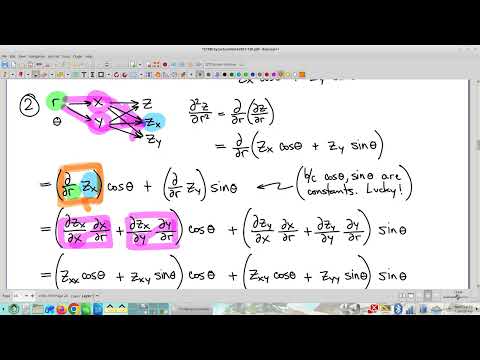
- For a second derivative such as Z_rr when Z = Z(x,y) and x,y depend on r, treat Z_x and Z_y as functions of x and y too; the dependency diagram then supplies the correct chain-rule paths.
- A partial derivative with respect to r holds theta fixed, so factors such as cos(theta) are constants and can be pulled outside the derivative.
- Coordinate choice should match a function's symmetry: for a point-charge potential proportional to 1/rho, spherical-coordinate angular derivatives vanish, making the Laplacian check far simpler than in rectangular coordinates.
- The chain rule can be written as relationships between derivative operators; solving the resulting 2-by-2 system translates first-derivative operators between rectangular and polar coordinates.
- For any unit direction v, the directional derivative is ∇f · v; rotating axes can make v a standard basis direction and connect this result to ordinary partial derivatives.
- df/ds measures change per unit distance and describes geometric steepness, while df/dt also depends on the speed of motion along the path.
Chapters
0:00
Second Derivatives Through Polar-Coordinate Composition
- Set up Z as a function of X and Y, with X = r cos(theta) and Y = r sin(theta).
- Apply the multivariable chain rule first to compute Z_r as Z_x times x_r plus Z_y times y_r.
- To obtain Z_rr, differentiate the entire first-derivative expression with respect to r.
5:30
Put Z_x and Z_y on the Dependency Diagram
- When differentiating Z_x with respect to r, avoid writing the ambiguous expression Z_xr as if Z depended directly on both x and r.
- Because Z_x and Z_y are functions of x and y, add them to the dependency diagram as intermediate functions.
- The diagram then gives two chain-rule paths for each derivative with respect to r: through x and through y.
11:30
Use Constants, Clear Notation, and Deliberate Layout
- In an r-partial derivative, theta is held constant, so cos(theta) can be factored out rather than handled with the product rule.
- Add functions such as Z_x to a dependency diagram when needed to reveal chain-rule paths, but do not add every product such as Z_x cos(theta).
- For long calculations, use clearly sized parentheses, align related terms, and proceed one step at a time to avoid losing factors or grouping.
16:35
Why the Spherical Laplacian Is Worth Learning
- The Laplacian appears in the wave equation, heat equation, and electrostatics, making it important in physics and engineering.
- Clark Bray contrasts the compact rectangular-coordinate Laplacian with its more elaborate spherical-coordinate form.
- Spherical coordinates can still be a major simplification when a physical quantity depends only on distance from a center.
20:10
Use the Chain Rule to Relate Coordinate Derivative Operators
- For polar coordinates, write the chain rule in operator notation to express derivatives in one coordinate system using derivatives in another.
- Treat the rectangular partial-derivative operators as unknowns in a 2-by-2 linear system and solve for them using linear algebra.
- The same chain-rule strategy relates rectangular and spherical second partials, although spherical coordinates require more bookkeeping.
23:40
A Point-Charge Potential Makes the Spherical Laplacian Simple
- Test a point-charge electric potential proportional to 1/rho in Laplace's equation, away from the charge at the origin.
- In rectangular coordinates, checking the Laplacian requires six second partial derivatives of a function involving a square root and repeated product-rule work.
- In spherical coordinates, the theta and phi derivative terms vanish because the potential depends only on rho; the remaining radial term also evaluates to zero.
- Choose coordinates that match the symmetry of the function: radial dependence alone eliminates most of this Laplacian calculation.
32:10
Interpret Partial Derivatives as Change Along Coordinate Directions
- A partial derivative describes how a function changes when the input moves along one coordinate axis while other coordinates stay fixed.
- For a parameterized line through a point, apply the chain rule to the composed function f(x(t), y(t), z(t)) to compute its rate of change along the line.
- The gradient dotted with a standard basis vector selects the corresponding partial derivative.
38:45
Rotating the Axes Makes Any Unit Direction a Basis Direction
- A direction that is not a standard basis vector in one coordinate system can be made an axis by rotating the coordinate system.
- The directional change of a function is an intrinsic vector-based idea; the chosen coordinates are a convenient description, not the underlying object.
- Restricting the argument to rotations preserves distances and avoids complications from coordinate changes that rescale space.
45:00
Define the Directional Derivative Using the Gradient
- For a unit vector v, define the directional derivative of f in direction v as the gradient of f dotted with v.
- This generalizes partial derivatives: the same interpretations of slope and local input-to-output change apply in any unit direction.
- The direction vector can be included as a subscript in directional-derivative notation.
48:10
Distinguish Change per Distance from Change per Time
- The notation df/ds describes function change per unit distance along a path, such as the steepness of stairs.
- The rate df/dt depends on how quickly someone moves along that path, so running or walking changes df/dt without changing the stairs' steepness.
- Directional derivatives are partial-derivative ideas extended beyond fixed coordinate axes because any unit direction can serve as an axis.
Summary, takeaways, and chapters were generated by AI from the video's transcript and may contain errors. The video belongs to its creator, Clark Bray Math.