2026 09 23 Math219 01
 Watch on YouTube →
Overview
Clark Bray Math connects second-derivative chain-rule bookkeeping to coordinate choice, then introduces directional derivatives as rates of change along unit vectors. A radial potential of the form k/ρ illustrates why the spherical-coordinate Laplacian can reduce a long Cartesian calculation to an almost immediate verification.
Key takeaways
- A dependency diagram helps prevent second-derivative chain-rule errors by showing which quantities depend on which variables and which variables are held constant.
- For the radial function f = k/ρ, the spherical Laplacian is easy to check: its angular terms vanish and the radial expression reduces to a constant whose derivative is zero.
- Coordinate systems are computational choices; the direction of change is intrinsic, and any unit direction can be treated as a coordinate axis after an appropriate rotation.
- With a unit direction vector v, the directional derivative is ∇f · v, giving the rate of change per unit distance along v.
- Normalize a supplied non-unit vector before using the unit-vector directional-derivative formula; otherwise the result is scaled by the vector's magnitude.
- Directional-derivative conventions vary: some definitions require a unit vector and preserve the rate-per-distance interpretation, while others allow arbitrary vectors.
Chapters
0:00
Second-Derivative Chain Rules: Let the Dependency Diagram Guide You
- Treat z_x and z_y as functions of x and y whenever z depends on x and y; add them to the dependency diagram as new variables.
- For a partial derivative with respect to r, the diagram identifies which quantities vary and which, such as θ in the example, remain constant.
- Use the diagram to identify actual intermediate variables in a composition and avoid adding unrelated terms such as θ to the chain rule.
- Work through each derivative step deliberately and use clear grouping and parentheses to reduce avoidable errors.
6:20
The Laplacian in Cartesian and Spherical Coordinates
- The Laplacian is important in modeling heat flow, electron behavior and electric potential, as well as wave motion.
- Clark Bray Math compares its Cartesian form with the more compact spherical-coordinate form, which can be advantageous for radial problems.
- The two formulas represent the same operator expressed in different coordinates; the lecture previews how chain-rule relationships establish that equivalence.
8:16
Operator Notation and Chain-Rule Coordinate Conversion
- An operator identity means the two derivative expressions produce the same result when applied to a function such as W.
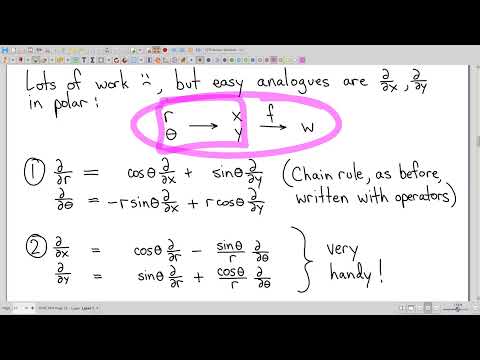
- In polar coordinates, the chain rule relates composed derivatives in r and θ to uncomposed derivatives in x and y.
- Solving those relationships as a 2-by-2 linear system gives expressions for the Cartesian derivative operators in polar-coordinate terms.
- Clark Bray Math says the current exam excludes this material, but recommends keeping the coordinate-conversion formulas for Exam 2.
13:14
Verifying a Radial Potential with the Spherical Laplacian
- For the example potential f = k/ρ, checking the Cartesian Laplacian requires repeated derivatives involving denominators, square roots, quotient rules and product rules.
- In spherical coordinates, the θ- and φ-derivative terms vanish because k/ρ contains neither angle.
- The remaining radial term simplifies after multiplication by ρ² to a constant, whose next derivative is zero.
- The spherical calculation verifies that the Laplacian is zero with far less algebra than the Cartesian calculation.
19:25
Why Radial Physics Favors Spherical Coordinates
- A function depending only on distance from a center is naturally represented by the spherical radius ρ, not by separate Cartesian coordinates.
- Gravity and electric potential are examples where distance matters while angular variables may not.
- Clark Bray Math also points to atoms and the Schrödinger equation as settings where spherical coordinates suit the radial structure of the problem.
22:15
Partial Derivatives as Rates Along Coordinate Directions
- A partial derivative can be understood as a graph slope or as the factor converting an input change into an output change.
- Applying the chain rule to a function of x, y and z along a parameterized path in a coordinate direction recovers the corresponding partial derivative.
- The gradient dotted with a standard basis vector selects the matching partial derivative.
- These interpretations apply directly to coordinate directions; changing several variables together requires a derivative along a more general direction.
27:00
Vectors Are Intrinsic; Coordinate Axes Are a Choice
- A direction on a hiking map, such as northeast, has meaning independently of how the map's x- and y-axes are drawn.
- Coordinate axes can be rotated to suit a problem—for example, aligning one axis with a beach—without changing the underlying direction.
- Any unit vector can be made a standard basis vector by choosing an appropriately rotated coordinate system.
- The rate of change along a direction is therefore not fundamentally tied to a particular coordinate system.
34:54
Directional Derivatives: Unit Vectors, Gradient Formula and Notation
- Clark Bray Math defines the directional derivative for a unit vector as the rate of change along that direction, extending the idea of a partial derivative beyond standard axes.
- Its convenient computational formula is the gradient dotted with the unit direction vector.
- The notation D_v f records the direction v, function f and evaluation point; df/ds can express change per unit distance traveled.
- Distance-based change df/ds differs from time-based change df/dt, which also depends on travel speed.
42:22
Computing Slopes and Temperature Change Along a Direction
- A requested slope in a specified direction is a directional derivative and can be computed with the gradient–direction dot product.
- For temperature T depending on three position variables, the rate dT/ds is computed by the same directional-derivative formula.
- The direction vector must have unit length under the lecture's definition; normalize a given non-unit vector by dividing it by its magnitude.
- A direction is taken in the function's domain—for a hill, it describes movement across the map, while the graph determines whether that movement goes uphill or downhill.
48:13
Different Conventions for Non-Unit Directional Derivatives
- Some mathematicians and applied fields call the gradient dotted with any direction vector a directional derivative, without requiring a unit vector.
- Under that broader convention, the result need not equal slope per unit distance or the other interpretations developed in the lecture.
- The unit-vector convention preserves those interpretations, so students should check which definition an engineering, physics or mathematics instructor is using.
- Clark Bray Math describes both conventions as reasonable but warns that the shared terminology can cause miscommunication.
Summary, takeaways, and chapters were generated by AI from the video's transcript and may contain errors. The video belongs to its creator, Clark Bray Math.