2026 09 21 Math219 03
 Watch on YouTube →
Overview
Clark Bray Math develops the multivariable chain rule by treating derivatives as factors that transform input velocities into output velocities: composing functions therefore composes their derivative matrices in the order the transformations act. The lecture applies this framework across different dimensions, shows how to extract a single partial derivative from a matrix product, warns against canceling partial-derivative notation, and derives a practical path-by-path formula for targeted calculations.
Key takeaways
- A derivative matrix transforms an input velocity into an output velocity, so for x → f(x) → g(f(x)), the composition derivative applies Df first and Dg second.
- For column-vector conventions, the chain-rule product is Dg(f(a))Df(a): the first-acting matrix is on the right, and each derivative is evaluated at the input to its own function.
- To find one entry of a derivative-matrix product, take the dot product of the corresponding output row and input column instead of computing the full product.
- Partial-derivative notation cannot be canceled like ordinary fractions because the derivatives being canceled hold different sets of variables constant.
- For a composition through y₁, …, yₘ, the partial ∂zᵢ/∂xⱼ is the sum over k of (∂zᵢ/∂yₖ)(∂yₖ/∂xⱼ), with each term representing one route by which a change can propagate.
Chapters
0:00
Single-Variable Chain Rule: Derivatives as Velocity Factors
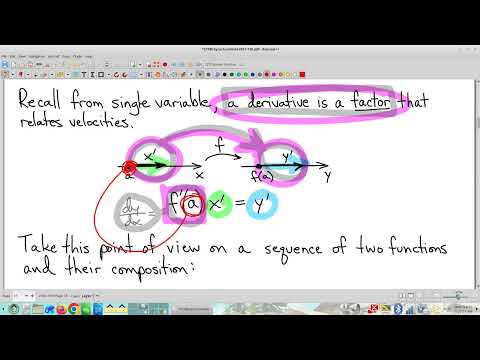
- A derivative acts as a factor: multiply an input velocity by f′ to obtain the output velocity.
- For z = g(f(x)), changes pass first through f and then through g, so the total factor is the product of the two derivatives.
- Evaluate each derivative where its function acts: f′ at a and g′ at f(a), since g receives f(a) as its input.
7:33
Extending the Factor Argument to Multivariable Derivatives
- Clark Bray applies the same velocity-factor reasoning to multivariable functions, where derivative factors are matrices rather than scalars.
- For a composition x → f(x) → g(f(x)), the derivative matrices transform the input velocity through the intermediate and final spaces.
- The composition derivative is the matrix product of the component derivatives, evaluated at the inputs where each function acts.
15:00
Different Dimensions, Evaluation Points, and Matrix Order
- The chain-rule argument works when the input, intermediate, and output spaces have different dimensions; the spaces need not all be two-dimensional.
- The derivative of g is evaluated at f(a), because g acts on the output of f.
- Matrix multiplication is not commutative: for column-vector velocities, the first transformation acts on the right and the second on the left.
- To avoid left-versus-right confusion, track which function acts first and write the matrix product to apply that transformation first.
19:51
Applying the Matrix Chain Rule to a Given Composition
- The worked problem computes the derivative matrix of a composition by multiplying the derivative matrices in their correct order.
- The supplied value f(1, 2) = (3, 10) identifies the correct evaluation point for the derivative of g.
- Matrix dimensions can expose an order mistake when the product will not fit, but Bray cautions that incorrect orders can sometimes still be dimensionally valid.
- To select ∂z₃/∂x₁ from the composition derivative, use the third output row and first input column.
25:20
Parametric Curves and Gradients as Chain-Rule Special Cases
- When the original input is a single parameter t, the derivative matrices have one column and describe velocities along parametric curves.
- A map f sends a curve in ℝⁿ to a curve in ℝᵐ; its derivative matrix converts the input curve’s velocity into the output curve’s velocity.
- When the output has one component, the derivative matrix has one row, connecting the chain rule to the familiar gradient dot-product formula.
32:12
Compute One Partial Derivative Without Building the Full Matrix
- If a problem asks for only one entry of the composition derivative, there is no need to calculate every entry of both derivative matrices.
- A single entry of a matrix product is the dot product of the corresponding row of the left matrix and column of the right matrix.
- This row-and-column calculation produces the requested partial derivative directly while avoiding unused matrix entries.
35:02
Why Partial-Derivative Fractions Cannot Be Canceled
- The notation ∂zᵢ/∂yₖ · ∂yₖ/∂xⱼ can resemble a cancelable fraction, but the apparent cancellation is invalid.
- In ∂yₖ/∂xⱼ, the other x variables are held fixed while changes in xⱼ can affect all intermediate y variables.
- In ∂zᵢ/∂yₖ, the other y variables are held fixed, so it describes a different variation scenario.
- The valid chain-rule entry is a full sum of products over intermediate variables, not a shortened expression obtained by canceling symbols.
40:13
Derive the Partial-Derivative Formula by Tracking Paths
- For zᵢ as a function of xⱼ through y₁, …, yₘ, a change in xⱼ can affect zᵢ along a separate path through each intermediate variable.
- The path through yₖ contributes the product (∂zᵢ/∂yₖ)(∂yₖ/∂xⱼ): first track the change from xⱼ to yₖ, then from yₖ to zᵢ.
- Summing the contributions from all intermediate-variable paths gives the corresponding entry of the matrix chain rule.
- The path interpretation provides a direct way to write one requested partial derivative without constructing the entire derivative matrix.
46:44
Use Intermediate-Variable Paths in a Worked Example
- For the requested partial ∂z₂/∂x₂, identify the intermediate variables y₁ and y₂ and write one contribution for each path.
- Each contribution follows the same pattern: multiply the derivative from x₂ to an intermediate y variable by the derivative from that y variable to z₂.
- Bray recommends drawing the variable-dependency diagram and identifying the input, output, and intermediate variables rather than memorizing a formula tied to labels such as x, y, and z.
Summary, takeaways, and chapters were generated by AI from the video's transcript and may contain errors. The video belongs to its creator, Clark Bray Math.