2026 09 21 Math219 02
 Watch on YouTube →
Overview
Clark Bray Math develops the multivariable chain rule as multiplication of derivative matrices, then shows how to compute individual partial derivatives by tracing change through intermediate variables. The lecture also addresses two common errors—cancelling partial-derivative notation and reusing variable names across a composition—and explains how renaming variables or adding an identity variable can put complicated dependencies into a valid composition of functions.
Key takeaways
- For a composition z = g(f(x)), the derivative matrix is Dg evaluated at f(x), multiplied on the right by Df evaluated at x; matrix order follows function order.
- A single chain-rule entry ∂zᵢ/∂xⱼ can be computed as a row-column dot product, avoiding calculation of the entire derivative matrix.
- Partial-derivative symbols cannot be cancelled like ordinary fractions: ∂yₖ/∂xⱼ allows other y variables to change, while ∂zᵢ/∂yₖ holds the other y variables constant.
- The path method generates one chain-rule term per intermediate variable that can transmit change from the chosen input to the chosen output.
- Distinct names for original inputs and intermediate outputs—such as x, y, and z, or x, y, u, and v—make evaluation points and composition structure clear.
- When a dependency system includes an original input in a later-stage formula, introducing an identity intermediate variable such as x₁* = x₁ can turn the system into a valid composition.
Chapters
0:00
Derivative Matrices Multiply in Composition Order
- A derivative is a multiplicative factor that converts input changes into output changes; composing functions therefore multiplies their derivative factors.
- For a composition, multiply the derivative of the second function evaluated at the first function’s output by the first function’s derivative.
- In the example, the provided values include f(1,2) = (3,1,0), so the given derivative of g at (3,1,0) is the one needed.
- To find ∂z₃/∂x₁, select row 3 for output z₃ and column 1 for input x₁; the example’s matrix entry is 3.
5:52
Parametric Curves Turn Derivative Matrices into Velocity Maps
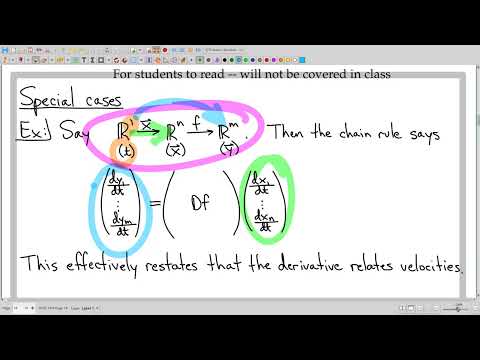
- When the original input is a single parameter t, each derivative matrix has one column because each function has one input variable.
- A function of t describing position in ℝⁿ or ℝᵐ is a parametric curve, and its derivative is a velocity vector.
- The derivative matrix of a function maps an input curve’s velocity to the velocity of its image curve.
- If the eventual output is also scalar, the derivative matrix has one row and its action is a dot product with the gradient.
12:07
Compute One Chain-Rule Entry Without Building the Whole Matrix
- When only one partial derivative is needed, use the corresponding row of the second derivative matrix and column of the first.
- The desired entry is their row-by-column dot product, so there is no need to calculate every entry of the composition’s derivative matrix.
- Do not cancel matching symbols in expressions such as ∂zᵢ/∂yₖ · ∂yₖ/∂xⱼ: the two partial derivatives describe different dependency scenarios.
- Varying xⱼ can change several intermediate variables y₁, y₂, and others, whereas taking a partial with respect to yₖ holds the other y variables constant.
19:39
Trace Variable Paths to Build the Chain Rule
- Represent the composition as a dependency diagram from original inputs x, through intermediate variables y, to final outputs z.
- For ∂zᵢ/∂xⱼ, list every path by which a change in xⱼ can affect zᵢ through an intermediate variable.
- Each path contributes a product of two factors: the change from xⱼ to yₖ and the change from yₖ to zᵢ.
- Each intermediate variable contributes one term, making the diagram a practical alternative to memorizing a formula tied to particular variable names.
26:04
Apply the Path Method to a Two-Function Example
- Start by drawing the inputs and outputs of each function, ensuring that the first function’s outputs are exactly the second function’s inputs.
- For the requested partial derivative ∂z₂/∂x₂, the diagram produces one term through y₁ and another through y₂.
- The number of chain-rule terms depends on the intermediate variables in the problem; it is not fixed by a memorized template.
- Diagramming remains useful when inputs and outputs have unequal counts or use irregular names such as α, γ, or P.
31:45
Use Dummy Variables to Prevent Single-Variable Chain-Rule Errors
- In the example with f(x) = x² and g(x) = x³, multiplying g′(x) by f′(x) is wrong because g′ must be evaluated at f(x).
- Name the output of f with a distinct variable, such as y, and rewrite g as a function of y so the composition’s inputs and outputs stay clear.
- With g(y) = y³, differentiate to get 3y², then substitute y = x² to express the composition derivative in terms of x.
- Distinct names handle the evaluation bookkeeping and reduce the risk of treating the input to g as the original x.
38:18
Rename Intermediate Variables in Multivariable Compositions
- If f takes inputs x and y and produces outputs u and v, write the following function g in terms of u and v rather than reusing x and y.
- Changing a function’s dummy-variable names does not change the function; it clarifies which quantities are inputs and which are outputs.
- The derivative matrices then multiply in composition order, with the renamed intermediate variables making evaluation points explicit.
- For the composition to be written as a function of x and y, substitute f’s formulas for u and v into the derivative expression.
41:18
Make an Unorganized Dependency System into a Valid Composition
- A collection of equations may define y₁ and y₂ from x₁ and x₂, while z₁ and z₂ depend on both the y variables and an original input such as x₁.
- That dependency diagram is not yet a composition: the second-stage outputs depend on an extra original input, and partial-derivative meanings can become ambiguous.
- Introduce a new intermediate variable such as x₁* and define x₁* = x₁, allowing the second-stage function to use only intermediate variables.
- The identity variable changes the representation, not the underlying values; the resulting diagram is a valid composition, and each intermediate variable supplies a term in the chain rule.
Summary, takeaways, and chapters were generated by AI from the video's transcript and may contain errors. The video belongs to its creator, Clark Bray Math.