2026 09 21 Math219 01
 Watch on YouTube →
Overview
Clark Bray Math develops the multivariable chain rule from derivative-matrix multiplication, then shows how to compute individual partial derivatives by summing contributions through intermediate variables. The lecture also explains why matching partial-derivative symbols cannot be canceled, how relabeling variables and repairing dependency diagrams prevent errors, and how the same diagram-based method handles second derivatives.
Key takeaways
- The derivative matrix of a composition is the product of the component derivative matrices, and the order follows the order in which the functions act.
- A single composed partial can be computed as a dot product between one relevant matrix row and one relevant matrix column, avoiding unnecessary calculation of the full matrix product.
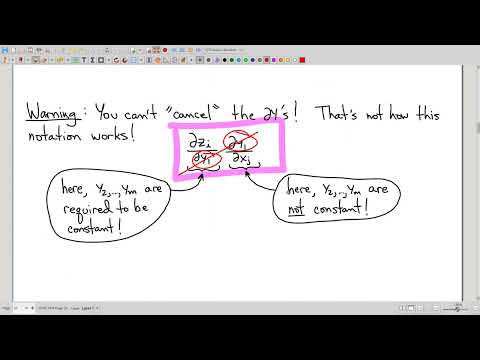
- Partial derivatives that share a variable symbol cannot generally be canceled: each derivative specifies which other variables are held constant, and those conditions differ across stages of a composition.
- For each intermediate variable, form one chain-rule term by multiplying the derivative from input to intermediate variable by the derivative from intermediate variable to output; sum all such terms.
- Before applying the chain rule, draw a dependency diagram and ensure each stage’s outputs match the next stage’s inputs; relabel variables or introduce an identity variable when necessary.
- For second derivatives, first compute the requested first derivative, then differentiate it again while respecting the diagram’s constant variables and treating first partials as functions of the original function’s inputs.
Chapters
0:00
Derivative Matrices Multiply Along a Function Composition
- For a composition, the output of the first function must match the input of the second.
- The derivative matrix of the composition is the product of the two derivative matrices, in the order that the transformations occur.
- When the initial input is time, the derivative matrices have one column and represent velocity vectors for parametric curves.
4:50
Single-Input and Single-Output Cases of the Chain Rule
- A function with one initial input variable has a derivative matrix with one column.
- If the composition also has one eventual output, its derivative matrix has one row.
- In the scalar-output case, multiplying the derivative matrix by a vector can also be written as a dot product with the transposed matrix.
6:19
Compute One Composed Partial from a Matrix Row and Column
- For functions mapping x variables to y variables and then y variables to z variables, a single composed partial is one entry of the product of their derivative matrices.
- That entry is the dot product of the relevant row from the first matrix and column from the second.
- Only the row and column needed for the requested partial have to be computed, rather than the entire product matrix.
10:23
Why Matching Partial-Derivative Symbols Cannot Be Canceled
- In the chain-rule term involving ∂y₁/∂xⱼ and ∂zᵢ/∂y₁, the two appearances of y₁ belong to different partial-derivative contexts.
- The first partial varies xⱼ while the other x variables are held constant, so the y variables may change together.
- The second partial varies y₁ while the other y variables are held constant; canceling the y₁ symbols would ignore these different assumptions and produce an invalid rule.
14:56
Interpret Each Chain-Rule Term as a Path of Change
- Each product of partial derivatives represents how a change in an initial variable propagates through one intermediate variable to an output variable.
- For a requested ∂zᵢ/∂xⱼ, form one term for every intermediate y variable and add the terms.
- The path interpretation reconstructs the matrix-product result without requiring students to write out the full derivative matrices.
21:28
Use a Dependency Diagram to Build the Chain Rule
- Before composing functions, check that the first function’s outputs are exactly the second function’s inputs.
- For the example computing ∂z₂/∂x₂, the intermediate variables y₁ and y₂ produce two chain-rule terms.
- The diagram identifies the roles of x₂, z₂, and each intermediate variable, helping generate the formula before calculating individual partials.
25:33
Prevent Variable Confusion in Single-Variable Compositions
- The example f(x) = x² followed by a cubing function shows that casually multiplying derivatives evaluated at x gives the wrong result.
- The outer derivative must be evaluated at f(x), the value actually passed into the second function.
- Renaming the first function’s output as y and writing the second function in terms of y makes the composition and derivative bookkeeping explicit.
32:52
Relabel Multivariable Inputs Before Applying the Chain Rule
- When composing multivariable functions, name the first function’s outputs with new variables rather than reusing its inputs.
- Rewrite the second function using those intermediate variables; changing dummy-variable names preserves the function itself.
- In the example, the intermediate variable V is replaced using its definition, x² − y², so the final derivative is expressed in the original inputs.
35:41
Repair Non-Composition Dependency Diagrams with a New Variable
- A diagram is not automatically a valid chain-rule setup: the chain rule applies to compositions, where each stage’s outputs become the next stage’s inputs.
- The example’s z₁ depends on x₁ as well as y₁ and y₂, so the original arrangement does not have a clear intermediate-variable stage.
- Introducing x₁* with the same value as x₁ creates an explicit composition; the repaired diagram then gives three paths for ∂z₁/∂x₁.
44:29
Apply the Chain Rule Twice for a Polar-Coordinate Second Partial
- For z = z(x,y), with x and y functions of r and θ, first compute zᵣ using the intermediate variables x and y.
- To obtain zᵣᵣ, take another r partial while treating θ as constant; xᵣ = cos θ factors out in this example, a convenience that is not guaranteed in general.
- Because zₓ and zᵧ are also functions of x and y, add them to the dependency diagram and use the chain rule again to differentiate zₓ with respect to r.
Summary, takeaways, and chapters were generated by AI from the video's transcript and may contain errors. The video belongs to its creator, Clark Bray Math.