10 trigonometric equations that separate EXPERTS from beginners
 Watch on YouTube →
Overview
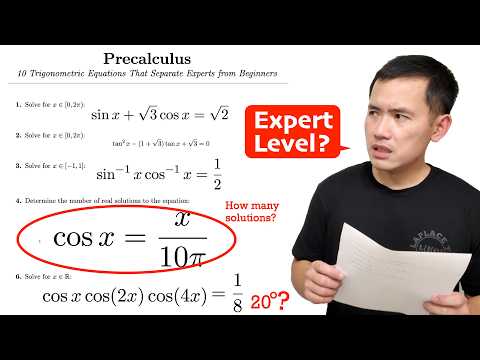
blackpenredpen works through 10 trigonometric equations on domains ranging from restricted intervals to all real numbers, using angle-addition identities, inverse-trig relationships, graph intersections, and geometric-series sums. The solutions emphasize domain checks and extraneous-root control, including a count of 21 real intersections for cos x = x/(10π) and the rejection of a negative candidate in the final inverse-sine equation.
Key takeaways
- The identity a sin x + b cos x can be rewritten as a single shifted sine; recognizing the special-angle coefficients in sin x + √3 cos x produces sin(x + π/3).
- For inverse-trigonometric equations, principal ranges and input domains are essential: arcsin x requires −1 ≤ x ≤ 1, and squaring an equation can introduce candidates that fail the original sign condition.
- Graph-based counting can reveal solutions that are easy to miss algebraically: cos x = x/(10π) has 21 real solutions, including the endpoint x = 10π but not x = −10π.
- Products of cosine terms at doubling angles telescope through sin(2a) = 2 sin a cos a; for cos x cos 2x cos 4x = 1/8, this leads to sin(8x) = sin x, subject to excluding sin x = 0.
- A finite-looking sequence 1 + sin²x + sin⁴x + ⋯ is an infinite geometric series, and its sum is valid only when |sin²x| < 1; equating it to 4 yields four solutions on [0, 2π].
Chapters
0:00
Combine Sine and Cosine into One Angle
- For sin x + √3 cos x = √2 on [0, 2π], divide by 2 to identify cos(π/3)sin x + sin(π/3)cos x.
- Apply the sine addition identity to obtain sin(x + π/3) = √2/2.
- The solutions in the requested interval are x = 5π/12 and x = 23π/12.
4:45
Factor a Quadratic in tan x
- Treat the equation as a quadratic in tan x and factor it as (tan x − 1)(tan x − √3) = 0.
- On [0, 2π], tan x = 1 gives π/4 and 5π/4; tan x = √3 gives π/3 and 4π/3.
- The tangent period is π, so each reference-angle solution has a second solution π radians later.
7:41
Turn an Inverse-Sine Product into a Quadratic
- For arcsin(x)·arccos(x) = 1/2, first require −1 ≤ x ≤ 1 and use arcsin(x) + arccos(x) = π/2.
- Set y = arcsin(x); then y(π/2 − y) = 1/2, a quadratic whose roots are y = (π ± √(π² − 8))/4.
- Both angles lie in the principal range of arcsin, giving x = sin((π ± √(π² − 8))/4).
16:36
Count Intersections for cos x = x/(10π)
- Compare the cosine curve with the line y = x/(10π); across five positive periods, the curve contributes 10 intersections.
- Evenness of cosine gives 10 corresponding intersections on the negative side, but the endpoints are not counted by that interval tally.
- At x = 10π, both sides equal 1, adding one more solution; x = −10π is not a solution, so the total is 21.
22:44
Reduce a Triple-Angle Fraction Equation
- For cos(3x)/cos x + sin(3x)/sin x = 2, combine fractions using denominator sin x cos x.
- The numerator becomes sin(4x), so the left side simplifies to 4 cos(2x), with sin x and cos x nonzero in the original equation.
- Solving cos(2x) = 1/2 for x in [0, 2π] gives π/6, 5π/6, 7π/6, and 11π/6.
29:04
Simplify Nested Inverse-Tangent and Sine Functions
- Represent tan(arctan x) with a right triangle having opposite side x, adjacent side 1, and hypotenuse √(1 + x²).
- This gives cos(arctan x) = 1/√(1 + x²); applying sin(arctan u) = u/√(1 + u²) then reduces the nested expression to 1/√(2 + x²).
- Setting that result equal to 1/3 yields x² = 7, so the real solutions are x = ±√7.
33:34
Solve a Trigonometric Base Raised to a Trigonometric Power
- For (sin x)^(cos(x − π/4)) = 1 on [0, 2π], consider a base of 1 and a zero exponent as separate cases.
- The base-one case gives sin x = 1, or x = π/2; the zero-exponent case gives cos(x − π/4) = 0.
- The resulting angles x = 3π/4 and 7π/4 join π/2 as the solutions.
37:49
Use a Doubling Product to Solve cos x cos 2x cos 4x
- For cos x cos 2x cos 4x = 1/8, multiply by sin x and repeatedly apply sin(2a) = 2 sin a cos a.
- When sin x ≠ 0, the product equation reduces to sin(8x) = sin x.
- The two angle families are x = 2kπ/7 and x = (2k + 1)π/9, for integers k; exclude values that are multiples of π because the original product is then ±1, not 1/8.
46:43
Solve a Sum of Two Inverse Sines Without Squaring Too Early
- For arcsin x + arcsin(2x) = π/3, first isolate arcsin(2x) and apply sine to both sides.
- The sine-difference identity gives 2x = (√3/2)√(1 − x²) − x/2, which simplifies to 5x = √3√(1 − x²).
- Squaring gives x² = 3/28, but the unsquared equation requires x ≥ 0; the valid solution is x = √21/14, while the negative root is extraneous.
51:31
Sum an Infinite Geometric Series of Even Sine Powers
- Interpret 1 + sin²x + sin⁴x + ⋯ as a geometric series with common ratio sin²x; convergence requires sin²x < 1.
- Its sum is 1/(1 − sin²x) = 1/cos²x, so setting the sum equal to 4 gives cos²x = 1/4.
- On [0, 2π], the four solutions are π/3, 2π/3, 4π/3, and 5π/3.
Summary, takeaways, and chapters were generated by AI from the video's transcript and may contain errors. The video belongs to its creator, blackpenredpen.