10 quadratic equations that separate experts from beginners
 Watch on YouTube →
Overview
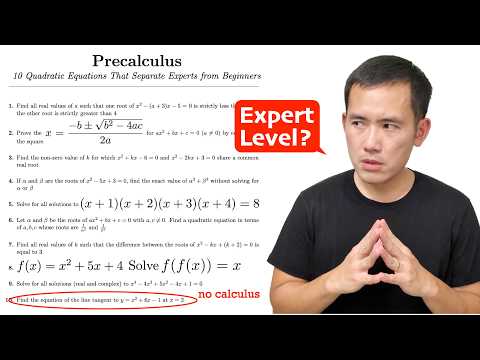
blackpenredpen works through 10 quadratic-focused problems, using graph behavior, completing the square, Vieta’s formulas, substitutions, discriminants, and tangent-line conditions. The set ranges from proving the quadratic formula to solving a quartic by the substitution x + 1/x; one displayed result needs correction: the root-difference problem gives k = 2 ± √21, not −17/3.
Key takeaways
- For an upward-opening quadratic to have one root below 2 and another above 4, it is enough to require negative function values at both boundaries; for x² − (a + 3)x − 5, this gives a > −1/4.
- Vieta’s formulas can compute symmetric expressions without solving for individual roots: for α + β = 5 and αβ = 3, the identity α³ + β³ = (α + β)((α + β)² − 3αβ) gives 80.
- For a quartic with reciprocal symmetry, dividing by x² and substituting u = x + 1/x can reduce a fourth-degree equation to a quadratic in u.
- A tangent line can be found without derivatives by imposing a repeated intersection: equating a candidate line to the parabola and setting the intersection quadratic’s discriminant to zero determines the slope.
- For x² − kx + (k + 2) = 0 to have roots differing by 3, Vieta’s formulas give k² − 4k − 17 = 0 and k = 2 ± √21; the transcript’s −17/3 conclusion is incorrect.
Chapters
0:00
Root Placement for x² − (a + 3)x − 5
- To place one root below 2 and the other above 4 for an upward-opening parabola, require f(2) < 0 and f(4) < 0.
- The inequalities give a > −7/2 and a > −1/4; both hold when a > −1/4.
- Checking function values at interval boundaries captures root location, beyond merely checking that the discriminant is positive.
4:49
Proving the Quadratic Formula by Completing the Square
- Start from ax² + bx + c = 0 and multiply through by 4a to form the perfect-square expression 4a²x² + 4abx.
- Add b² to both sides to obtain (2ax + b)² = b² − 4ac.
- Taking square roots and isolating x yields x = (−b ± √(b² − 4ac))/(2a).
7:43
Finding a Shared Root of Two Quadratics
- For x² + kx − 6 = 0 and x² − 2kx + 3 = 0, call a shared root r and substitute it into both equations.
- Adding twice the first equation to the second eliminates the kr terms and gives 3r² − 9 = 0, so r = ±√3.
- Substitution back into either equation gives k = ±√3.
11:13
Using Vieta’s Formulas to Compute α³ + β³
- For roots α and β of x² − 5x + 3 = 0, Vieta’s formulas give α + β = 5 and αβ = 3.
- Squaring the sum gives α² + β² = 25 − 2(3) = 19.
- Apply α³ + β³ = (α + β)(α² − αβ + β²) to get 5(19 − 3) = 80.
15:18
Reducing a Four-Factor Equation with a Substitution
- Group (x + 1)(x + 4) and (x + 2)(x + 3); each pair has the same linear coefficient, 5x.
- Set t = x² + 5x + 4, making the original product equation t(t + 2) = 8, or (t + 4)(t − 2) = 0.
- Back-substitution gives x = (−5 ± i√7)/2 from t = −4 and x = (−5 ± √17)/2 from t = 2.
20:13
Constructing a Quadratic with Roots 1/α² and 1/β²
- Starting from ax² + bx + c = 0, whose roots are α and β, the target roots are reciprocals of the squared original roots.
- Their product is 1/(α²β²) = a²/c², and their sum is (α² + β²)/(α²β²) = (b² − 2ac)/c².
- A quadratic with those roots is c²t² + (2ac − b²)t + a² = 0, assuming a and c are nonzero.
26:03
Finding Root Difference 3 with Vieta’s Formulas
- For x² − kx + (k + 2) = 0, Vieta gives α + β = k and αβ = k + 2.
- A root difference of 3 requires (α − β)² = (α + β)² − 4αβ = 9.
- This produces k² − 4k − 17 = 0, so k = 2 ± √21; the transcript’s stated value −17/3 is an algebra error.
30:09
Solving f(f(x)) = x Without Expanding a Quartic
- For f(x) = x² + 5x + 4, set y = f(x); then f(f(x)) = x becomes y² + 5y + 4 = x alongside y = x² + 5x + 4.
- Subtracting the equations factors to (y − x)(y + x + 6) = 0, reducing the problem to two cases.
- The case y = x gives the double root x = −2; y = −x − 6 gives the complex roots x = −3 ± i.
37:05
Solving a Symmetric Quartic with x + 1/x
- For x⁴ − 4x³ + 5x² − 4x + 1 = 0, note x = 0 is not a root and divide by x².
- Group terms using u = x + 1/x; adding 2 to complete the square turns the equation into u² − 4u + 3 = 0.
- The cases u = 1 and u = 3 yield x = (1 ± i√3)/2 and x = (3 ± √5)/2, respectively.
43:39
Finding the Tangent to y = x² + 6x − 1 Without Calculus
- At x = 2, the parabola passes through (2, 15); write a candidate tangent as y = 15 + m(x − 2).
- Set the line equal to the parabola and require the resulting quadratic in x to have exactly one intersection, so its discriminant is zero.
- The condition gives (m − 10)² = 0, hence the tangent line is y = 10x − 5.
Summary, takeaways, and chapters were generated by AI from the video's transcript and may contain errors. The video belongs to its creator, blackpenredpen.