10 Factoring Problems That Separate Experts From Beginners
 Watch on YouTube →
Overview
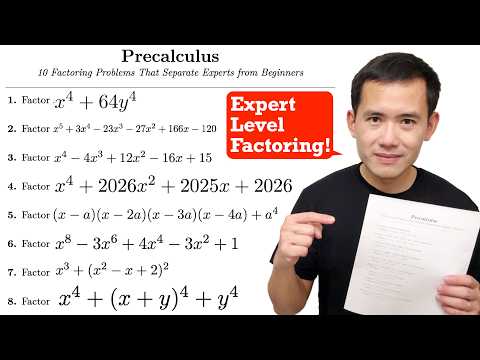
blackpenredpen works through 10 polynomial factoring problems, progressing from completing the square and the Rational Root Theorem to quartic factorization, reciprocal polynomials, symmetric expressions, and cyclic identities. The solutions emphasize pattern recognition and strategic rearrangement while aiming for integer-coefficient factors, including examples such as x^4 + 64y^4, x^3 + y^3 + z^3 - 3xyz, and a cyclic degree-four polynomial.
Key takeaways
- Completing a square can convert an apparently unfactorable sum of fourth powers into a difference of squares, as x^4 + 64y^4 factors into two integer-coefficient quadratics.
- For monic polynomials with integer roots, synthetic division can both test candidate roots and progressively reduce the degree; the quintic example has roots 1, 2, 3, -4, and -5.
- A quartic can often be factored by assuming two monic quadratics, matching selected coefficients, and checking the remaining coefficient before accepting the result.
- Reciprocal polynomials with symmetric coefficients can be simplified using a substitution such as t = x^2 + 1/x^2, then converted back to polynomial factors.
- Symmetric and cyclic expressions often reveal factors by testing when variables are equal; the degree-four cyclic expression has factors x - y, y - z, x - z, and x + y + z.
- Strategic rearrangement can expose a hidden perfect square: x^4 + (x + y)^4 + y^4 = 2(x^2 + xy + y^2)^2.
Chapters
0:00
Setup: Ten Factoring Problems with Integer-Coefficient Factors
- blackpenredpen introduces 10 polynomial problems and specifies real-number factoring with integer coefficients.
- The problems range from familiar identities to two problems described as especially difficult.
0:24
Problem 1: Complete the Square to Factor x^4 + 64y^4
- Rewrite x^4 + 64y^4 as x^4 + 16x^2y^2 + 64y^4 - 16x^2y^2.
- The first three terms form (x^2 + 8y^2)^2; subtracting (4xy)^2 creates a difference of squares.
- The integer-coefficient factorization is (x^2 - 4xy + 8y^2)(x^2 + 4xy + 8y^2).
2:43
Problem 2: Find Five Integer Roots with Synthetic Division
- For x^5 + 3x^4 - 23x^3 - 27x^2 + 166x - 120, test likely integer roots using synthetic division.
- Testing 1, 2, and 3 successively reduces the polynomial to a quadratic; the remaining roots are -4 and -5.
- The complete factorization is (x - 1)(x - 2)(x - 3)(x + 4)(x + 5).
10:44
Problem 3: Use the Double-Cross Method on a Quartic
- Model x^4 - 4x^3 + 12x^2 - 16x + 15 as (x^2 + ax + 3)(x^2 + bx + 5).
- Match the cubic and linear coefficients to obtain a + b = -4 and 5a + 3b = -16, giving a = b = -2.
- The x^2 coefficient check confirms (x^2 - 2x + 3)(x^2 - 2x + 5).
16:30
Problem 4: Spot a Difference-of-Squares Pattern in a 2026 Quartic
- For x^4 + 2025x^2 + 2025x + 2026, split the terms to expose x^4 + x^2 + 1 and 2025(x^2 + x + 1).
- Complete the square identity x^4 + x^2 + 1 = (x^2 + x + 1)(x^2 - x + 1).
- Factoring out the shared quadratic gives (x^2 + x + 1)(x^2 - x + 2026).
21:33
Problem 5: Pair Symmetric Factors to Reveal a Perfect Square
- Pair (x - a) with (x - 4a), and (x - 2a) with (x - 3a), so both products share x^2 - 5ax.
- Writing t = x^2 - 5ax + 4a^2 turns the expression into t(t + 2a^2) + a^4.
- Completing the square yields (x^2 - 5ax + 5a^2)^2.
25:52
Problem 6: Factor a Reciprocal Octic by Substituting x^2 + 1/x^2
- The palindromic polynomial x^8 - 3x^6 + 4x^4 - 3x^2 + 1 is organized around its middle power, x^4.
- Use x^4 + 1/x^4 = (x^2 + 1/x^2)^2 - 2 to convert the expression into a quadratic pattern.
- Clearing the temporary denominators gives (x^4 - x^2 + 1)(x^4 - 2x^2 + 1), which factors further as (x^2 + x + 1)(x^2 - x + 1)(x - 1)^2(x + 1)^2.
34:12
Problem 7: Recognize a Sum-of-Cubes Structure in a Cubic Square
- The expression is (x^3 + x^2 - x + 2)^2; rearranging its inner cubic exposes the factor x^2 - x + 1.
- The inner polynomial factors as (x^2 - x + 1)(x + 2), using x^3 + 1 = (x + 1)(x^2 - x + 1).
- Thus the full expression is (x^2 - x + 1)^2(x + 2)^2; x^2 - x + 1 is irreducible over the reals.
37:20
Problem 8: Factor a Quartic Sum with a 3×3 Coefficient Layout
- Expand x^4 + (x + y)^4 + y^4 using the binomial coefficients 1, 4, 6, 4, 1.
- After combining like terms, factor out 2 to obtain 2(x^4 + 2x^3y + 3x^2y^2 + 2xy^3 + y^4).
- The remaining quartic is a perfect square, so the result is 2(x^2 + xy + y^2)^2.
42:06
Problem 9: Factor the Three-Cube Identity with −3xyz
- For x^3 + y^3 + z^3 - 3xyz, combine x^3 + y^3 with the matching terms needed to form (x + y)^3.
- Apply the sum-of-cubes identity to (x + y)^3 + z^3, then collect the terms involving -3xy.
- The identity factors as (x + y + z)(x^2 + y^2 + z^2 - xy - yz - xz).
47:59
Problem 10: Extract Cyclic Factors from a Degree-Four Polynomial
- For x^3(y - z) + y^3(z - x) + z^3(x - y), setting x = y makes the expression zero, revealing x - y as a factor.
- Cyclic symmetry similarly reveals y - z and x - z; the degree-four expression therefore needs one additional linear factor.
- Regrouping terms exposes the remaining factor x + y + z, giving (x - y)(y - z)(x - z)(x + y + z).
Summary, takeaways, and chapters were generated by AI from the video's transcript and may contain errors. The video belongs to its creator, blackpenredpen.