10 derivative questions that differentiate experts from beginners
 Watch on YouTube →
Overview
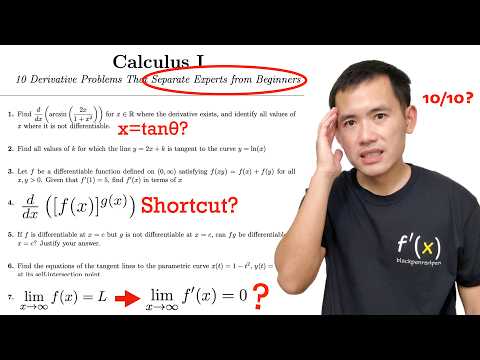
blackpenredpen works through 10 derivative problems that test domain awareness, derivative definitions, inverse functions, parametric curves, and counterexamples. The solutions include a piecewise derivative for arcsin(2x/(1+x²)), logarithmic differentiation of f(x)^g(x), and a squeeze-theorem proof that x²sin(1/x) is continuous at zero—while a related piecewise function with f(0)=1 is not differentiable there.
Key takeaways
- For arcsin(2x/(1+x²)), simplifying the chain-rule denominator produces |1−x²|; the derivative is 2/(1+x²) for |x|<1, −2/(1+x²) for |x|>1, and does not exist at x=±1.
- Tangency requires matching both value and slope: the line y=2x+k tangent to ln x touches at x=1/2 and has intercept k=−1−ln 2.
- The functional equation f(xy)=f(x)+f(y), together with f′(2)=3, forces f′(x)=6/x; setting x=y=1 first establishes f(1)=0.
- Logarithmic differentiation gives d(f^g)/dx=f^g(g′ ln f+g f′/f) for positive f, separating the contributions from a changing exponent and a changing base.
- A finite horizontal limit does not imply a zero derivative limit: sin(x²)/x tends to zero, but its derivative contains the nonconvergent oscillation 2cos(x²).
- Differentiability requires continuity: x²sin(1/x) tends to zero at zero, so assigning f(0)=1 makes the function discontinuous and therefore nondifferentiable there.
Chapters
0:00
Differentiate arcsin(2x/(1+x²)) and Track the Absolute Value
- The inner expression 2x/(1+x²) stays in [-1,1] for all real x, so the arcsine expression is defined everywhere.
- Applying the chain rule and quotient rule introduces √(1−(2x/(1+x²))²), which simplifies using |1−x²|.
- The absolute value is essential: after cancellation, the derivative changes sign depending on whether |x| is below or above 1.
5:12
Resolve the Piecewise Derivative and Nondifferentiable Points at ±1
- The correct derivative is 2/(1+x²) when |x|<1 and −2/(1+x²) when |x|>1.
- At x=1 and x=−1, the arcsine input reaches an endpoint and the function has a cusp, so its derivative does not exist.
- The case split comes from the sign of 1−x²; canceling its square root without absolute values would lose the sign information.
10:03
Find the Tangent Line y=2x+k to ln x
- Tangency requires both equal slopes and equal y-values; the line y=2x+k has slope 2.
- Since d(ln x)/dx=1/x, the contact point has x=1/2.
- Matching y-values gives 1+k=ln(1/2), so k=−1−ln 2.
13:59
Derive f′(x)=6/x from a Multiplicative Functional Equation
- Given f(xy)=f(x)+f(y) for positive x and y, the derivative is obtained from the difference quotient rather than an explicit formula.
- Writing x+h=x(1+h/x) lets the functional equation split the quotient into a term involving f(1+h/x).
- Setting x=y=1 gives f(1)=0; a substitution then yields f′(x)=f′(1)/x.
- Using f′(2)=3 gives f′(1)=6 and therefore f′(x)=6/x, consistent with f(x)=6 ln x.
20:05
Prove the Derivative Rule for a Function Raised to a Function
- For positive f(x), set y=f(x)^g(x) and take natural logarithms to obtain ln y=g ln f.
- Implicit differentiation and the product rule give y′=f^g(g′ ln f+g f′/f).
- The two terms correspond to differentiating the base while holding the exponent fixed, then differentiating the exponent while holding the base fixed.
23:23
Apply Logarithmic Differentiation to (x²+1)^(sin x)
- The general power rule handles both the changing base x²+1 and the changing exponent sin x.
- The base contribution is (x²+1)^(sin x)·sin x·2x/(x²+1).
- The exponent contribution is (x²+1)^(sin x)·ln(x²+1)·cos x.
25:26
Show That a Differentiable Product Can Hide a Nondifferentiable Factor
- A differentiable f and a nondifferentiable g at c do not prevent the product fg from being differentiable at c.
- For f(x)=x and g(x)=x^(1/3), g′(0) does not exist, but fg=x^(4/3) has derivative 0 at zero.
- The example demonstrates that differentiability of a product must be checked directly rather than inferred from each factor.
28:53
Find Tangents at the Self-Intersection of a Parametric Curve
- For x=1−t² and y=t³−3t, a self-intersection requires two distinct parameter values to produce the same x and y.
- Equal x-values imply opposite parameters; equating the y-values gives the distinct pair t=√3 and t=−√3.
- Both parameters map to (−2,0); dy/dx=(3t²−3)/(−2t) gives slopes −√3 and +√3.
- The two tangent lines are y=−√3(x+2) and y=√3(x+2).
36:55
Disprove a Derivative-Limit Claim with sin(x²)/x
- A finite limit f(x)→L as x→∞ does not guarantee that f′(x)→0.
- For f(x)=sin(x²)/x, the function tends to 0 because |sin(x²)|≤1.
- Its derivative is 2cos(x²)−sin(x²)/x²; the first term keeps oscillating, so the derivative has no limit at infinity.
43:25
Compute an Inverse Derivative Without Solving a Quintic
- For g=f⁻¹, differentiating f(g(x))=x gives g′(x)=1/f′(g(x)).
- With f(x)=x⁵+2x³+3x−2, find g(4) by solving f(k)=4; the integer k=1 works.
- Since f′(x)=5x⁴+6x²+3, g′(4)=1/f′(1)=1/14.
48:39
Use the Derivative Definition for e^√x
- Starting from [e^√(x+h)−e^√x]/h, rationalize √(x+h)−√x to obtain the factor 1/(2√x).
- Factor out e^√x so the remaining exponential quotient becomes [e^t−1]/t after a substitution.
- Using the standard limit lim(t→0)(e^t−1)/t=1 gives d(e^√x)/dx=e^√x/(2√x) for x>0.
55:42
Use Continuity to Test Differentiability of x²sin(1/x) at Zero
- For x≠0, |sin(1/x)|≤1 implies −x²≤x²sin(1/x)≤x², so the squeeze theorem gives a limit of 0 at zero.
- Defining f(0)=1 makes the function discontinuous because the limit is 0 while f(0)=1.
- A function that is not continuous at zero cannot be differentiable there, so f′(0) does not exist.
- The classic version with f(0)=0 is continuous and has derivative 0 at zero, found from the difference quotient x sin(1/x).
Summary, takeaways, and chapters were generated by AI from the video's transcript and may contain errors. The video belongs to its creator, blackpenredpen.