1:3 Fluid Properties - Wave Speeds, Viscosity, Vapor Pressure, Surface Tension
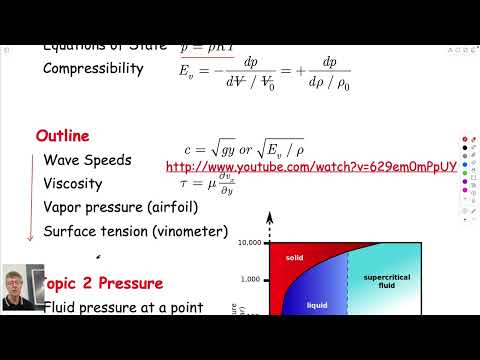 Watch on YouTube →
Overview
Derek Elsworth connects fluid properties to real-world wave hazards and engineering, then develops the governing ideas behind compressibility, wave speed, viscosity, vapor pressure, and surface tension. He estimates water and air wave speeds, explains how water depth controls tsunami travel, and derives capillary rise as a tool for understanding fluid displacement in porous reservoirs.
Key takeaways
- Shallow-water wave speed is approximately √(g y), so a tsunami travels faster in deep water and slows near shore, where incoming water can pile up.
- Water’s bulk modulus is about 2 GPa, while an ideal gas’s bulk modulus is approximately its ambient pressure; those values determine compressional-wave speeds.
- A Bingham drilling mud has a yield stress: it can resist motion at low applied stress, then flow and transport drill cuttings after that threshold is exceeded.
- Capillary rise follows h = 4σ cosθ/(Dρg), linking fluid-interface properties and pore size to the pressure needed to move fluids through reservoir rock.
- For a tsunami roughly 100 km offshore in 1,000-meter-deep water, the shallow-water estimate gives about 16 minutes of travel time, while seismic P- and S-waves can provide earlier warning.
Chapters
0:00
Engineered Surf Waves and the Depth Dependence of Ocean Waves
- A lagoon-shaped wave generator produces repeatable surf waves over a roughly 150-meter run.
- Elsworth introduces Nazaré-style monster waves as an example of waves building when water depth decreases and wave speed falls.
- He previews the central relationship for shallow-water waves: speed depends on water depth.
3:18
Nepal Flooding and Applying Fluid Mechanics to Natural Hazards
- Elsworth describes a glacier collapse in Nepal that registered on seismometers because the falling mass struck the valley floor.
- He relates seismic energy to gravitational potential energy, mass, and fall height to estimate the amount of material involved.
- A later Bernoulli analysis can estimate flood-front velocity from the upstream-to-downstream elevation difference.
6:17
Water Phase Diagrams, Vapor Pressure, and Cavitation
- A water phase diagram links absolute pressure and temperature; at 100°C, water boils at approximately 101 kPa.
- At roughly 50 kPa, as on high-altitude Everest, water boils near 50°C, so cooking takes longer.
- Supercritical CO₂ combines gas-like low viscosity with liquid-like high density, making it useful for compact subsurface storage.
- Fast flow over a submarine propeller can lower pressure enough to form collapsing cavitation bubbles, which create detectable noise.
13:19
Compressibility, Bulk Modulus, and the Ideal-Gas Result
- Compressibility is the reciprocal of bulk modulus: the modulus has pressure units, while compressibility has units of Pa⁻¹.
- Water’s bulk modulus is about 2 GPa, showing that liquid water resists compression despite being a fluid.
- Using the ideal gas law, Elsworth derives that a gas’s bulk modulus is approximately its ambient pressure.
18:08
P-Waves, S-Waves, and the Speed of Sound
- The approximate compressional-wave speed is √(bulk modulus/density); using water values gives about 1,000 m/s.
- Shear waves travel more slowly, with the lecture’s approximation √(modulus/(2 × density)); liquids such as water do not transmit shear waves.
- For air, the estimate is about 300 m/s, or roughly 600 mph, explaining the delay between seeing lightning and hearing thunder.
- P-waves arrive before the more damaging S-waves, a distinction used in earthquake early-warning systems.
23:37
Tsunami Speed, Ocean Depth, and Wave Shoaling
- Shallow-water wave speed follows c = √(g y), where g is gravity and y is water depth.
- At 1,000 meters depth, the estimate is about 100 m/s; at the roughly 10,000-meter Mariana Trench, it rises to about 300 m/s.
- A tsunami can cross an ocean basin quickly while remaining small offshore, then grow as shallower water slows the wave behind it.
26:20
Japan’s 2011 Earthquake and Tsunami Warning Times
- At Japan’s subduction zone, accumulated frictional stress releases suddenly, displacing the seabed and generating a tsunami.
- Using an estimated rock P-wave speed of 3,000 m/s, a signal can travel 100 km in about 30 seconds; the S-wave takes roughly 60 seconds.
- A tsunami traveling at 100 m/s through 1,000-meter-deep water takes about 16 minutes to cover 100 km.
- The Kamaishi footage shows why moving to high ground matters: the tsunami arrives as a sustained inundating flow, not simply a breaking surf wave.
33:19
Newtonian and Bingham Fluids: Shear Stress and Viscosity
- In laminar plate flow, the moving upper plate drags adjacent fluid layers while the stationary lower boundary slows the flow.
- Newton’s law of viscosity relates shear stress to the velocity gradient: τ = μ(dvₓ/dy), where μ is dynamic viscosity.
- For a Newtonian fluid such as water, doubling shear stress doubles the shearing rate.
- Drilling mud behaves more like a Bingham fluid: it resists motion until yield stress is exceeded, then flows while carrying drill cuttings and stabilizing the borehole.
42:20
Surface Tension, Water Striders, and the Vinometer
- Surface tension explains how water-walking insects are supported at a lake surface and how liquid interfaces behave.
- A vinometer uses liquid height in a narrow capillary tube to estimate alcohol content.
- The instrument’s reading depends on interfacial tension and fluid properties, including the density change as alcohol mixes with water.
45:01
Capillary Rise and the Young–Laplace Relationship
- In a glass capillary, water forms a concave meniscus and rises because adhesion to hydrophilic glass creates an upward surface-tension force.
- Balancing the upward force around the tube circumference against the water-column weight gives h = 4σ cosθ/(Dρg).
- The equation shows that capillary rise increases with interfacial tension and decreases as tube diameter or fluid unit weight increases.
- Pore throats between reservoir grains behave like capillaries, so the relationship helps estimate the pressure needed to displace water with air or oil with water.
52:43
Tsunami Inundation and the Next Fluid-Mechanics Topic
- Kamaishi’s footage shows the tsunami continuing up a river and carrying vehicles inland as water levels rise.
- The lecture notes that a coastal barrier can fail if the tsunami overtops it; the Fukushima nuclear plant’s defenses were insufficient for the event.
- Elsworth closes by assigning the first homework and previewing next week’s study of how pressure changes with elevation and depth.
Summary, takeaways, and chapters were generated by AI from the video's transcript and may contain errors. The video belongs to its creator, Derek Elsworth.