1:2 Fluid Properties - Mass, Weight, Dimensions, EOS, Compressibility
 Watch on YouTube →
Overview
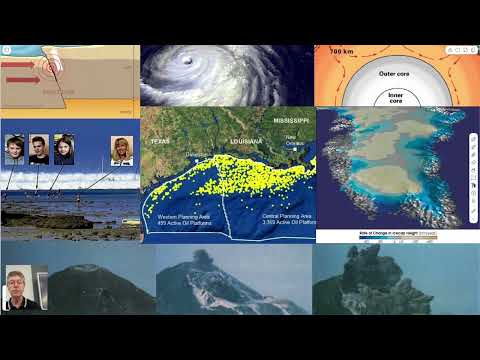
Derek Elsworth introduces fluid mechanics through applications in natural systems, engineering, and sport, then develops core fluid-property and dimensional-analysis concepts. He gives representative values for density, viscosity, and bulk modulus; explains why the ideal gas law requires absolute pressure and temperature; and connects Bernoulli’s equation to the Euler and Froude numbers, including tsunami speeds of roughly 200 mph in 1,000 m of water.
Key takeaways
- Useful SI-scale estimates are 2,700 kg/m³ for rock, 1,000 kg/m³ for water, and about 1 kg/m³ for air; these help catch order-of-magnitude errors.
- Water is difficult to compress despite seeming fluid: its bulk modulus is about 2 GPa, which is why air trapped in hydraulic brake lines makes brakes feel soft.
- A tsunami in 1,000 m of water travels at approximately √(g·depth) ≈ 100 m/s, or about 200 mph, while remaining only a small surface disturbance offshore.
- The ideal gas law must use absolute pressure and Kelvin temperature; substituting gauge pressure or Celsius gives physically incorrect results.
- Dimensionless numbers support model-to-prototype comparisons: Euler relates pressure and inertia, Froude relates flow speed to gravity-wave speed, and Reynolds relates inertia to viscosity.
Chapters
0:00
Everyday Fluid Mechanics and Terminal Velocity
- Fluids are liquids and gases that flow; buoyancy makes objects float when its upward force exceeds their weight.
- Drag acts like friction from a fluid, pushing against a hand held outside a moving car.
- A falling skydiver reaches terminal velocity when downward weight balances upward aerodynamic drag.
6:30
Course Structure, Canvas Materials, and Exam Preparation
- Derek Elsworth advises students to download homework and past exams from Canvas; the exam archive covers 2009–2025 and includes recent solutions.
- The course uses three short, closed-book and closed-note tests, each about 30 minutes, with an equation sheet provided during review.
- Elsworth cautions that some archived solutions may not match altered versions of the original exam questions.
9:22
Fluid Mechanics in Earth Systems and Engineering
- Underwater earthquakes displace seawater and generate tsunamis; the 2011 Japan earthquake caused most fatalities through the resulting coastal flooding.
- Atmospheric and ocean circulation, slowly flowing ice, and magma circulation beneath Earth’s crust illustrate fluid mechanics in natural systems.
- Airplane wings use pressure differences associated with flow speed, while a Pitot tube measures airspeed from the difference between stagnation and ambient pressure.
- The 2009 Air France Flight 447 disaster followed iced Pitot tubes that produced unreliable airspeed readings; Airbus aircraft subsequently heated the probes.
15:07
Fluid Mechanics in Sport: Swimwear, Sails, and Golf Balls
- Elsworth links swimming performance to fluid drag and discusses full-body suits used in elite competition before regulations changed.
- A curved sail acts like an airfoil, generating forces that let a sailboat travel close to the wind.
- Golf-ball dimples promote a turbulent boundary layer that can reduce pressure drag and help the ball travel farther.
- Baseball seams and football spin affect aerodynamic forces and trajectory; snowboarding balances downhill gravity against air drag and board friction.
19:14
Course Roadmap: Fluid Properties and Equations of State
- The first week covers fluids versus solids, dimensional homogeneity, mass and weight, fluid properties, and the ideal gas law.
- Compressibility, wave speeds, Newton’s law of viscosity, and surface tension round out the opening topics across the initial lectures.
- Elsworth specifies that course calculations use SI units rather than imperial units.
21:02
Density, Viscosity, and Bulk Modulus Benchmarks
- Density is mass per volume: representative values are about 2,700 kg/m³ for rock, 1,000 kg/m³ for water, and 1 kg/m³ for air.
- Dynamic viscosity is measured in Pa·s; water is approximately 10⁻³ Pa·s and air approximately 10⁻⁵ Pa·s.
- Bulk modulus measures resistance to volume change, with illustrative values of 20 GPa for rock and 2 GPa for water.
- At low temperatures, a gas’s bulk modulus is approximately its absolute pressure; near Earth’s surface, air pressure is about 100 kPa.
27:29
Dimensional Homogeneity, Bernoulli Head, and Similarity Numbers
- Dimensional homogeneity requires both sides of an equation to have matching units; Darcy’s law gives flow rate in m³/s from hydraulic conductivity, area, and head gradient.
- Bernoulli’s equation sums elevation head, pressure head, and velocity head; each term has units of length.
- Comparing pressure and inertial effects produces the dimensionless Euler number, useful for scaling model-aircraft forces to a full-sized prototype.
- Comparing flow speed with gravity-wave speed produces the Froude number, expressed using velocity and the scale √(g·depth).
31:00
Mass-Length-Time Dimensions and Fluid Scaling
- The primary dimensions used are mass, length, and time, represented in SI by kilograms, meters, and seconds; temperature is an additional dimension.
- Force follows from Newton’s second law, giving dimensions of mass × length × time⁻², while velocity has dimensions of length per time.
- Dimensional analysis and dimensionless groups such as Euler and Froude numbers help compare wind-tunnel models with full-scale systems.
- The Reynolds number compares inertial effects with viscous effects and helps characterize different flow regimes.
40:34
Gauge versus Absolute Pressure, Kelvin, and the Ideal Gas Law
- Atmospheric pressure is approximately 101 kPa absolute and is defined as 0 kPa gauge; a perfect vacuum is about −101 kPa gauge.
- The ideal gas law requires absolute pressure and absolute temperature: for example, 20°C is about 293 K, while absolute zero is 0 K or −273°C.
- For a gas, pressure can be written as density × specific gas constant × absolute temperature, or using mass, volume, the universal gas constant, and molecular weight.
- Elsworth ends by assigning phase diagrams for the next lecture and previewing tsunami wave speeds, Newton’s law of viscosity, and surface tension.
Summary, takeaways, and chapters were generated by AI from the video's transcript and may contain errors. The video belongs to its creator, Derek Elsworth.