01 - InvertR - Assignment II - Background
 Watch on YouTube →
Overview
Alex Smith frames the second InvertR assignment around measuring hydrothermal-vent biodiversity and connectivity with alpha and beta diversity, pairwise dissimilarity, and non-metric multidimensional scaling (NMDS). The methods matter for conservation decisions because vent communities may be highly endemic and fragmented, while deep-sea mining plans are advancing despite limited species and baseline data.
Key takeaways
- Hydrothermal vents are small, widely separated habitats whose high endemism and fragmented distribution make dispersal essential for recolonization after disturbance.
- NMDS represents pairwise community dissimilarities by preserving their rank order in a low-dimensional plot, without requiring linear relationships among ecological variables.
- Bray–Curtis dissimilarity runs from 0 for identical species composition to 1 for no shared species, making it a practical input for comparing vent communities.
- A conventional NMDS stress value below 0.2 or 0.3 is presented as a useful-fit guideline, but the stress plot should also be inspected.
- Turnover and nestedness lead to different conservation strategies: turnover favors protecting multiple distinct sites, while nestedness may support prioritizing the richest site.
- Deep-sea mining decisions are being considered despite limited exploration and difficult baseline monitoring, strengthening the case for understanding species distributions before disturbance.
Chapters
0:00
Hydrothermal Vents as Isolated Islands of Life
- The second assignment builds on larval dispersal, metapopulations, and genetic evidence of isolation from Assignment I.
- Hydrothermal vents occur along ridges and cracks such as the Mid-Atlantic Ridge, Central Indian Ridge, and East Scotia Ridge.
- These small, scattered habitats can support biomass comparable to coral reefs and tropical rainforests, but many species remain undescribed.
4:30
Mining Pressure, Biotic Value, and the Case for Baseline Data
- Exploratory licenses granted by the International Seabed Authority overlap or border protected marine areas and economic zones.
- Mining-related surveys and environmental monitoring are difficult in the deep sea, where many habitats and species have not been explored.
- Vent organisms can have commercial value: compounds associated with Pompeii-worm bacteria inspired the heat-protective cosmetic ingredient Abyssine.
- A review by Paul Snelgrove and Anna Metaxas argues that endemic fauna and fragmented habitats make recolonization—and thus resilience to disturbance—dependent on dispersal.
13:05
Why Ecologists Use Ordination for Multivariate Data
- Alpha diversity summarizes diversity within a site, while beta diversity compares composition between sites; possible measures include species counts and the Shannon index.
- Ordination reduces many interrelated variables—such as species, depth, salinity, and temperature—to a smaller number of dimensions that summarize variation.
- Smith contrasts principal components analysis and correspondence analysis with NMDS, which does not require linear relationships among variables.
17:25
NMDS Maps Rank-Ordered Community Dissimilarities
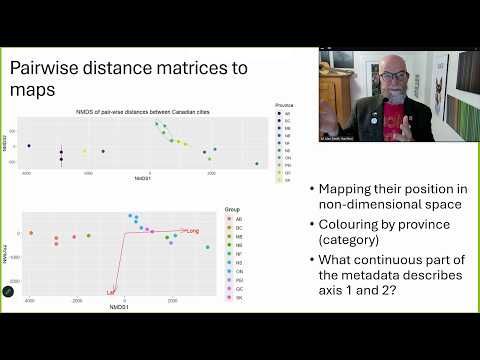
- NMDS arranges objects in a chosen number of dimensions while preserving the rank order of pairwise dissimilarities.
- A Canadian-city example shows how rank-ordered distances can approximately reconstruct a map, with longitude and latitude added afterward as environmental vectors.
- Ecological community data can be converted into dissimilarity matrices using measures such as Bray–Curtis or Jaccard before NMDS ordination.
- Bray–Curtis dissimilarity ranges from 0 for identical composition to 1 when two sites share no species.
25:20
Checking NMDS Stress and Interpreting Turnover
- An NMDS stress plot compares observed dissimilarities with ordination distances to show how well the reduced arrangement preserves the data.
- The lecture gives a conventional stress guideline of below 0.2 or 0.3 for a useful NMDS result.
- Beta diversity can reflect turnover, where sites have different species complements, or nestedness, where one community is largely contained within another.
- Turnover implies that multiple sites may need protection; under nestedness, protecting the site with the greatest combined diversity may preserve more of the overall community.
28:30
Assignment II Deliverables and Conservation Interpretation
- The R exercise will produce a map, a box plot, and an NMDS plot for hydrothermal-vent diversity and connectivity analyses.
- The assignment deliverable is a three-minute video answering the R assignment questions and reflecting on development pressures.
- Students should upload a private or unlisted YouTube link rather than the video file and treat scientific communication as an iterative skill.
Summary, takeaways, and chapters were generated by AI from the video's transcript and may contain errors. The video belongs to its creator, Alex Smith.